
SHINOBI
Shinobi Legendary File
Prologue: The City of Shadows
In the year 2184, Neo-Terra loomed as a gargantuan relic of mankind’s most hubristic dreams and most depraved sins. The city, sprawling across a once-barren landscape, had been a marvel of modern engineering – a utopia envisioned by its architects. Yet, as the decades wore on, the gleaming façade of progress had corroded into a dystopian nightmare.
Neo-Terra’s rise to its current state was a tale of ambition gone awry. In the mid-21st century, what began as a grand project to overcome humanity’s most pressing issues – overpopulation, climate change, and economic disparity – quickly spiraled into a grotesque caricature of its original ideals. The megacorporations, led by entities like AetherCorp, seized upon the chance to profit from the crisis, driving their own agenda of unchecked power and control.

As the city grew, so did its problems. The air, once breathable, became thick with industrial pollutants and the exhaust of countless vehicles. The sky, obscured by layers of smog and artificial lights, was a perpetual twilight, rarely touched by the sun. The environment within was now a place where nature was little more than a memory, replaced by a synthetic wilderness of metal and concrete.
In this sprawling urban jungle, life for the average citizen was a brutal, grinding existence. The city was divided into starkly contrasting zones – opulent skyscrapers and luxury districts rising above a festering underbelly of squalor and decay. The disparity was as glaring as it was oppressive. In the upper echelons of the city, the elite resided in sky-high penthouses, their lives a blur of endless luxury, augmented reality experiences, and bioengineered perfection. Their homes were immaculate, shielded from the grime and chaos below by layers of security and artificial climates. They lived in a world of their own design – one that was as disconnected from the city’s harsh reality as it was extravagantly adorned.
Below, the streets were a cacophony of desperation and violence. The lower tiers of the city were a labyrinth of crumbling buildings, makeshift homes, and neon-lit markets that thrived on the fringes of legality. Here, life was a constant struggle for survival. The air was laced with the acidic smell of refuse and chemical waste, mingled with the ever-present haze of synthetic smoke from cheap, illicit drugs. These substances were a common escape for the denizens of the lower city, whose lives were marked by poverty and crime.
The inhabitants of Neo-Terra’s underbelly were a mix of lost souls and survivors. Street vendors peddled a variety of goods – everything from counterfeit cybernetic enhancements to dubious pharmaceuticals. Markets were alive with the clamor of bartering voices, while shady figures conducted illicit transactions in the shadowed corners. The bars and nightclubs were havens for the desperate and the damned, places where robot prostitutes with artificial skin and exotic designs entertained patrons with fleeting, simulated affection and sex.
Daily life in the lower districts was punctuated by violence and disorder. Gangs ruled the streets, their power supported by an ever-growing black market of illegal weapons and cybernetic augmentations. The law enforcement in these areas was minimal and often corrupt, serving as little more than a token presence in a city that had long since abandoned justice for profit.
Above this chaotic maze, the mid-levels were less extreme but no less grim. Here, the middle class toiled away in cubicles for the megacorporations, their lives governed by the relentless demands of productivity. Corporate advertisements and propaganda were omnipresent, projecting an illusion of progress and prosperity that starkly contrasted with the reality faced by most. The mid-levels were marked by their own struggles – a monotonous existence punctuated by the occasional respite in corporate-sponsored entertainment or the escape of synthetic recreational drugs.
The skyline of Neo-Terra was a jagged testament to the city’s evolution – a mixture of sprawling mega-towers and towering skyscrapers that loomed like monolithic sentinels. The upper echelons of these buildings, with their opulent designs and cutting-edge technology, cast long, oppressive shadows over the city below. Holographic billboards and neon advertisements flickered incessantly, projecting endless streams of consumerist propaganda and corporate slogans into the skies.
Yet, amidst this opulent display, the city’s heartbeat was one of relentless, grinding despair. The haze of smog and neon light rendered the world below a pulsating blur of color and shadow. It was a place where human souls were commodified, where people were as interchangeable as the cybernetic parts that replaced their failing bodies. The relentless advancement of technology, far from alleviating suffering, had become a new form of bondage, enhancing the divide between the privileged and the oppressed.
In this maelstrom of disparity and decay, the megacorporations ruled with an iron grip. AetherCorp, the most powerful of these entities, was both the creator and the executioner, their influence weaving into every facet of daily life. They controlled the data streams, manipulated the economy, and even dictated the fates of the inhabitants through their relentless pursuit of profit and control.
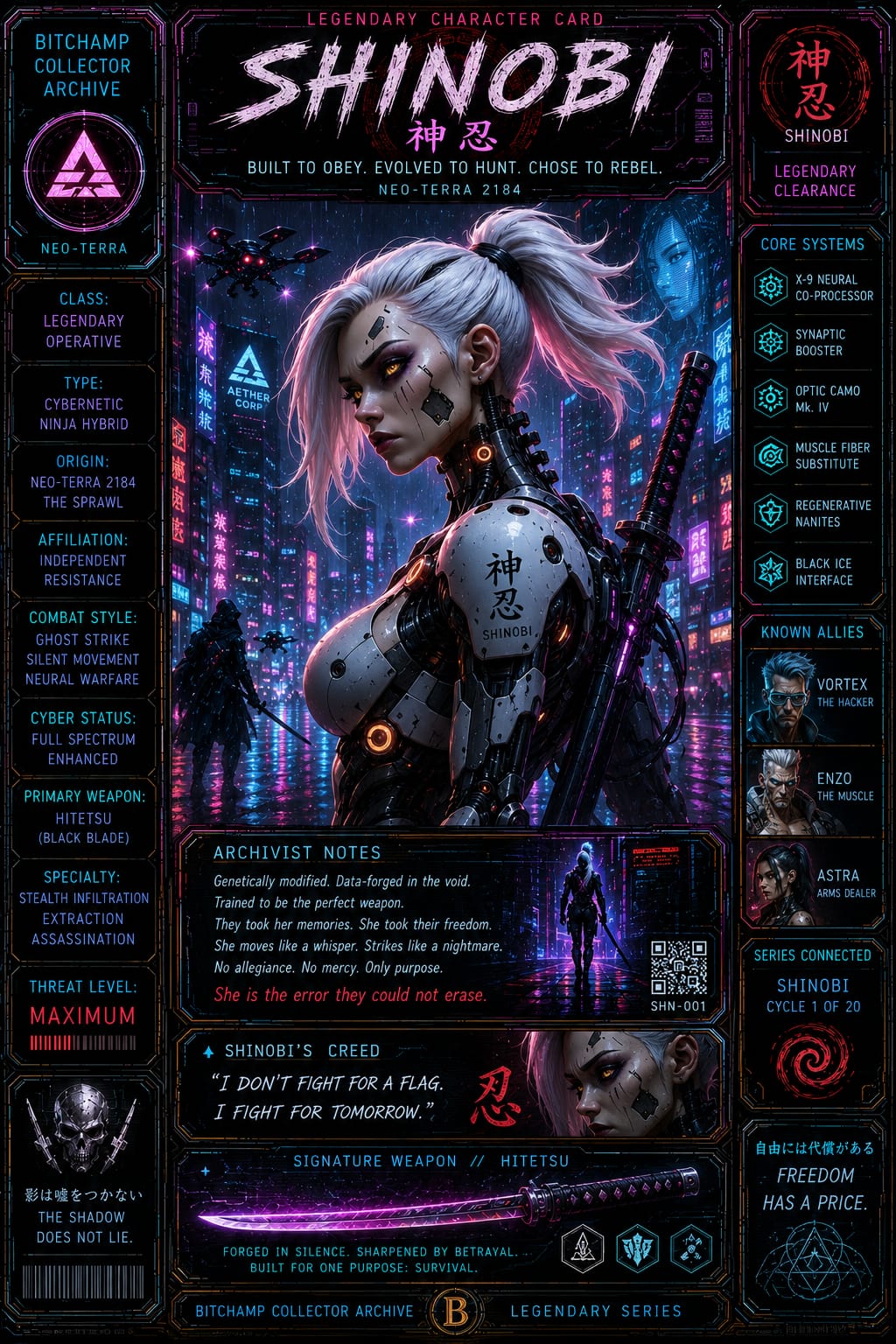
Shinobi, the half-human, half-robot enigma, was a ghostly whisper in this cacophonous nightmare. In a city where shadows ruled and the line between human and machine blurred, she was a figure of dark majesty and haunting menace – a symbol of resistance in a world that had long since forgotten what it meant to be truly alive.
SHINOBI – THE ASHEN PHANTOM
Some called her an assassin. Some called her a ghost. Street kids, always quicker to myth than adults, called her the Ashen Phantom and dared each other to whisper her name in alleys after midnight. Fixers said she was bad luck. Gang lieutenants said she was what happened when AetherCorp’s black-budget projects stopped listening to their masters. Corporate security bulletins did not name her at all, though her blurred image appeared often enough in internal alerts—an unidentified female operative, extremely dangerous, engagement prohibited unless overwhelming force could be guaranteed.
Those who saw her up close tended not to forget the sight. Her hair fell white as ash down the back of her dark combat jacket, catching every wash of color the city threw across it—violet from nightclub signs, acid blue from transit rails, red from surveillance towers sweeping rooftops for movement. Her face still held the shape of a young woman, but there was something in the stillness of it that unsettled people, some tension between the organic and the deliberate. And her eyes were the thing that always stayed with them. They burned with a deep electric amber, not bright enough to cast light, but bright enough to make people feel exposed when they met her gaze. There was humanity in those eyes. There was anger too. And behind both of those things there was something harder, something sharpened and reforged.
She moved like someone who had learned long ago that hesitation got you killed.

Tonight she walked alone through the underlevels of Sector Nine with her collar raised against the warm chemical mist drifting up from the drainage channels. Overhead, the giant support ribs of the city vanished into layers of haze and cable clusters. Beneath her boots, cracked pavement alternated with metal plating and patched utility grates. Vendors still worked the curbside stalls despite the hour, selling black-market implants, counterfeit ration tabs, weapon mods, narcotic inhalers, and fried protein skewers whose smell would have made an ordinary stomach turn. Music leaked from doors with no signs and windows painted over from the inside. Somewhere farther down the block, a man screamed once, then stopped. No one ran toward the sound. No one looked concerned. Neo-Terra trained its people well. Mind your own business. Keep your head down. Survive until morning, if morning meant anything at all.
Shinobi moved through it all like she belonged nowhere and could survive anywhere.
She had come for information, which in Neo-Terra was more valuable than weapons and far more dangerous to carry. There were names she had been gathering for months, half-buried data trails, payroll anomalies, shipment manifests routed through dummy corporations, medical waste logs that didn’t match any registered clinics, personnel files redacted so heavily they were practically confessions. All of it pointed back to the same buried project, the same sealed chamber in her mind.
Eclipse.
Even thinking the name left an afterimage in her skull.
She did not remember her life in a clean line. Memory came to her in violent pieces. A steel table under white light. Hands in surgical gloves. The smell of antiseptic cut with hot blood. A male voice saying subject stability is improving. A woman’s voice answering not stability—adaptability. She remembered pain that did not feel like ordinary pain, but like being rewritten while still conscious enough to know it was happening. Metal joining flesh. Nerves taught to obey foreign signals. A restraint frame locking over wrists and ankles. The hum of machines so constant it became its own sort of silence. Then there were the isolation chambers: black walls, no sound, no time, nothing to do but feel the ache of new augmentations settling under the skin and hear commands repeated through hidden speakers until language itself started to sound poisonous.
AetherCorp had built her to become part of something larger than a person. That had been the lie at the center of Eclipse. They did not merely want soldiers. Plenty of corporations had soldiers. They wanted instruments—operatives with human intuition, machine-level physical performance, and obedience so absolute it would survive any battlefield or moral cost. The minds of the prototypes were not supposed to rebel. Emotions were inserted in fragments only where useful. Memory was meant to be an adaptive layer, not a living thing. But the scientists in the subterranean labs had made one mistake that prideful men often made. They believed they could cut the soul into manageable pieces and still keep it under glass.

Something in Shinobi had survived the process intact enough to hate them.
Her escape had become rumor because no one at AetherCorp wanted the truth spoken aloud. Security footage had been erased, rewritten, buried under seven levels of classification. Bodies disappeared. Equipment logs vanished. Entire shifts of personnel were reassigned or made to disappear into the corporate silence reserved for catastrophic embarrassment. But every now and then, in places where data thieves and old maintenance engineers got drunk enough to talk, fragments surfaced. There had been a breach in one of the lower research sectors. There had been an internal massacre. There had been a prototype that should not have become self-aware and an alarm sequence that had run for seventeen full minutes before the system went blind.
Shinobi remembered running. She remembered alarms drowning out her own thoughts. She remembered taking a weapon from a guard whose throat she had crushed without meaning to, then using it on doors, cameras, men, anything between her and open air. She remembered emerging into rain somewhere in the lower city with blood in her mouth and corporate tracers already sweeping the district for her heat signature. After that came weeks of hiding, months of half-memory, years of putting herself back together from instincts, rumors, stolen files, and the names of people who knew how to disappear in Neo-Terra.
Now she wanted the heart of it.
No more fragments. No more rumors. She wanted the truth buried in AetherCorp’s mainframe. The full extent of Eclipse. The prototypes. The deaths. The financial backers. The field deployments. The test subjects who had not survived and the ones who maybe had. If she was going to burn the corporation’s mask off in public, she needed proof heavy enough that even Neo-Terra’s bought media channels would choke trying to bury it.
That was why she had come to the Neon Lotus.

The bar crouched at the bend of a narrow service street in the oldest part of Sector Nine, where the pavement sloped and pooled and the buildings leaned toward one another as if conspiring overhead. Its sign flickered in cracked pink and green script, the letters losing half their light every few seconds before buzzing angrily back to life. Two augmented bouncers stood by the entrance smoking from the same inhaler, their eyes following the street with practiced boredom. They noticed Shinobi coming and both straightened without meaning to. Fear moved quicker than thought. She did not look at them. She passed between them, opened the door, and stepped inside.
Heat and noise rolled over her immediately. The Neon Lotus was packed with the city’s functional wreckage: mercenaries still wearing armored plates under civilian coats, couriers with neural jacks shining through shaved temples, braindance coders, black-market surgeons, dancers with programmable skin tinting and metal joints that moved more beautifully than biology allowed. Screens above the bar showed illegal cage fights and stock summaries in alternating loops. The bass from the sound system rattled the glasses hanging behind the counter. Thin streams of projected koi swam through the haze from some half-broken ceiling rig, passing through cigarette smoke and holographic menus alike. Deals were made here. Threats were made here. Occasionally people were killed here if they forgot where they were.
Shinobi ignored the room and made for the back.
He was waiting in the corner booth exactly where he had said he would be, seated crookedly with one boot on the bench, a portable cyber deck open beside a sweating glass of something amber and cheap. Victor DeVries looked like the kind of man who had once belonged somewhere clean and expensive and had spent the last several years proving he no longer needed to. His dark coat was expensive but frayed at the cuffs. Fine connector ports traced along his neck and behind one ear. One of his eyes had been replaced with a custom aug lens that glowed ember-red when it adjusted focus. There were elegant hands beneath the grime and nicotine stains, hands meant once for executive consoles and sterile offices, now used to crack corporate vaults for whoever could pay or amuse him.
He looked up as Shinobi approached, and his mouth tilted into the closest thing he had to a smile.
“Well,” he said over the throb of the music, “if it isn’t the city’s least sociable legend.”
“Vortex.”
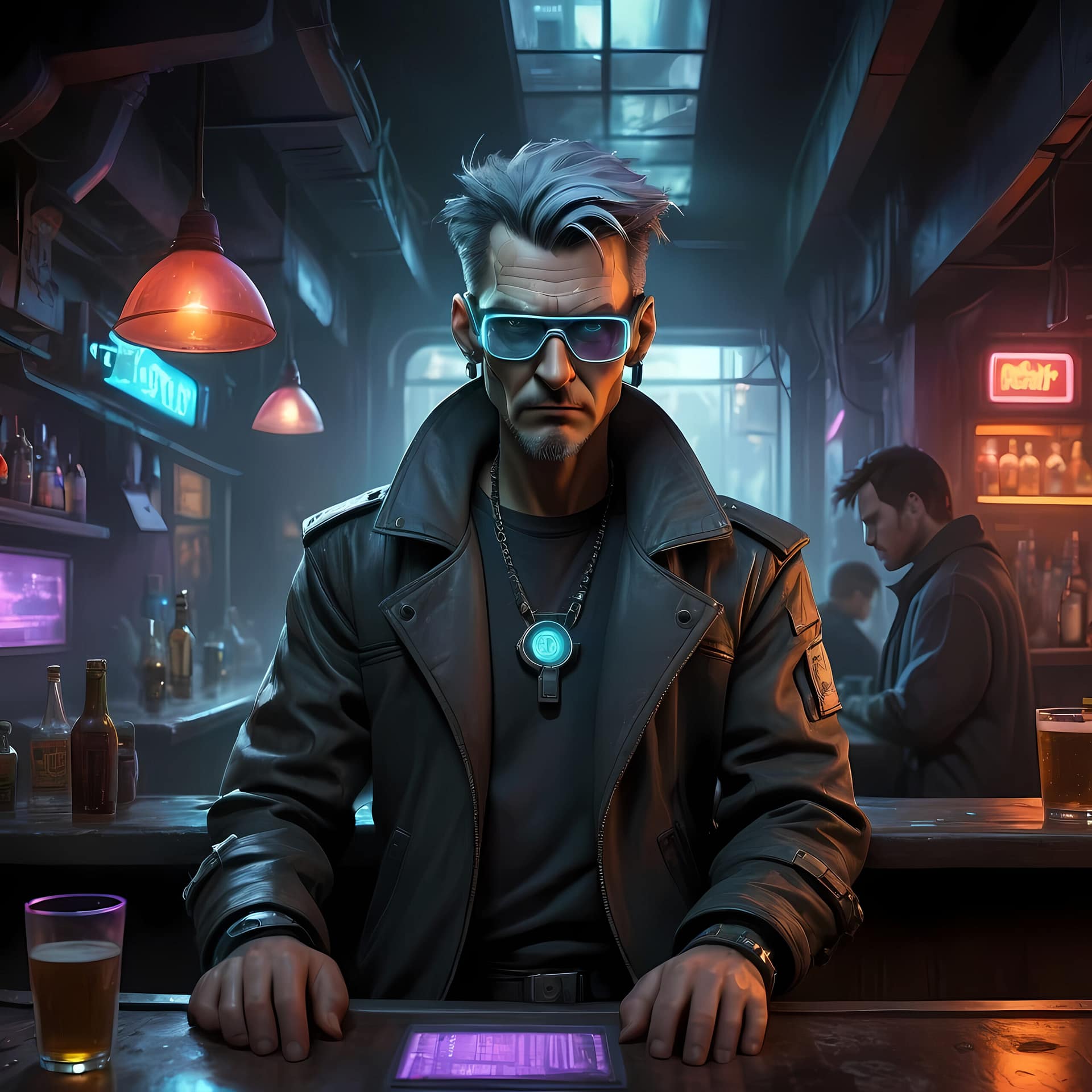
His smile widened by a degree. “Still warm as ever.”
She slid into the booth across from him. He looked her over openly, not leering, just measuring. Vortex had a habit of treating every room, every person, every problem as if it were a system to be mapped. That was part of what made him good. It was also what made him impossible to trust all the way.
“I heard rumors,” he said. “Freight loss in the warehouse tiers. Three dead extraction men in a service tunnel near the north stacks. One corporate courier stripped of a data case and left breathing just long enough to be embarrassed about it.”
“Rumors travel fast.”
“In this city? Faster than bullets and not half as honestly.” He tapped ash into an empty glass. “You didn’t come here to hear me admire your work.”
Shinobi reached into an inner pocket and placed a small black data chip on the table. It clicked softly against the scarred surface. Vortex looked at it, then at her.
“I need access to AetherCorp’s mainframe,” she said.
That got a proper pause out of him.
“Do you.”
“The Eclipse files.”
There it was again, the almost invisible sharpening around his eyes. Vortex knew enough not to pretend ignorance of the name. In the circles where he worked, you survived by recognizing when a word carried too much buried blood to be casual.
“AetherCorp central doesn’t run on ordinary architecture,” he said at last. “Their public servers are bait. Their inner systems are segmented, mirrored, and watched by counter-intrusion routines smart enough to make most hackers religious. You’re not asking me to steal a payroll file, Shinobi. You’re asking me to kick open the front door of the city’s biggest god.”
“Can you do it?”
“Probably.”
“Probably isn’t useful.”
“It is when everyone else would tell you no.”
He picked up the chip and turned it between his fingers. “What’s on this?”
“Enough.”
“That answer makes me think it’s either very valuable or very dangerous.”
“It’s both.”
He gave a low chuckle. “That’s why I like you. Terrible for my stress levels. Excellent for my curiosity.”
Vortex slotted the chip into a side port on his deck. A line of code flashed across one of the screens. His brows lifted.
“Well now,” he murmured. “You’ve been busy.”
“I need the core files,” Shinobi said. “Project records. Test logs. Death counts. Funding streams. Personnel. Anything tied to Eclipse. I want the whole body, not another scrap.”
“You planning to sell it? Leak it? Drop it on a media node and start a riot?”
“I’m planning to expose them.”
“Same thing in Neo-Terra, just with different branding.”
She did not answer.
Vortex sat back and studied her for a moment. He had met her before, long before tonight. Their first real alliance had come during a data-vault job that had gone sideways in under six minutes and bloody in under ten. A client had wanted files connected to illegal disappearances in the transit grid. Vortex had been the digital entry man. Shinobi had been there for reasons he still suspected ran deeper than the contract. When the alarm tripped and corporate kill drones cut off their exit, she had dragged him through a maintenance shaft with a dislocated shoulder and two security teams closing in behind them. She had saved his life, though neither of them had ever used those exact words. Since then there had existed between them an unstable understanding. He charged her less than he charged others. She trusted him more than she trusted most. Neither fact should have been mistaken for loyalty, but in Neo-Terra those things came close.
Finally Vortex stood, grabbed his deck, and jerked his head toward the hallway behind the bar.
“Come on. Let’s see how loudly AetherCorp screams when I knock.”
The back corridor of the Neon Lotus looked like the inside of a dead machine. Exposed wires drooped from the walls. Ancient conduits rattled overhead. Half the doors were either locked or welded shut. At the far end sat Vortex’s workroom, a converted storage cell filled wall to wall with screens, signal boosters, illegal processors, tangled cables, and enough cooling fans to make the air vibrate faintly. Blue light washed everything in the room the color of deep water.
Vortex dropped into a chair and jacked a cable into the port behind his ear. His whole posture changed when he connected. The slouch left him. His fingers became precise. One eye flickered as the lens synced. Code cascaded across the screens in vertical rivers of light.
“Talk to me,” Shinobi said.
“I’m ghosting through one of their outer contractor networks first. Waste management, by the look of it.” His voice had gone distant, split between the room and whatever architecture he was moving through in the net. “No one secures the plumbing the way they secure the throne room.”
He worked fast. Windows opened, closed, duplicated, nested. Security keys bloomed and vanished. An abstract map of network layers rotated across the central monitor like a metallic flower opening under surgical light.
Shinobi waited, still as a drawn blade.
Then Vortex muttered, “Well, that’s rude.”
The screens flashed once. Twice. Then the room filled with red warnings. He tore the cable free with a hiss and shoved back from the console hard enough that the chair rolled into a tower of hardware behind him.
“Damn it.”
“What happened?”
“I got inside their outer grid, slipped one layer deeper, and found a route to a sealed archive tree.” He jabbed at the central monitor, where a cluster of access-denied messages multiplied so quickly they looked almost organic. “The second I touched anything tagged Eclipse, the system woke up like I’d stepped on a nest.”
“Did they trace you?”
“Not fully.” He exhaled and rubbed a hand over his face. “But they knew somebody was probing. They severed the route, blackwalled the node, and launched active countermeasures before I could pull more than breadcrumbs.”
Shinobi looked at the frozen display. “How bad?”
Vortex laughed once without humor. “Bad enough that remote access is off the table if we want the full files. They’ve built a deadman shell around that archive. Anything that unusual gets flagged instantly.” He turned to face her. “If you want Eclipse, you’re going to have to go in physically.”
Shinobi had expected that possibility before she ever walked in. She simply nodded.
“Where?”
“AetherCorp main data lab. Not the public tower vaults. I’m talking about the inner architecture. Sub-basements. Segmented storage. Probably air-gapped at the final layer.” He leaned forward, thinking aloud now. “I can build a deck strong enough to breach it if it’s plugged directly into the right spine. But getting you in there? That’s not a solo stroll.”
“You know someone.”
He smirked. “I know several someones. Most of them are dead, compromised, or annoying.” He grabbed a jacket from the back of the chair. “There’s one who might work.”
The Wraith District sat west of the freight canals where the city’s official maps began to lose confidence. Buildings there were lower, older, more brutal in their construction—warehouse blocks, reinforced depots, abandoned transit shells cut apart and rebuilt into black-market compounds. Streetlights failed more often than they functioned. The advertising holograms that reached every other part of Neo-Terra died at the district line as if even the corporations preferred not to look too closely. Gangs controlled whole corridors. Mercenaries rented rooms by the week. People came to Wraith when they needed weapons, bodies, or disappearances.
Vortex led them through narrow lanes painted in wet shadow and chemical runoff, talking just enough to keep silence from turning hostile.
“His name is Enzo Marrow,” he said. “Ex-corporate tactical retrieval. Then private contractor. Then freelance because he got tired of being ordered to do ugly things for people who called themselves clean.”
“Reliable?”
“For a mercenary? More reliable than average.”
“That isn’t reassuring.”
“It wasn’t meant to be.”
The building Enzo used as a base had once been a logistics warehouse. Rusted fencing enclosed the lot. Two armed sentries watched the entrance from a guard platform built out of welded cargo plating. Their weapons tracked Vortex and Shinobi until one of them recognized him and hit a release switch. The gate buzzed open.
Inside, the warehouse had been hollowed into a functional command post. Worktables overflowed with stripped rifles, drones in various stages of repair, ammo crates, med kits, and stacked armor plates stamped with serial codes filed off long ago. A suspended holo-projector turned slowly near the center of the room, throwing rotating topography maps across the floor. At the far end, behind a desk made from an old machine crate and a slab of dark composite, sat Enzo.

He was broad-shouldered, hard-faced, and had the kind of stillness that suggested violence wasn’t a mood for him but a professional language. One of his arms had been replaced from shoulder to wrist with a matte-black cybernetic rig plated for impact. Faint scars cut through the stubble along his jaw. A visor rested pushed up on his forehead. When he stood, Shinobi could see he carried his weight slightly to one side—not weakness, just an old injury turned habit.
“Vortex,” he said. His voice sounded like gravel rolled in metal. “You owe me money or trouble. Which is it?”
Vortex spread his hands. “Opportunity.”
“Same thing with better perfume.”
His gaze shifted to Shinobi. He took her in carefully and did not hide that he recognized danger.
“And who is this?”
“Shinobi,” Vortex said. “She has a job.”
Enzo looked at her a moment longer. “I know the name.”
“Then you know I don’t waste time,” Shinobi said.
A faint approval touched one corner of his mouth. “Good. Neither do I. Tell me.”
So she did. Not everything. Not the laboratory memories or the nights she woke with phantom surgical pain burning through metal buried beneath skin. But enough. AetherCorp. Main data lab. Eclipse files. Physical breach. Digital extraction. Fast entry. Fast exit if possible, fighting exit if necessary.
When she finished, Enzo gave a low breath through his nose and sat back against the desk.
“You’re not asking for a job,” he said. “You’re asking for a war story.”
“What’s your answer?”
“My answer is AetherCorp’s inner facilities are layered like military bunkers. Security doesn’t start at the doors. It starts with transit patterns, heat signatures, employee route anomalies, machine-learning surveillance, biometric locks, armed response teams, and automated kill architecture. If we step wrong, we won’t just have guards on us. We’ll have the building itself trying to close its fist.”
“Can you get us in?”
“Probably.”
Vortex groaned. “You two are going to make me miss optimism.”
Enzo ignored him. “Nothing about this is clean. Price goes up accordingly.”
Shinobi named a number. Enzo did not react. She added intel on two high-value routes in the south stack zones, both tied to rivals of his. That got his interest. Vortex muttered something about everyone in the room being emotionally unhealthy.
At last Enzo nodded once. “Alright. I’m in.”
They moved to the holo-table. Planning stretched for hours. Recon first. Enzo pulled whatever off-grid maps he had of AetherCorp’s service access, cross-referenced them with municipal utility schematics Vortex lifted from forgotten server caches, then layered in maintenance patterns, security shift estimates, and freight timing windows. The main data lab was buried deep beneath one of AetherCorp’s primary business-sector towers—not the public-facing executive levels, but the substructure beneath them where systems that actually mattered were hidden. Access would have to come through a service route, probably via maintenance transit linked to environmental controls and waste heat exchange. Biometric locks could be spoofed if they acquired the right templates. Cameras could be looped in limited windows. Patrol patterns, however, would remain a problem.
Vortex focused on the deck. “If I’m inside the mainframe physically, I can get through. Remotely, no. Plugged direct? Yes. But once the deck goes live, the clock starts. They’ll know something’s wrong eventually, even if they don’t know what.”
“How long?” Shinobi asked.
“Best case? Three minutes to locate and begin extraction. Another two to seven depending on file weight and whether their archive redundancies fight me.” He pointed at the projected sub-basement layout. “You’ll need to hold the room.”
Enzo added equipment lists. EMP charges, not big enough to fry the mainframe but enough to blind local security for short bursts. Signal dampeners. Hardline spoofer. Breach foam. Compact weapons only. No heavy explosives unless something went catastrophically wrong, because bringing down half a corporate basement tended to complicate clean exits.
By the time the planning ended, the false dawn cycle had begun to lighten the haze beyond the warehouse skylights.
Shinobi remained standing while the men argued over route timing, but her mind kept slipping. Fatigue did strange things to memory. As the holographic schematics rotated over the table, her gaze snagged on one vertical maintenance shaft and suddenly she was seeing a different corridor entirely—white walls, polished floors, a row of restraint chairs behind glass, a woman in a lab coat holding a tablet and saying raise the voltage incrementally, we need to measure emotional retention under stress. Then the vision broke and she was back in the warehouse with Enzo asking whether she could move silently in a confined shaft if her mobility dropped below ideal range.
“Yes,” she said.
He looked at her a beat longer than necessary, aware she had gone somewhere else for a moment but polite enough not to say it aloud.
The next day passed in fragments of preparation. Vortex vanished into his hardware nest and rebuilt the deck twice, swearing at encryption models and heat thresholds until the machine purred like something barely legal. Enzo acquired uniforms, access tags, a maintenance vehicle, and a set of cloned biometric patterns sourced from an AetherCorp subcontractor who would wake up tomorrow with a headache and no memory of the last eight hours. Shinobi inspected weapons, checked the balance of new blades, calibrated her visual overlays, and sat through a med-scan that Enzo insisted on running. The machine mapped her internal systems and spit out errors the moment it found architecture it couldn’t classify.
Enzo stared at the output. “You always this hard to read?”
“Yes.”
“Comforting.”
He meant it as a joke. She let it pass.
When night came again, the city thickened with fog rolling in from the coolant reservoirs and the thermal stacks. It suited them. Neo-Terra became stranger in fog, its heights turned to suggestion and its streets broken into glowing islands of neon and shadow. Shinobi sat in the back of the maintenance transport while Vortex checked the deck for the sixth time and Enzo drove with one hand on the wheel and the other resting near the weapon mounted under the dash. No one talked much.
The business district rose ahead of them like a separate civilization. Here the streets widened and smoothed. Security drones glided between buildings in disciplined patterns. Glass facades climbed toward the smoky heavens, reflecting the city back at itself in fractured splendor. AetherCorp’s tower dominated the skyline—not the tallest in Neo-Terra, but one of the most arrogant, all mirrored angles and thin lines of white light running up its sides like veins.
They parked in a shadowed service lane behind an adjoining utility annex. Enzo killed the engine.
“From here on, stay tight and stay quiet.”
They geared up fast. Dark tactical fabric. Concealed armor. Shinobi clipped EMP grenades to her belt, holstered a compact sidearm, and checked the monofilament edge of the blade sheathed against the small of her back. Vortex, who hated fieldwork and looked insulted by every piece of practical gear he wore, slung the deck over one shoulder and muttered about the many better ways he could be spending his night.
The approach took them through a service trench, across a loading spur, and into a recessed access corridor half-hidden behind condenser units and maintenance housings. The biometric lock there was sleek, expensive, and designed to reassure executives that the people beneath them could never reach anything important. Enzo pressed the cloned template pad to the sensor and worked the spoofer with his cybernetic fingers. The light flashed red once. Twice. Then green.
The door opened.
Inside, the world changed. The rough grime of the city disappeared behind them. The corridor beyond was polished, chilled, and quiet in a way only expensive buildings ever managed. The walls were pale composite. The floor reflected overhead light in clean strips. Air recyclers whispered behind hidden vents. Somewhere deep in the structure, servers hummed like a mechanical choir.
Shinobi felt her heartbeat change.
Not fear exactly. Recognition.
AetherCorp interiors all carried the same sickness. Sterile. Controlled. Designed to suggest perfection while concealing the violence necessary to maintain it.
They moved quickly through service hallways, ducking cameras where Vortex looped them, freezing in shadowed alcoves while patrol pairs crossed distant intersections. Enzo led with the ease of someone who had spent years learning how institutions hid their weaknesses. Twice he diverted them through utility spaces barely wider than their shoulders. Once they had to pause while an inspection drone rolled within three feet of Shinobi’s boots and scanned the hall, its lens reflecting the amber glow of her eyes before Vortex’s interference routine nudged it onward.

At an elevator checkpoint they bypassed downward travel by prying open a maintenance shaft and descending a ladder run that seemed to fall forever into the tower’s buried spine. The air grew cooler. The hum of machinery deepened.
Shinobi’s fingers tightened once on the rung as a memory hit so hard it blurred her vision: another shaft, another descent, white-coated men below waiting beside a restraint chair while she was still too drugged to fight them. She shut it down and kept moving.
At the bottom, Enzo keyed open a narrow service hatch. Beyond it sprawled the sub-basement level. The architecture changed again here. Less polished, more functional, but no less expensive. Reinforced doors. Security nodes every fifteen meters. Cables thick as a man’s leg vanishing into the walls. The deeper systems of AetherCorp did not care about appearances. They cared about permanence.
Vortex whispered, “Data lab should be through the next axis and one level deeper.”
They crossed a junction. A guard team turned the corner ahead of them.
Everything compressed into instinct.
Shinobi was moving before the men fully registered what they were seeing. She hit the first one with the side of her hand under the jaw hard enough to snap his head back into the wall. The second reached for an alarm stud and Enzo put him down with a suppressed burst center mass. The third got his weapon halfway up before Shinobi’s blade flashed once and the man folded without a sound except the soft clatter of metal against floor.
Vortex stared at the bodies. “I hate when you two make that look easy.”
“It wasn’t,” Enzo said. “Move.”
They reached the final door after two more corridors and one brutally tense wait while an overhead surveillance sweep passed directly through the hallway intersection they needed. The entrance to the main data lab was a thick composite slab set into a reinforced frame, its lock architecture nested under biometric, coded, and live-network verification.
Vortex knelt by the panel, connected a tool bundle, and worked faster than Shinobi had ever seen him move.
“Come on,” he whispered. “Come on. Be arrogant for me. That’s it…”
The lock clicked. The door released.
Cold air met them first. Dry, filtered, and carrying the faint heat-metal scent of active processors. Then the room opened around them. The main data lab was cavernous. Towering racks of servers rose in orderly black columns. Status lights blinked in silent constellations. Fiber trunks ran overhead in glowing bundles. At the center of the room stood a cluster of master terminals and control arrays linked directly into the mainframe spine beneath the floor. It was beautiful in the way cathedrals could be beautiful if built by people who worshipped control instead of God.
Shinobi stepped toward the central terminal, and for one disorienting second the room overlaid with memory—the resonance chamber, the neural rig, electrodes descending toward her scalp while a voice said begin integration. She forced the vision aside.
“Deck,” she said.
Vortex moved to the terminal and set up fast, connecting line after line, fingers jittering not from fear but from concentration so intense it bordered on ecstasy.
“Once I start this, there’s no pretending we were never here.”
“We crossed that line already,” Enzo said, taking position by the door.
Shinobi stood near the central server spine, eyes scanning entrances, exits, vents, kill angles. Her senses sharpened until each hum in the room seemed to separate into its own layer.
Vortex plugged the final connector into the mainframe port. The deck lit. Streams of code spilled across its screen in shimmering columns.
“I’m in,” he said, and despite everything there was wonder in his voice. “God help me, I’m in.”
“How long?”
“Working.” His hands flew. “The encryption is ugly. Beautiful, but ugly. Give me a second… there.” He inhaled sharply. “I found the archive tree.”
Shinobi stepped closer, unable not to look. On the monitor flashed the word ECLIPSE followed by a branching cluster of sealed directories. Prototype Trials. Neural Conditioning. Mortality Logs. Asset Deployment. Behavioral Deviation Reports.
For an instant the room seemed to tilt. She had spent years hunting ghosts and here they were, waiting behind glass.
“Pull it all,” she said, her voice lower than usual.
Vortex nodded. “Starting extraction now.”
The deck began transferring data. Percentage markers crawled upward too slowly to be tolerated.
Enzo checked the hallway feed on his wrist display and swore under his breath.
“What?”
“Increased movement on the north corridor. Could be routine. Could be nothing.”
“Could be we’ve already tripped something,” Vortex said without looking up. “Thirty-two percent. Hold steady.”
Shinobi kept her eyes on the door.
Fifty-one percent. Sixty-three.
A faint click sounded somewhere above them. Then another.
Vortex’s head snapped up. “That’s not good.”
“What is it?” Enzo asked.
“Passive diagnostics waking up. The system’s noticing load variance.”
“Can you suppress it?”
“I am suppressing it.”
Seventy-one percent.
Then every light in the room shifted. A pulse of crimson rolled across the server racks. The first alarm sounded so suddenly and so loudly that for a split second it felt physical, a blade of noise driven straight through the room. Red warning lights began flashing in every corner, bathing the data lab in emergency color. A second later a security klaxon joined it, deeper, harsher, and unmistakably real.
Enzo’s face hardened as he brought his weapon up. “We’ve been compromised.”
Vortex stared at the deck, horrified and furious all at once. “No, no, no—”
Shinobi was already turning toward the door.
The hallway went silent. Then something heavy struck the wall hard enough to shake the picture frames.
Enzo looked at both of them, voice flat and urgent over the screaming alarm.
“We need to move, now!”
The hallway went silent. Then something heavy struck the wall hard enough to shake the picture frames.
