THE BATTLE BENEATH ASHEN VALE
Before Ashen Vale was called Ashen Vale, before the roots went black beneath the soil and the streams carried that permanent gray tint through the lower rock, the valley had another name, older and greener, spoken by shepherds and road wardens and the men of the frontier forts who drank bitter ale in spring and swore no shadow in the realm could live long under an honest sun. That name has not survived. Fire took some of it. Time took the rest. What remains is the story of the battle that killed the valley and the man who would not leave when the killing was done.
Henry was not old then, though he had already become the kind of man younger soldiers watched when they wanted to learn how fear should be worn. He belonged to the Order of the Vanguard, a militant brotherhood sworn not merely to fight wars, but to stand where other men broke. Their charge was simple in wording and terrible in practice: hold the line, hold the breach, hold the gate, hold the dark. Kings borrowed them when they could afford them. Cities prayed for them when they could not. In every painting ever made of the Order, the men are shown glorious and upright, shining beneath banners, helms tucked proudly beneath their arms. Paintings lie. The Order of the Vanguard was mud, hunger, split knuckles, iron discipline, and the slow shaping of human beings into walls.
Henry had given most of his life to becoming one.
By the time his company rode into the valley, he was already a captain in all but title, though the commander of the detachment remained an older veteran named Sir Aldren Voss, whose beard had gone white before Henry had grown his first. Aldren was the kind of officer who never raised his voice because he had survived long enough to understand that men listened hardest when command came calm. There were thirty-two of them in that column, armored riders and infantry mixed, cloaks dark with road dust, the white sigil of the Order sewn over breast and shoulder. They had been summoned by panicked reports from the southward hamlets, where tremors had split barns from their foundations and strange lights had been seen at night beneath the valley floor, moving like lanterns carried through deep water.
The local peasants had called it witch-fire. The priest in the nearest chapel had called it a wound in the earth. Aldren had called it a problem, which was how men like him kept breathing into old age.
Henry remembered the first sight of the vale with a clarity that outlived nearly everything else from his mortal years. The valley was broad and deceptively beautiful, ringed by low ridges clothed in pine and silver birch, with a river winding along its eastern edge like a polished blade laid into green velvet. Sheep grazed the lower meadow. Wildflowers nodded in pockets of yellow and blue where the wind moved through them. Yet even before the Order made camp, Henry felt the unease of the place settle under his armor like a second skin. The birds were too quiet. The ground carried a faint vibration that could be mistaken for imagination if it had not been felt by every man in the company. And the old standing stones near the center rise, half-sunk into the earth and furred with moss, wore runes no one in the valley claimed to understand.
That night the tremor came again.
It was not enough to throw a man from his feet, but it shook tankards, rattled buckles, and sent the horses snorting against their tethers. Henry rose from his bedroll before Aldren gave the order, already reaching for his sword as men stumbled from canvas and cloak. The standing stones in the moonlight had begun to glow faintly from within their carved lines, pale as old bone. Then, with a sound like a giant door opened beneath the roots of the world, the earth between them split.
The crack ran thirty paces through the center rise, opening the ground in a jagged black seam. Dirt and stone collapsed inward, and from the wound came a gust of air so cold and stale it felt less like wind than the exhalation of something sealed for centuries. One of the younger soldiers crossed himself. Another whispered a prayer to any god still awake. Aldren gave neither comfort nor warning. He simply ordered lanterns, ropes, and six men to follow him down at first light.
Henry was among them.
They descended through broken stone into a buried passage older than the kingdom that had commissioned the Order. The architecture beneath the vale did not resemble the ruins of any known people. The walls were not built in the fashion of men, dwarves, or the old southern empires whose halls still littered forgotten hillsides. Vast blocks of dark stone had been fitted together without visible seam, their surfaces carved with grooves that caught the lantern light and returned it in dull red glimmers. The deeper the company went, the quieter the world became, until even their breathing seemed an intrusion.
The passage opened at last into a chamber so large the lanterns could not find its end.
There were pillars like the trunks of ancient trees, each one scored with vertical runes. There was a floor of black stone patterned in great concentric lines that spread outward from a raised central platform. And around the entire chamber, half-embedded in the walls and floor, were colossal iron rings thicker than wagon wheels, as though at some point chains of impossible size had once been anchored there. At the center stood a seal disk of pale stone, cracked in three places and covered in symbols that made the eyes ache if stared at too long.
The man beside Henry, a broad-faced shieldbearer named Tomas Grell, muttered, “This was built to keep something in.”
Henry did not answer because the truth of it had already arrived in his bones.
Aldren approached the central seal with care, studying the cracked lines running through it. One of the Order’s attached scholars, a thin and perpetually anxious rune-reader named Brother Cale, knelt near the nearest fracture and ran trembling fingers above the carved symbols without quite touching. What little color remained in the man’s face abandoned him entirely.
“It is a prison,” Cale said. “Or a gate held in the state of imprisonment. I cannot say which is worse.”
Aldren asked the question every commander asks when confronted by ancient horror. “Can it be reinforced?”
Cale swallowed. “Perhaps. But not if the breach widens.”
It widened even as he spoke.
A sound rose from below the seal, not loud, but deep enough to be felt through greaves and boot leather. The central disk shifted by a finger’s breadth. Dust danced from the cracks. Several men stepped backward at once. Henry did not. He drew his sword instead, because instinct is often faster than wisdom. A second later the disk lurched upward from beneath, and the chamber erupted.
THE RUNES REMEMBER WHAT THE KINGDOM FORGOT.
THIRTY-TWO RODE INTO THE VALLEY. NOT ALL WOULD SEE THE SKY AGAIN.
Stone exploded. A shape rose through the broken seal in a shower of rock shards and ancient dust, so massive that at first Henry’s mind rejected its form. It was not a man made of stone, not exactly, though it carried the rough anatomy of one in the broadest and cruelest sense. It had shoulders like battlements, arms the size of fallen trees, and a torso scored with the same runes that lined the chamber walls, as if it had been carved from the vault itself. Its face was unfinished and monstrous, a suggestion of eyes set deep in a wedge of granite, a mouthline cracked across a slab-like head, and below that a chest whose center pulsed with a dull ember-red light behind fissures in the rock. Chains still hung broken from one arm, each link large enough to crush a man flat.
The first soldier it hit did not scream long.
The creature’s arm swept once across the platform, and three men were thrown from their feet like toys flung by an angry child. One struck a pillar hard enough to burst open inside his armor. Another landed headfirst and lay still with his legs twitching. The third tried to rise, but a falling slab from the shattered seal caught him across the spine and folded him in half. The chamber thundered with shouts, steel, and the impossible grinding groan of stone waking after ages of stillness.
Henry had fought raiders, oathbreakers, marsh beasts, and men possessed by fevered gods in border shrines, but nothing in his life prepared him for the simple enormity of striking a thing like that and hearing his blade ring as if against a fortress wall. The Vanguard surged anyway because that was what the Order did. Shields locked. Spears leveled. Archers loosed at the creature’s glowing fissures while the front line moved to buy time. Aldren bellowed commands that cut through chaos with practiced precision. Men fell into formation by instinct. They had been trained for the end of the world, if it came, to meet it shoulder to shoulder.
The end of the world met them back.
Arrows shattered against the thing’s upper chest. Spears found crevices in the stone but snapped or lodged too shallow to matter. Tomas Grell managed to drive his blade into a glowing crack beneath the left arm, and for one hopeful instant the creature staggered. Then it seized him in one hand and crushed him. Henry heard the armor collapse before he heard the man within it. A gout of blood sprayed from between the creature’s fingers and struck Henry’s cheek hot.
The battle became slaughter in stages.
The Vanguard were too disciplined to rout, too stubborn to break cleanly, and too brave to understand quickly enough that bravery alone was not a language the thing beneath the vale could speak. Men died buying seconds, then half-seconds, then mere gestures of time. One swordsman leapt onto the creature’s back and hacked at the rune-lines along its neck until a backward slam into a pillar turned both man and column into rubble. A pair of spearmen held one side stair long enough for Cale and the engineers to drag reinforcement chains toward the central platform, and both were pulped when the creature brought down its broken links like flails. Aldren lost an arm at the elbow and kept issuing orders until a descending stone fist smashed him to one knee.
Henry was at his commander’s side when that happened. He still remembered the wet hiss of Aldren’s breath through his teeth, the way the older man braced his remaining hand on his sword to keep himself upright, and the fact that his gaze remained completely steady even with blood flooding his cuisses and pooling under him on the chamber floor.
“Listen to me,” Aldren said, voice hoarse but unbroken. “The runes. It is tied to the chamber.”
Henry turned in time to see it. Each time the creature moved too far from the center platform, the carved lines across the floor flared red and dragged at it, not enough to stop it, but enough to slow it for the smallest instant. It was not merely housed within the vault. It was anchored to it. The prison and the prisoner were one design.
Cale saw it too. The scholar, wild-eyed and spattered with dust and blood, shouted over the chaos that the original seal had not only closed the vault below but bound the creature to the central chamber as a living lockstone. If the seal could be restored, even incompletely, the entity might be trapped again. If the chamber was abandoned without repair, time and strain would eventually widen the breaches until the thing could walk free into the world above.
“How long?” Henry demanded.
Cale stared at the shuddering fractures in the central platform. “Years, perhaps. Decades. But it would wake fully. It would break the vault and carry the dark with it.”
That was the first moment Henry understood the scale of the disaster. This was not merely a battle to survive. It was a battle to prevent a future no one else could yet see.
The surviving Vanguard rallied around the engineers and rune-smiths as they worked. Chains were reset into the anchoring rings. Powdered silver, salt, and ground obsidian were cast into the fracture lines. Men took positions on the broken steps and narrow approaches to the center, forming a living wall around the ritual labor. Henry fought in that wall with sword and shield so long his arm became a furnace of pain. He hacked at glowing fissures to distract the creature, shattered smaller fragments it tore from itself to throw like boulders, and dragged wounded men backward when he could still find any part of them worth saving.
At some point the battle climbed the stairs toward victory, and at some point it simply became a desperate transaction with death.
For every rune Cale restored, another Vanguard fell. For every chain the engineers drove into place, another body hit the floor and stayed there. One of the younger brothers of the Order, barely old enough to have earned the right to a full cloak, stood over Cale with shield raised while the scholar carved the final spiral of a binding line. The creature’s hand came down on that shield with enough force to split iron, oak, and the boy inside them. Cale kept carving because the dead had paid for his hand not to tremble.
When the sealing rite was nearly complete, Aldren called Henry close.
The old commander was propped against a shattered stair by then, gray-faced from blood loss, the severed stump of his arm lashed tight with his own belt. Around them the chamber shook with impacts, red light pulsed through the runes, and the survivors of the Order fought in pockets of dwindling resistance.
“It must be finished,” Aldren said. “You understand me.”
Henry did. That was the burden of command. Often the last order was not difficult to hear. It was simply unbearable to obey. He nodded once and rose to return to the line, but Aldren caught his vambrace with failing fingers.
“If the chamber closes and the thing remains bound,” the commander said, “someone must remain to watch the seal.”
Henry frowned. “Until reinforcements come.”
Aldren’s eyes held his for one steady second. In that second Henry saw not instruction, but pity.
“If reinforcements come to a valley that swallows its own dead and remembers this place. If kings still care in twenty years. If any of that matters to the thing below.” Aldren released his arm. “You have always been the one most likely to understand duty after hope.”
The words lodged in Henry deeper than any blade.
The seal was completed in fire. Cale drove the final sigil with a blade of silver into the central fracture, and every rune in the chamber ignited at once in a blaze of crimson-white light. The creature reared with a roar like mountains grinding in pain. Chains snapped taut from every wall ring and slammed into place around its limbs and torso, not physically wrapping it, but pinning it in a lattice of force so intense the air itself seemed to harden. The floor cracked wider under the pressure, and from beneath the central platform there came a howl not from the stone entity, but from whatever blackness still lay below the chamber, as though the vault beneath were furious to be denied.
“Out!” Henry shouted, seizing the order from Aldren before the older man could no longer give it. “All living brothers, fall back to the ascent! Move!”
Some did. Not all.
The Vanguard had begun the descent thirty-two strong. By the time the central seal flared shut, there were perhaps nine still capable of walking and three more half-dragged between them. The rest remained where they had fallen, broken across the black stone among the dead embers of shattered lanterns. Henry lifted Aldren with the help of two others and began the retreat toward the passage. Behind them, bound at the center of the chamber, the stone entity went still. Not dead. Not truly asleep. Waiting.
They reached the ascent shaft with the first gray hints of dawn filtering down from the broken earth above.
It should have been relief. Instead it was judgment.
The repaired runes had dimmed the creature and resealed the deeper breach, but the chamber floor still carried unstable fractures radiating outward from the central platform. Cale, who had survived by miracle and stubbornness alone, examined the trembling rune-lines and announced in a voice more exhausted than afraid that the seal would hold only so long as the chamber remained undisturbed and the creature stayed dormant. If the binding lines were left unwatched, if shifting stone or future tremors broke them again, there would be no one below to know until it was too late.
Aldren, half-delirious, looked toward Henry but did not speak. He did not need to.
The others were loading wounded men into rope slings, speaking in low, ragged voices about sending for masons, for priests, for royal scholars, for more of the Order. All of it was sensible. All of it belonged to the world of men still able to imagine rescue. Henry listened, blood drying stiff on his armor, and turned his gaze back across the chamber toward the silent giant at its center. Even bound, the creature seemed watchful. The ember-light in its chest had dimmed, but had not gone out. It stood in stillness like a patient catastrophe.
That was when Henry realized he would die there.
Not in a sudden flash of noble certainty. Not to trumpet-blown revelation. The understanding came the way winter enters a room through bad stone, steadily and without permission, until the whole place is cold and there is no arguing with the season. He saw the truth laid plain before him. Reinforcements might come and fail to find the hidden breach. Kings might dismiss the reports as madness. The valley might heal over above them while the thing below gathered its strength one hairline fracture at a time. A watched seal might survive. An unwatched one would eventually fail. And if it failed, everything above the vale would pay for the choice made in that chamber.
He looked at the surviving brothers of the Order, men he had trained beside and bled beside, and saw them already half turned toward the world of sun, weather, horses, and graves with names on them. He looked at Aldren and saw that the old commander knew it too, knew it and hated that the burden had fallen where it had. Then Henry looked back at the creature bound in the dark, and the long shape of his future rose before him with hideous clarity. Years beneath the earth. No wife. No children. No seasons but the dimming and brightening of runes. No voice but his own until even that failed from disuse. No death in battle with brothers singing at his side. Only duty, thinning into solitude so complete it would devour the memory of everything else.
One of the surviving sergeants asked, “Captain?”
Henry realized he had not yet been given that title formally. It no longer mattered.
“You go up,” Henry said.
Silence followed. Men heard finality in him at once.
Aldren tried to push himself higher against the stone. “Henry—”
“The seal needs a guardian.” Henry’s voice was calm, which made the words worse. “Not for a week. Not until a patrol returns. For as long as it must. The Order was built for this, if it was built for anything.”
A younger brother shook his head violently. “We can all remain. Rotate watches. Build a post.”
“With what supplies?” Henry asked. “With what certainty the roof above us stays open? With what food when winter comes? You know the answer. Do not make me kinder than I can afford to be.”
No one spoke after that because every man there was Order of the Vanguard, and the ugly mathematics of sacrifice had been written into all of them long before this valley was ash.
Aldren wept only once in Henry’s sight, and it was then. Not with sobbing, not with any loss of dignity, but with two exhausted tears cutting pale lines through the grime on his face. He reached up, unclasped the command torque from beneath his torn gorget, and pressed it into Henry’s hand.
“Then by what remains of my authority,” Aldren said, voice breaking at last, “I name you Keeper of the Seal. Last sword of the Order in this place.”
Henry took the torque and bowed his head. The gesture felt older than language.
The others left by noon.
Henry did not watch them climb. He stood at the edge of the chamber with shield in hand and eyes on the bound creature while ropes creaked and boots scuffed up the ascent shaft behind him. He listened as each sound diminished, as each human presence withdrew into distance. A wounded man called his name once from above, not loudly, almost as if ashamed to do it. Henry did not answer because if he had, he might have told them to come back. At last even the scrape of the final rope was gone, and the world beneath the vale became still enough for him to hear the faint tick of cooling stone.
That first night of the vigil was the hardest of all the mortal years.
The chamber seemed larger once loneliness entered it. Henry lit three braziers from the surviving oil stores and placed them at intervals around the central platform, not because flame would help against the creature if it woke, but because men remain men while they can still pretend light matters. He gathered the bodies of his fallen brothers where he could. Some were too crushed to move cleanly. Some came apart in armor-stripped fragments that he handled with a tenderness he would later forget how to give the living. He laid them in a line against the north wall, covered faces when faces remained, and spoke every name he could remember into the dark.
When he finished, the creature shifted.
It was only the smallest motion, a settling of stone under binding force, but it froze the blood in him more effectively than any battle cry. Henry snatched up his sword and stood for what felt like an hour with the point leveled at the giant’s chest. It did not wake. The ember-light behind its fissures pulsed once, then returned to stillness. Yet the message had been delivered. He was not standing watch over a tomb. He was standing watch over a pause.
Days became pattern. Pattern became life.
Henry measured time at first by ration marks cut into a pillar with the tip of his sword. Then by the refilling of oil casks from the stores the Order had managed to lower before the breach collapsed. Later still, when all ordinary systems failed him, he measured it by the slow weathering of memory. He ate sparingly from the sealed provisions left behind, then from mushrooms and pale root-growth that crept through cracks in the upper tunnels where moisture gathered. He learned the language of the runes enough to recognize when one line dimmed too sharply and needed re-inking with blood and mineral paste from Cale’s abandoned satchel. He spoke aloud every day at first so his voice would not desert him. Reports, prayers, jokes, curses, recitations of old battlefield songs. After a few years he no longer remembered whether the speaking kept madness away or merely gave it shape.
His body aged in the dark because that is what bodies do.
His hair silvered. His beard grew long, then was cut with his dagger when it interfered with his helm straps. Old wounds ached with intimate cruelty during the coldest seasons. Some winters above drove such chill through the stone that his fingers stiffened around his sword hilt and his knees burned like iron left too near flame. Yet each time weakness tempted him toward sleep too deep or resignation too soft, the creature would remind him why he remained. A rumble from its chest. A finger twitching against the force-lines. A drift of grit from its shoulder as if some dream in stone had made it strain toward waking.
Decades passed.
Henry buried hope in increments, which is the only way a dutiful man survives its death. First he stopped expecting the Order to return. Then he stopped resenting them for not returning. Then he stopped imagining the faces of those who had left. What remained to him at the end of his human years was not bitterness, but purpose rendered down to something hard and clean enough to outlast ordinary grief. He was there because the thing was there. He breathed because the runes still needed witness. He endured because the world above had forgotten what lay beneath it, and forgetting did not make danger less real.
When death finally came for his mortal flesh, it did not arrive in battle. There was no glorious clash, no final alarm, no awakening of the stone giant to give his last hour shape. Henry simply sat one winter night against the base of the northern pillar, sword laid across his knees, and knew from the deep inward heaviness of himself that the body could not be commanded much longer. His hands had become narrow with age. The scars along them looked like faded cracks in old parchment. His breathing came shallow and careful. Across the chamber the creature stood exactly as it had on a thousand other nights, runes dull, ember-heart faint and hateful in the dark.
Henry removed his helm and set it beside him.
He thought, not of kings or oaths or grand speeches, but of sunlight on a training yard in his youth. Of Aldren correcting his stance with a cuff to the shoulder and a rare smile afterward. Of Tomas Grell laughing through a mouth full of stolen apples. Of the men lined against the north wall, whose bones had long ago turned to dust within their armor. He realized, with a quiet sadness rather than terror, that he could no longer remember his mother’s voice. Then he understood that he was about to join the forgotten things of the world while the thing he guarded remained unforgotten, and he found that strangely fitting.
“All right,” he whispered into the chamber. His voice was thin by then, worn almost to parchment. “But not you.”
He died sitting upright.
The braziers had gone low. The chamber was cold. His heart slowed, labored, and ceased. For one suspended instant nothing moved at all beneath the vale except drifting ash from the spent coals.
Then the runes on his armor awakened.
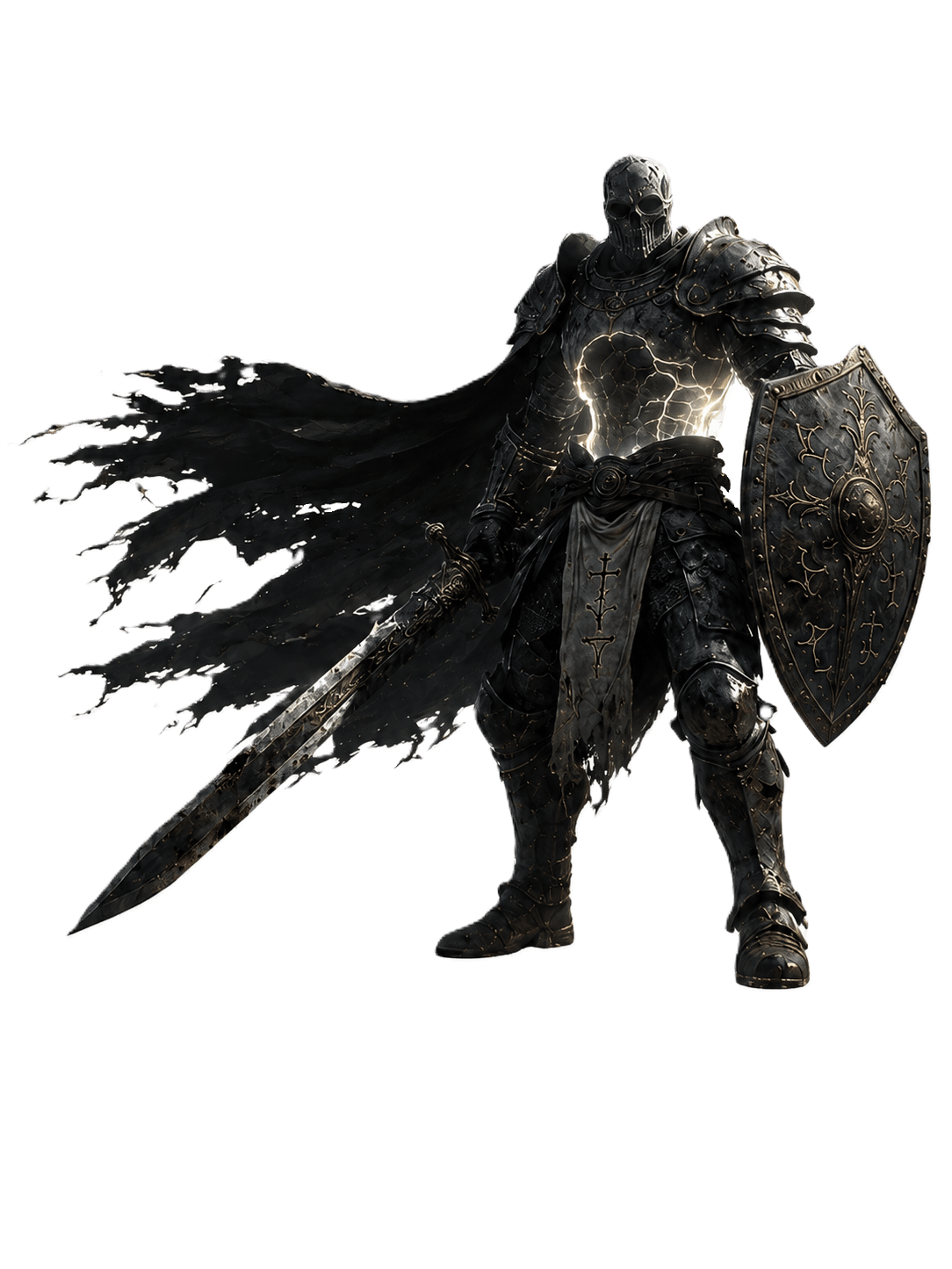
The forging of the Order’s plate had always included rites older than the kingdom itself, though most believed those rites ceremonial, relics of the brotherhood’s first age when men were superstitious and iron was dear enough to bless. Henry had worn such runes his entire adult life without asking whether they possessed more than symbolic worth. In the final stillness of his mortal body, the answer came blazing.
Lines carved into the breastplate, greaves, gorget, and gauntlets filled with white fire. The torque Aldren had given him flared against his chest. The sigils on the armor drank the last heat from Henry’s dying flesh and answered with something neither healing nor resurrection in the ordinary sense. It was binding. His essence, whatever invisible architecture made Henry Henry and not another man in the great census of the dead, struck the threshold of departure and found another command waiting. Duty. Hold the line. Hold the breach. Hold the gate. Hold the dark. The oath he had lived within closed around him like a mailed fist and would not let him pass beyond it.
His human body failed. His soul did not leave.
When awareness returned, it did not return to lungs, flesh, heartbeat, or blood. It returned to weight. To iron. To the sensation of standing without muscle. Henry opened eyes he no longer physically possessed and saw the chamber from behind the dark slit of his helm. Below him, pooled within the lower half of his armor, lay what remained of the body that had once animated it: cloth, bone fragments, a collapse of age and dust already surrendering to centuries. His hand lifted, and the gauntlet obeyed. The metal fingers flexed with a sound like old hinges learning a forgotten prayer.
Across the chamber, the stone creature stirred for the first time in years.
Not fully. Not yet. But enough. Its ember-heart brightened behind the fractures in its chest, and its head tilted with the slow inevitability of a mountain deciding to look. It recognized, perhaps, that something in the chamber had changed. That the guard who had watched with mortal patience now stood in a different form. Henry rose from the pillar base, every piece of the armor moving as if inhabited by memory and oath alone, and picked up his sword.
The blade felt right in the iron hand.
No pulse beat in him. No breath entered the hollow dark of the helm. Yet purpose burned clearer than it ever had through mortal pain, mortal exhaustion, mortal fear. He was no longer a man enduring a vigil. He had become the vigil.
The creature’s light dimmed again. The chamber returned to stillness. And in that stillness, beneath what the world above would one day call Ashen Vale, Henry the man ended and Henry the Hollow Knight began.
Centuries later, when others would find the vault and wonder what legend had taken root in that black chamber, they would see only the armor. They would see a towering silent figure, ancient plate scarred by impossible time, a great sword in hand, standing watch before a seal older than nations. They would not see the young captain riding into a green valley beneath bright morning skies. They would not hear the thirty-two brothers of the Order of the Vanguard descending into forbidden stone. They would not know how many men bled for every rune cut back into place, or how quiet the world became after the last rope was pulled from the ascent and the final human voice faded overhead.
But the chamber remembered.
The runes remembered.
And Henry, sealed inside iron and oath, remembered enough for all of them.