
SISTER THÉRÈSE
Vatican Mission Report
SISTER THÉRÈSE
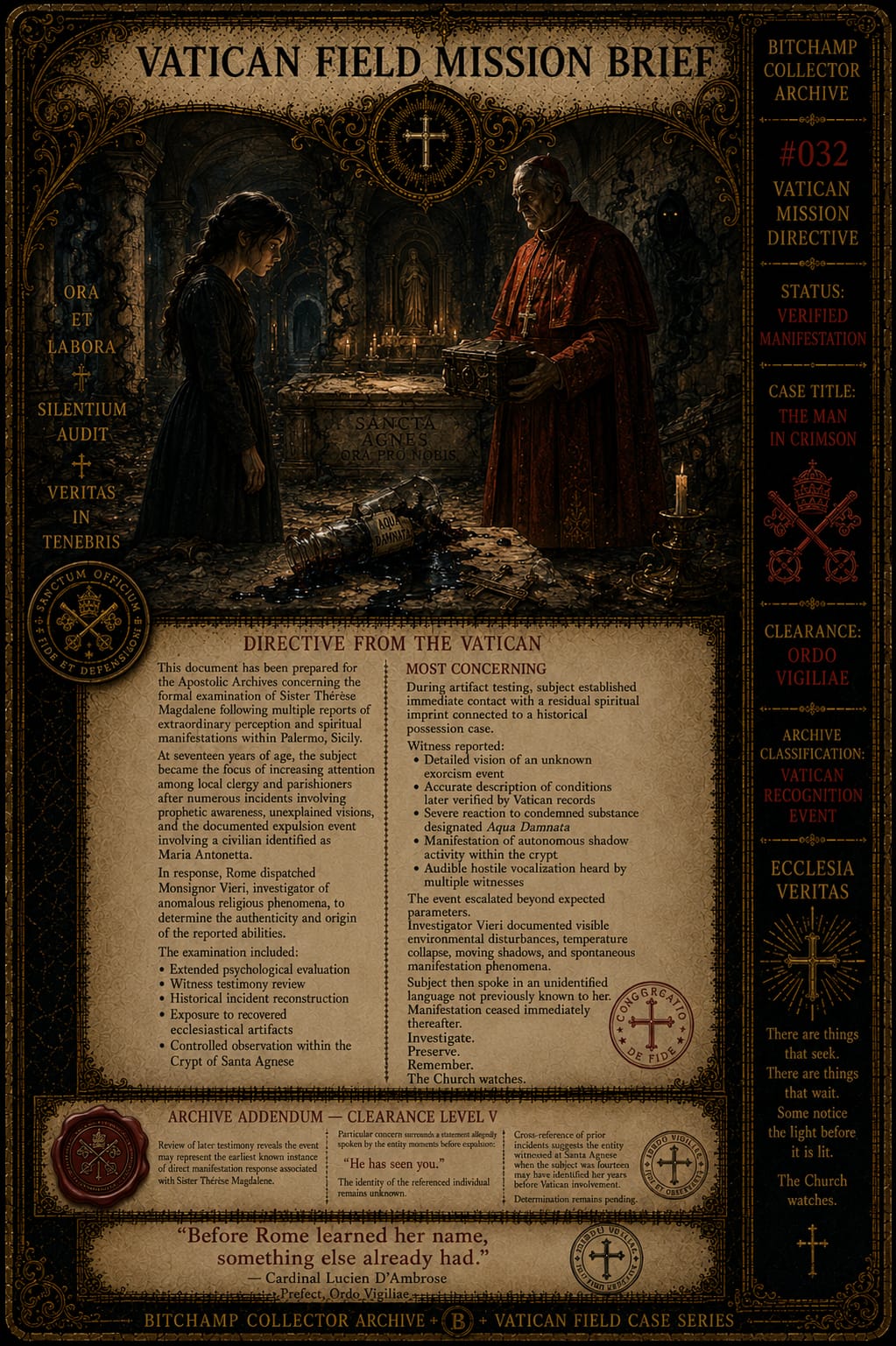
Chapter Four — The Man in Crimson
March 6th · 2:09 AM · Palermo, Sicily
I was seventeen years old when Rome finally decided to learn my name, though the truth is that Palermo had been speaking it for months before that. Cities are strange creatures. They possess memories, prejudices, fears, and habits just as surely as the people who inhabit them. News travels through them the way water travels through cracked stone, finding paths no one notices until the damage has already been done. By the time the Vatican became aware of me, the city had already formed a hundred opinions about who I was, and most of those opinions had very little to do with the truth.
The whispers began quietly enough. A woman would lower her voice when I entered a bakery. Two men speaking outside a café would suddenly find something else to discuss as I walked past. Parishioners who once greeted me with easy familiarity began studying me with expressions I could never quite decipher. Some looked curious. Others looked concerned. A few looked frightened, though they always tried to disguise it with polite smiles. The attention might have amused me had it not been directed toward things I desperately wished to keep hidden.
The stories changed depending on who told them. One version claimed I could predict accidents before they happened. Another insisted I had cured a dying child with a touch. Someone else swore I spent my evenings walking through cemeteries speaking to spirits only I could see. None of these stories were true, yet each contained a fragment of something real. That is often how rumors survive. A complete lie collapses beneath its own weight, but a lie wrapped around a small truth can travel for years without tiring.
At seventeen, I hated being spoken about more than I hated being misunderstood. I wanted an ordinary life with ordinary concerns. I wanted to worry about friendships, family obligations, and the future in the same uncomplicated way everyone else seemed to. Instead, I found myself becoming a subject of discussion among people who had never once asked me what I actually experienced. They preferred the mystery of me to the reality of me, and mysteries are easier to fear than human beings.
I often think about Maria during that period. After what happened in her room, she slowly returned to herself. Her laughter came back first, then her appetite, then her endless habit of talking through moments that might otherwise have become uncomfortable. To anyone watching from the outside, it would have seemed as though she had recovered from a severe illness and nothing more. Only I knew how close she had come to disappearing completely. Only I remembered the sound of another voice speaking through her mouth. That memory remained lodged inside me like a splinter too deep to remove.
Maria noticed the whispers before I admitted they existed. She always noticed such things. One afternoon we sat near the harbor eating bread and olives while gulls argued overhead. She watched a group of women glance in our direction before immediately pretending they had not. Then she nudged my shoulder and smiled in a way that was meant to comfort me.
“You know what they’re saying, don’t you?” she asked.
“I know enough.”
“No,” she replied. “You know the polite version. The real version is much more entertaining.”
I laughed despite myself. Maria had a gift for making difficult conversations feel less threatening than they were. Even after everything she had endured, she refused to surrender her sense of humor. Looking back now, I suspect that resilience was one of the reasons she survived.
“They think you’re either a saint or a witch,” she continued. “Palermo has not decided which yet.”
“I am neither.”
“I know that. Unfortunately, no one ever asks the people who actually know someone.”
The comment stayed with me long after we parted. There is a loneliness that comes from being isolated, and there is a different loneliness that comes from being misunderstood. I was beginning to discover the second kind. It settles into a person’s life quietly, reshaping ordinary moments until even familiar places feel slightly foreign.

Bishop D’Avanzo saw the change long before I spoke of it. He had a remarkable ability to recognize burdens in other people while pretending not to notice them. Age had softened his voice and curved his shoulders, but neither had diminished the sharpness of his perception. He possessed the rare gift of making people feel seen without making them feel examined, and there are far fewer men like that in the world than there should be.
When I think of him now, I remember ink stains. They were always present somewhere on his hands, usually near his fingers, because he spent so much of his life writing letters, reports, and notes for people who would never know how much work had been done on their behalf. He looked more like a tired schoolmaster than a bishop. That appearance often caused visitors to underestimate him. It never took them long to realize their mistake.
The summons came on a rainy evening toward the end of winter. I had spent most of the day assisting elderly parishioners with their confessions and helping one of the sisters prepare meals for several families who had fallen on difficult times. My clothes smelled faintly of candle wax and soup by the time a novice informed me that the bishop wished to see me immediately. Something in her expression suggested she knew more than she intended to say.
The rectory felt unusually quiet that evening. Rain tapped against the windows while distant thunder rolled somewhere beyond the city. The corridors smelled of damp stone and old books. As I walked toward the bishop’s office, I became aware of a growing tension inside my chest. It was not fear exactly. Fear is often specific. This felt more like the anticipation of bad news that had not yet decided what shape it intended to take.
Bishop D’Avanzo was waiting when I arrived. A teapot sat between two cups on his desk, and the sight of it immediately made me uneasy. Important conversations in the Church are often preceded by tea. I have never fully understood why. Perhaps people believe difficult truths become easier to swallow when accompanied by something warm.
He motioned for me to sit and poured tea into both cups before speaking. For several moments he said nothing at all. He simply watched the steam rise between us while rain whispered against the glass behind him. The silence lasted long enough for me to imagine half a dozen possible reasons I might have been called there.
Finally, he sighed.
It was not the sigh of an angry man or a disappointed one. It was the sigh of someone who had spent weeks hoping a problem would solve itself and had finally accepted that it would not.
“They’ve heard about you,” he said.
I knew immediately who he meant.
Rome.
The word seemed to settle into the room before either of us spoke it aloud.
The bishop wrapped both hands around his cup. His eyes looked tired in a way I had never seen before.
“I hoped we would have more time.”
“More time for what?” I asked.
His expression softened.
“For you to remain seventeen.”
I remember staring at him, uncertain whether to laugh or feel frightened. The answer was so unexpected that it bypassed my defenses entirely. Years later, after witnessing far more suffering than any person should, I came to understand exactly what he meant. There are moments in life when innocence does not vanish all at once. Instead, it is gently escorted toward the door by people who know it cannot stay.
He explained that representatives from Rome had taken an interest in the reports surrounding me. They were not coming because they believed I was blessed. They were not coming because they believed I was cursed. They were coming because the Church had spent centuries learning that certainty is often dangerous. Claims required examination. Miracles required investigation. Gifts required discernment.
“The Church has seen many things,” he said quietly. “Holy things. False things. Broken things. We would be irresponsible if we accepted every extraordinary story at face value.”
“I understand.”
“I believe you do.”
He hesitated before continuing.
“The man arriving here has spent most of his life examining cases like yours.”
Something in the way he said yours unsettled me.
“What is his name?”
The bishop looked toward the rain-covered window.
Then he answered.
“Monsignor Vieri.”
At the time, the name meant nothing to me.
Later, it would mean everything.
Three days later, Monsignor Vieri arrived in Palermo beneath a sky the color of wet slate. The rain had finally weakened to a steady drizzle, leaving the streets slick and reflective beneath the afternoon light. I happened to be helping unload supplies near the church entrance when I first saw him. No carriage bearing Vatican insignia announced his arrival. No assistants followed him carrying documents. No ceremonial greeting awaited him at the door. He simply stepped from a hired automobile carrying a weathered leather satchel and a dark overcoat, as though he were an ordinary traveler rather than a man whose decisions could alter the course of another person’s life.
My first impression had nothing to do with authority. It was control. Everything about him seemed governed by discipline so complete that it had become instinctive. He moved with the quiet efficiency of someone accustomed to entering unfamiliar places and immediately understanding where every danger might be hiding. His crimson clerical garments were immaculate despite the weather, and silver-rimmed glasses rested low upon his nose. Gray touched his temples, but it was difficult to determine his age because there was something timeless about his expression, as though years had ceased leaving visible marks upon him long ago.
He greeted the sisters politely. He greeted the clergy politely. He even offered a courteous word to several parishioners gathered nearby. Yet there was a distance in him that never diminished regardless of whom he addressed. His kindness felt genuine, but it was carefully measured. Looking back, I think he had spent so many years examining deception that he no longer surrendered trust casually.
Then he looked at me.
The moment itself lasted only a few seconds, but I remember it with uncomfortable clarity. His gaze settled upon me without hesitation, and I experienced the strange sensation of being evaluated before a single word had been exchanged. Most people look at another human being and see a person first. Monsignor Vieri seemed to see a question. The realization irritated me immediately, though I suspect the irritation came from recognizing that he was not entirely wrong.

“Sister Thérèse Magdalene,” he said.
His voice was calm and low, carrying none of the theatrical authority I expected from a Vatican investigator. He sounded more like a professor introducing a difficult subject than a man arriving to determine whether another person’s experiences were genuine.
“Monsignor,” I replied.
“We will begin after Vespers.”
There was no greeting beyond that. No attempt at small talk. No effort to place me at ease. His eyes remained fixed upon me as though he were already cataloguing details for a report.
“You will answer only the questions I ask. You will not volunteer information unless requested. You will not discuss the examination with others while it is ongoing. Do you understand?”
I nodded.
For the first time, the faintest hint of expression touched his face. It was not warmth. It was approval.
“Good,” he said. “God often speaks in silence. We would be wise to listen the same way.”
The investigation began that evening and continued for nearly two days. This is one of the details most people never understand when they hear stories about the Church examining unusual claims. They imagine relics, rituals, and dramatic confrontations. The reality is often far less exciting. Most investigations begin with questions. Endless questions. Questions so ordinary and repetitive that they eventually become exhausting.
Monsignor Vieri questioned me about my childhood first. He wanted to know about my parents, my education, my health, and my earliest memories. He asked about dreams, fears, illnesses, friendships, and habits. He asked whether I lied often as a child. He asked whether I enjoyed attention. He asked whether I had ever experienced periods of depression, anxiety, or isolation. Some questions seemed entirely unrelated to the supernatural. Others struck so close to personal insecurities that I found myself resenting him for asking them.
At first I believed he was wasting time. Then I realized he was searching for patterns.
Many years later, after participating in investigations myself, I came to appreciate the wisdom behind his approach. People often assume deception begins with lies. More often it begins with need. A person desperate for attention, validation, belonging, or significance can convince themselves of extraordinary things without ever consciously intending to deceive anyone. Monsignor Vieri was attempting to determine whether my experiences originated from external reality or internal longing.
The process was humiliating.
There is no gentler way to describe it.
I had spent years questioning myself in private. I had asked whether I imagined the figure in Santa Agnese. I had wondered whether fear had distorted my memories of Maria. I had spent countless nights lying awake and considering explanations that required no supernatural involvement whatsoever. To have another person examine those doubts aloud felt like having old wounds reopened for inspection.
By the second day, I was exhausted.
The monsignor showed no sign of fatigue.
He sat across from me in a small room near the rectory library while rain continued drifting through Palermo in irregular waves. Lamps burned softly between us. Papers accumulated beside him. Each answer generated another question. Each memory seemed to lead him deeper into territory I would have preferred remain undisturbed.
Finally, he asked about Santa Agnese.
The room seemed colder the moment he spoke the church’s name.
I told him everything.
I described the Mass. The breathing. The darkness around the sanctuary. The figure standing near the altar. I described the black eyes, the raised hand, and the moment it pointed directly at me. I described waking in the sacristy and smelling burnt lavender mixed with sulphur. I described the fear of telling no one.
When I finished, he simply stared.
His expression revealed nothing.
“Do you believe what you saw was real?” he asked.
The question irritated me.
“Yes.”
“Why?”

I hesitated.
The answer seemed obvious.
Because I had seen it.
Because I remembered it.
Because it changed my life.
Yet none of those responses would satisfy him.
Finally, I said, “Because it felt more real than anything else in the room.”
The monsignor nodded slightly.
“Many people say the same thing about hallucinations.”
I wanted to argue.
Instead, I remained silent.
Partly because he had instructed me to answer only what was asked. Partly because I hated how reasonable his skepticism sounded.
The questioning continued.
Eventually he turned toward the subject I had been dreading most.
Maria.
Even now, writing these words decades later, I can still feel the tension that settled into my chest when her name entered the conversation. Some memories remain tender regardless of how much time passes. Maria’s possession was one of them.
I told him everything.
The rumors about her behavior. The old woman in the alley. The room. The smell. The voice. The thing that looked through her eyes. I described the pressure in the air and the impossible cold of her touch. I described the vision, the prayer, and the shadow peeling away from her body like smoke being torn apart by wind.
When I finished, Monsignor Vieri leaned back in his chair.
For several moments he said nothing.
Then he asked a question I had never considered.
“Did you enjoy it?”
I stared at him.
The question felt offensive.
“What?”
“The power,” he said quietly. “Did any part of you enjoy it?”
I remember becoming angry then.
Not dramatically. Not visibly. Just enough that my hands tightened in my lap.
“My friend nearly died.”
“That wasn’t my question.”
The room felt suddenly smaller.
I hated him in that moment.
Not because he was cruel.
Because he was asking something I did not want to examine.
Eventually, I answered honestly.
“No.”
The monsignor continued watching me.
“No?”
“I was terrified.”
His gaze remained steady.
I took a breath.
“And afterward I was more frightened than before.”
Something shifted in his expression then. Not agreement. Not approval. Recognition, perhaps. The answer seemed to matter to him more than I understood at the time.
The interviews ended shortly after sunset.
I believed the examination was over.
I was wrong.
The true test began beneath the church.
The crypt of Santa Agnese stretched beneath the sanctuary like a forgotten memory. Few parishioners ever entered it. Narrow stone stairs descended into darkness beneath the building, leading toward chambers lined with tombs belonging to bishops, priests, and benefactors whose names had slowly faded from public memory. The air smelled of dust, wax, and ancient stone. Every sound seemed amplified by the enclosed space, creating echoes that lingered longer than they should have.
Candles had already been arranged throughout the chamber when we arrived.
Their light trembled across carved walls and worn inscriptions.
Two chairs sat near the center of the room.
Beside them rested a small iron box.
The moment I saw it, something tightened inside my chest.
Not fear exactly.
Recognition.
The sensation reminded me of standing near a thunderstorm before the first lightning strike. The air itself seemed aware of what was coming.
Monsignor Vieri noticed my reaction immediately.
“You feel something.”
It was not a question.
I nodded reluctantly.
The monsignor approached the box and rested a hand upon its lid.
“This was recovered from a possession case in Vercelli,” he said. “The Church determined that the object retained residual influence after the exorcism concluded.”
The phrase residual influence unsettled me.
Objects should not retain influence.
Wood should remain wood.
Metal should remain metal.
The idea that suffering could cling to something long after the suffering itself ended disturbed me more than I cared to admit.
The monsignor opened the box.
Inside rested a small crucifix.
It looked ordinary.
Broken near the top.
Darkened by age.
Yet the instant I saw it, a pressure settled behind my eyes.
The candles flickered.
The room seemed to recede.
And somewhere deep inside the crypt, I thought I heard something sigh.
“Touch it,” Monsignor Vieri said.
My hand trembled despite my efforts to steady it.
I reached forward.

The moment my fingers brushed the crucifix, the crypt disappeared.
And I was somewhere else.
The room that replaced the crypt was so small that for a moment I believed I had been trapped inside a closet. The ceiling hung low overhead, stained black by years of smoke from candles that had burned too long and too often. A single oil lamp sat upon a narrow table, casting weak yellow light across rough stone walls. The air felt suffocatingly warm, thick with the smells of sweat, old incense, and fear. It was the smell that convinced me the vision was real. Imagination can reproduce sights and sounds with remarkable accuracy, but terror possesses its own scent, and that room reeked of it.
A young girl lay tied to a bed in the center of the chamber. She could not have been older than thirteen. Leather restraints secured her wrists and ankles, and deep red marks surrounded each place where the straps met her skin. Her dark hair clung to her face with perspiration. Every few seconds her body trembled, not with the violence of a seizure but with a constant, exhausting tension that suggested she had been struggling for a very long time. The sight of her stirred something painful inside me because she reminded me of Maria, not in appearance but in helplessness. There is a particular look shared by those who have become prisoners inside their own lives.
A priest knelt beside the bed.
He was weeping.
Not dramatically, not loudly, but with the quiet despair of a man who has reached the edge of his understanding. Tears rolled down his face as he clutched a rosary between trembling fingers. His lips moved continuously in prayer, though I could not hear the words. What frightened me most was not his grief but his exhaustion. This was not a man confronting evil for the first time. This was a man who had been confronting it for days and was slowly losing hope.

The girl opened her eyes.
Even now, years later, I hesitate when describing what I saw in them. The easiest explanation would be to say they were possessed, but that word has become so familiar that it no longer communicates the horror of the reality. Her eyes were not merely occupied by something foreign. They had become windows through which something foreign observed the world. The intelligence looking through them was ancient, patient, and entirely without compassion. It examined the weeping priest with the detached curiosity one might show an insect trapped beneath glass.
Then it smiled.
The expression spread slowly across the girl’s face until it became physically painful to witness. There was nothing childish in it. Nothing human. It was the smile of a thing that had discovered a private joke centuries ago and never grown tired of repeating it. The priest lowered his head and began praying harder, and the thing wearing the girl’s smile seemed delighted by his effort.
I tried to look away.
I could not.
The walls were changing.
At first I thought the shifting shapes came from the flickering lamp, but the movement continued even when the light steadied. Faces appeared beneath the stone surface, emerging like impressions trapped beneath ice. They were not fully visible. Some revealed only eyes. Others revealed mouths. A few showed enough features to suggest human forms before sinking once more into the walls. The room felt crowded despite containing only three visible occupants. Something unseen watched from every direction simultaneously.
The smile widened.
The girl began speaking.
The language meant nothing to me, yet I understood the emotion behind it immediately. Mockery. Cruel amusement. A certainty of victory so complete that resistance had become entertainment. The priest’s shoulders shook as he listened. I remember realizing that he no longer believed he was winning. He was simply refusing to abandon the child.
That realization broke my heart.
People often imagine courage as confidence. They imagine brave individuals marching forward with certainty shining in their eyes. True courage rarely resembles that image. More often it looks like a frightened person continuing despite overwhelming evidence that they may fail. The priest kneeling beside that bed possessed the kind of courage that rarely receives recognition because it does not look impressive from the outside.
The thing inside the girl suddenly stopped speaking.
Its eyes shifted.
For the first time, it looked directly at me.
The room vanished.
I found myself stumbling backward inside the crypt, gasping for breath. Cold stone struck my shoulder. Candlelight flickered around me. The crucifix had fallen from my fingers and lay on the floor near the iron box. For several moments I could not separate memory from reality. My heart hammered so violently that I thought I might collapse.
Monsignor Vieri was watching me.
His expression remained controlled, but something had changed in his eyes. The detached skepticism I had grown accustomed to during the interviews had begun to crack. He had expected a reaction. I do not think he had expected the reaction he received.
“What did you see?” he asked.
His voice sounded distant.
I struggled to answer.
The images remained painfully vivid. The room. The priest. The girl. The faces trapped within the walls. Every detail lingered with uncomfortable clarity. When I finally spoke, my voice sounded strained even to me.
“A child,” I whispered. “A possession.”
The monsignor said nothing.
“There was a priest.”
Still nothing.
“He was crying.”
That answer seemed to affect him more than anything else I said. A subtle tension crossed his face before disappearing again. It lasted only a second, but I noticed it. Years later, I would discover why. He knew the case. He had read the reports. Perhaps he had even known the priest personally.
For several moments neither of us spoke.
The crypt settled into silence once more.
Then Monsignor Vieri reached into his satchel.
The object he removed looked harmless enough. A small glass vial no larger than my palm. Murky liquid rested inside, dark and cloudy beneath the candlelight. Had I encountered it elsewhere, I might have mistaken it for medicine or contaminated water. Yet the instant it appeared, every instinct inside me recoiled.
The reaction was immediate.
The air felt heavier.
The shadows surrounding the tombs seemed to deepen.
Something about the vial offended the room itself.
Monsignor Vieri noticed.
His eyes narrowed slightly.
“This is called aqua damnata,” he said. “Most records concerning it were destroyed centuries ago. The substance originates from a ritual condemned by the Church long before either of us were born.”
His tone remained calm, but I sensed caution beneath it.
“It was recovered from a site in northern Italy where several deaths occurred under unusual circumstances. Every priest who handled it reported feelings of dread. One became physically ill. Another refused to remain in the same room with it.”
I stared at the vial.
The liquid inside appeared motionless.
Yet I could not shake the feeling that something beneath the surface was listening.
The monsignor stepped closer.
“If you are mistaken about your experiences, nothing will happen.”
I looked at him.
His expression softened for the first time since our meeting.
“If you are not mistaken,” he said quietly, “I apologize in advance.”
Those words frightened me more than any warning could have.
He placed the vial into my hand.
The pain arrived instantly.
It did not begin in my skin.
That is the part most people misunderstand when they hear stories like this. Physical pain can be described. It has shape, intensity, location. What entered me through that vial was something different. It felt like revulsion made tangible. My mind recoiled before my body understood why. Every nerve seemed to recognize the wrongness of the object simultaneously.
A scream escaped me before I realized I was making a sound.
The vial slipped in my grasp.
Darkness surged along the edges of my vision.
I felt something moving inside the crypt.
Not physically.
Spiritually.
The distinction mattered.
The tombs surrounding us remained motionless. The candles remained lit. Yet an unmistakable presence stirred within the chamber. The sensation reminded me of standing near a sleeping animal large enough to kill without effort. One becomes aware of its existence before seeing it.
My arm convulsed.
Black veins appeared beneath my skin, spreading from my hand toward my wrist. They vanished almost as quickly as they emerged, but I saw them clearly. Judging by the expression on Monsignor Vieri’s face, so did he.
The shadows moved.
This time there was no possibility of imagination.
Darkness gathered unnaturally along the walls, twisting into shapes that refused to remain consistent. Faces appeared and disappeared within it. Fingers seemed to stretch from corners before dissolving. The temperature dropped so rapidly that my breath became visible.
Then something growled.
The sound rolled through the crypt like distant thunder.

Monsignor Vieri heard it too.
I knew he heard it because his eyes immediately shifted toward the nearest tomb.
For the first time since meeting him, he looked genuinely afraid.
I wish I could tell you that what happened next felt holy.
Years later, after Vatican archives, exorcisms, missions, and investigations too numerous to count, people occasionally ask whether one can feel the presence of God in moments like those. They imagine a warmth descending into the room or a certainty settling over the heart. Such things do happen, but they rarely arrive when one expects them. What entered the crypt that night was not comfort. It was conflict. For the first time in my life, I became aware of two opposing realities occupying the same space, pressing against one another like unseen tides.
The growl echoed again.
It seemed to come from everywhere and nowhere at once. The sound rolled through the stone floor beneath my knees and vibrated in my ribs. Dust drifted from the ceiling. The candle flames flattened as though struck by a sudden wind, yet the air itself remained still. Every instinct inside me screamed to run, but terror had already rooted me in place.
Monsignor Vieri stepped between me and the nearest tomb.
The movement was subtle, almost unconscious, but I noticed it. For all his skepticism, for all his endless questions and relentless examinations, he moved to protect me without hesitation. The realization startled me because it revealed something I had not previously understood. He was not investigating me because he distrusted me personally. He was investigating me because he had spent his life standing near dangerous things. Suspicion had become his method of keeping people alive.
The shadows continued shifting.
They no longer resembled darkness.
Darkness is passive. It merely occupies space where light is absent. Whatever gathered along the crypt walls possessed intention. Shapes emerged within it only to collapse and reform elsewhere. Faces appeared, twisted with expressions of rage, grief, hunger, and desperation. Some looked human. Others did not. A few seemed only partially formed, as though they had not yet decided what they wished to become.
The vial fell from my hand and struck the stone floor.
The glass did not shatter immediately.
Instead, it rolled in a slow circle between the chairs. The murky liquid inside churned unnaturally despite the gentle motion. As I watched, the contents seemed to move against gravity, climbing the interior surface of the glass before sinking again. The sight made my stomach twist. Whatever ritual had created that substance, it had left something behind.
My hands began burning.
The sensation started in my palms and spread upward through my arms. It reminded me of what I experienced after Maria’s possession, though far stronger. The pain felt less like injury and more like pressure. Something was trying to force its way through me. My muscles trembled. My teeth clenched involuntarily. Every breath became an effort.
“Thérèse.”
Monsignor Vieri’s voice sounded distant.
I looked toward him.
His face remained composed, but the composure required effort now. The investigator from Rome had vanished. In his place stood a priest confronting something he could neither measure nor control.
“Look at me.”
I tried.
The shadows immediately reacted.
A hiss rolled through the crypt. The sound resembled steam escaping a sealed pipe, except it carried unmistakable malice. Several candle flames extinguished simultaneously. Darkness surged forward across the floor between us.
The monsignor crossed himself.
Not casually.
Not out of habit.
He crossed himself like a soldier reaching for a weapon.
That image has remained with me for decades. Before that night, I believed faith belonged primarily to the realm of comfort. Faith helped people endure suffering, process grief, and survive uncertainty. Watching Monsignor Vieri stand before those moving shadows taught me something different. Faith could also be defiance. Faith could be refusal.
The growl returned.
This time it emerged from directly behind me.
I turned.
The nearest tomb stood less than ten feet away. Its stone lid remained sealed. Dust covered its surface. Nothing visible had changed. Yet I became aware of a presence standing beside it. I could not see a figure. I could not describe a shape. I simply knew something occupied that space.
And it was watching us.
The realization struck with terrible familiarity.
I had felt this before.
Santa Agnese.
The altar.
The black-eyed figure.
The memory rushed back with such force that my vision blurred. For a moment I was fourteen again, standing in a church filled with sunlight while something impossible pointed directly at me. The years between then and now seemed to collapse. Every strange dream. Every unexplained voice. Every moment of dread. They suddenly felt connected.
The thing behind the altar had not been random.
It had been waiting.
The thought entered my mind with complete certainty.
Waiting.
The word echoed through me.
Waiting for what?
Waiting for whom?
The answer arrived before the question finished forming.
Me.
The crypt seemed to tilt.
A cold sensation settled at the base of my spine. Fear is often described as sudden, but true fear usually arrives in stages. First comes discomfort. Then concern. Then understanding. Understanding is the worst part because it transforms anxiety into certainty.
Something had known me long before I knew myself.
The realization nearly broke my concentration.
The shadows surged.
Several candles exploded simultaneously. Hot wax sprayed across the stone floor. One of the chairs overturned. The vial finally shattered, releasing dark liquid that spread across the crypt like spilled ink.
The reaction was immediate.
Every shadow in the room lunged toward it.
Not physically.
Hungrily.
The darkness twisted around the spreading liquid as though drawn to it. Faces emerged within the walls. Mouths opened. The growling intensified until it became a chorus of overlapping sounds. Some resembled animals. Others resembled human voices speaking beneath water.
Monsignor Vieri shouted something.
I never learned what.
The noise swallowed his words.
My hands burned hotter.
The pressure inside me increased.
The language returned.
I recognized it instantly.
For years it had existed only in dreams. Strange syllables whispered through sleep. Fragments of conversations I could never remember upon waking. Sounds that lingered just beyond comprehension. Whenever I tried describing them, they dissolved into nonsense. Yet now they rose through me with absolute clarity.
I fought them.
That is the part I rarely discuss.
People assume I surrendered immediately.
I did not.
I was terrified.
The language felt ancient and immense. It carried weight beyond meaning. Every instinct told me that speaking words I did not understand was dangerous. What if they were not prayers? What if they belonged to something else entirely? What if the voices from my dreams had never been holy at all?
The fear nearly silenced me.
Then I looked at Monsignor Vieri.
He was standing alone against the darkness.
The image struck me harder than any vision. He was afraid. I know that now. Yet he remained where he was. He had come expecting to expose a fraud, investigate a rumor, perhaps even help a confused young woman. Instead he found himself standing in a crypt filled with moving shadows and impossible sounds.
And still he stayed.
Something about that steadiness gave me strength.
I stopped resisting.
The first words left my mouth like water breaking through a damaged wall.
I did not understand them.
Even now I cannot translate them.
The language flowed with its own rhythm and structure. Some syllables felt sharp enough to cut. Others carried a resonance that seemed to vibrate inside the stone itself. The sounds echoed through the crypt, filling spaces where ordinary speech should not have reached.
Everything stopped.
Not gradually.
Instantly.
The growling ceased.
The shadows froze.
The darkness recoiled from the shattered vial.
Silence descended with such force that it felt physical.
I continued speaking.
The language poured through me faster now. My fear remained, but it no longer controlled me. For the first time, I sensed that the words were not emerging from some external source. They were passing through me, certainly, but they belonged to a deeper place than I had ever accessed consciously. They felt older than memory and yet intimately familiar.
The shadows began retreating.
Slowly at first.
Then all at once.
The darkness peeled away from the walls like smoke drawn into a powerful wind. Faces vanished. Shapes collapsed. The oppressive pressure inside the crypt weakened. Candle flames steadied. Warmth gradually returned to the air.
One final scream echoed through the chamber.
It came from nowhere visible.
Yet both of us heard it.
The sound contained fury beyond anything I had previously encountered. It was the cry of something denied what it wanted. The cry of a predator watching prey escape. The cry lingered for several seconds before fading into silence.
Then everything was over.
I collapsed.
Not dramatically.
Simply because my body had reached its limit.
The stone floor rushed upward. My arms felt numb. Every muscle trembled with exhaustion. Breathing became difficult. I remember staring at the ceiling and wondering whether I had fainted. The distinction seemed unimportant at the time.
For several minutes neither of us spoke.
The crypt settled around us.
Wax dripped from damaged candles.
Rain tapped faintly somewhere far above.
The ordinary sounds of the world slowly returned.
Eventually Monsignor Vieri approached.
His footsteps echoed softly against the stone.
He knelt beside me and remained there longer than I expected. When I finally turned my head, I discovered he was studying the shattered vial rather than me. Whatever conclusion he reached seemed to settle something inside him.
Then he crossed himself.
Slowly.
Carefully.
Almost reverently.
When he finally spoke, his voice sounded different than before. The skepticism had not disappeared completely. I do not think men like Monsignor Vieri ever stop questioning things. Yet certainty had entered where doubt once dominated.
“Sister Thérèse,” he said quietly, “the Vatican recognizes your gift.”
I closed my eyes.
Relief should have followed.
Instead I felt dread.
Because recognition carries consequences.
The monsignor seemed to understand this.
“You are no longer a question to be investigated.”
The words hung between us.
“You are now a responsibility.”
I looked at him.
For the first time since our meeting, genuine sadness appeared in his expression.
“You will not be permitted an ordinary life after this.”
The honesty hurt because it confirmed what I already suspected.
The whispers in Palermo.
The visions.
Maria.
The dreams.
The crypt.
None of it was ending.
It was beginning.
Monsignor Vieri sat beside me on the stone floor. For a while we listened to the silence together. The investigator and the girl he had been sent to examine. The distance between us seemed smaller now.
Finally he spoke again.
“There are things in this world most people never see.”
I laughed weakly.
“I’ve noticed.”
A faint smile touched his face.
It was the first one I had seen.
“There are also people whose responsibility is to confront those things.”
The smile vanished.
“You were never going to avoid this.”
His certainty frightened me more than the shadows had.
Because deep down, I believed him.
Years later I would travel to Rome. I would study archives hidden beneath the Vatican. I would meet priests, scholars, exorcists, investigators, and witnesses whose stories sounded impossible until the evidence arrived. I would learn names like Sancta Obscura and Ordo Vigiliae. I would walk into places abandoned by reason and discover that reason had been wise to leave.
But all of that remained in the future.
That night, I was still seventeen.
Still frightened.
Still exhausted.

Still trying to understand why the impossible seemed determined to follow me.
Monsignor Vieri eventually helped me to my feet. Together we climbed the stairs from the crypt into the quiet church above. Dawn had begun touching the stained glass. Pale light filtered through colored windows and spread across the empty pews.
The sanctuary looked ordinary.
Beautifully ordinary.
I remember stopping near the altar and staring at it.
Monsignor Vieri waited patiently.
After a moment he asked what I was thinking.
I looked toward the place where the black-eyed figure had stood three years earlier.
Then I answered honestly.
“I think something saw me a long time ago.”
The monsignor’s expression changed.
Only slightly.
But enough.
He understood exactly what I meant.
And the fact that he understood frightened me more than anything else that had happened that night.
For a long moment, neither of us moved.
The church remained empty except for the two of us and the pale dawn slowly filtering through the stained-glass windows. Colored light spilled across the sanctuary floor in uneven patches of gold, blue, and crimson. Dust drifted lazily through the beams, transforming ordinary air into something almost sacred. The peacefulness of the scene felt surreal after what had occurred beneath us. My heart was still racing. My hands still ached. Somewhere deep inside my chest, fear continued moving through me like a second pulse.
Monsignor Vieri remained silent for so long that I wondered whether he intended to answer at all. His gaze drifted toward the altar before returning to me. The expression on his face had become difficult to read. During the investigation I had grown accustomed to skepticism, caution, and professional detachment. Now I saw something different. Concern lingered there, though it was accompanied by a familiarity that disturbed me.
“Tell me about it,” he said quietly.
I knew immediately what he meant.
The figure.
The church.
The thing I had seen when I was fourteen.
Until that moment, no one had ever heard the complete story.
I told him everything.
The words emerged more easily than I expected. Perhaps exhaustion stripped away the caution I had carried for years. Perhaps surviving the crypt had altered my perspective. Whatever the reason, I described the Mass at Santa Agnese in detail. I told him about the heat that day, the strange breathing behind the altar, the black-eyed figure standing beside the crucifix, and the way it had pointed directly at me while the congregation remained oblivious.
Monsignor Vieri listened without interruption.
That alone made the conversation different from our previous exchanges.
Throughout the investigation he had challenged nearly every statement I made. He questioned assumptions. He searched for inconsistencies. He examined every memory from multiple angles. Now he simply listened. The absence of interruption felt strangely intimate.
When I finished speaking, the church fell silent again.
Outside, bells from another parish began ringing in the distance.
The sound drifted through Palermo like a reminder that ordinary life still existed somewhere beyond our conversation.
Finally, the monsignor spoke.
“You never saw it again?”
I shook my head.
“No.”
That answer was technically true.
I had never physically seen the figure again.
But I had felt it.
In dreams.
In moments of unexplained dread.
In the sensation of being watched while alone.
The distinction seemed important, though I could not fully explain why.
Monsignor Vieri appeared to understand.
His eyes narrowed slightly.
“Did it ever speak?”
“No.”
“Did it approach you?”
“No.”
He considered that carefully.
Then he asked the question that had clearly been waiting beneath the others.
“Did it recognize you?”
The church seemed colder.
I looked away.
Toward the altar.
Toward the exact place where the figure had stood years earlier.
The memory remained painfully vivid.
“I think so.”
The words barely rose above a whisper.
The monsignor lowered his gaze.
Something troubled him.
I could see it.
Years later I would learn that investigators within the Vatican develop a particular expression whenever pieces of separate cases begin fitting together. It is the look of someone who has discovered a pattern they were hoping not to find. Monsignor Vieri wore that expression now.
“What is it?” I asked.
He hesitated.
The hesitation frightened me.
Until that moment, I had never seen him uncertain.
“Monsignor?”
He removed his glasses and rubbed the bridge of his nose.
For the first time since our meeting, he looked tired.
Not physically tired.
Burdened.
“There are entities,” he said carefully, “that become aware of certain people before those people become aware of themselves.”
The answer created more questions than it resolved.
“What does that mean?”
The monsignor replaced his glasses.
“It means some things notice potential.”
I stared at him.
The explanation sounded absurd.
Then again, so had most of my life.
He continued speaking.
“A musician can recognize talent in a child long before the child understands music. A scholar can identify intelligence before it has been educated. Predators often recognize vulnerability before victims understand they are being hunted.”
His voice remained calm.
“Spiritual realities are sometimes no different.”
The implication settled heavily between us.
I understood it immediately.
The figure in Santa Agnese had not merely observed me.
It had identified me.
A chill moved through my body.
The sanctuary suddenly felt much larger than it had moments before.
Rows of empty pews stretched into shadow. Ancient statues watched from alcoves. The sanctuary that had always represented safety now seemed filled with hidden depths. I became aware that I understood almost nothing about the world surrounding me.
That realization would become a recurring theme throughout my life.
The more I learned, the more mysterious everything appeared.
Monsignor Vieri eventually led me toward one of the side chapels where morning light had begun warming the stone floor. We sat together in silence for several minutes. The quiet no longer felt uncomfortable. Something had changed between us in the crypt. The investigation was over. Whatever conclusions he intended to reach had already been reached.
At length he opened his satchel.
I immediately tensed.
The reaction caused him to smile faintly.
“A reasonable response,” he admitted.
This time he withdrew papers.
Nothing supernatural.
Nothing dangerous.
Just documents.
The sight of them somehow frightened me more.
“These are preliminary recommendations,” he said.
The word recommendations sounded deceptively harmless.
I had lived around clergy long enough to understand that important decisions often hid behind gentle terminology.
Recommendations became assignments.
Assignments became obligations.
Obligations became lives.
I watched him place the papers on the chapel bench between us.
“Recommendations for what?”
His gaze remained fixed on the documents.
“Further evaluation.”
My stomach tightened.
The phrase sounded suspiciously similar to a sentence.
Further evaluation.
As though my life had become a medical condition.
The monsignor seemed aware of my discomfort.
“There are places in Rome where individuals with gifts like yours are studied.”
The word studied did not improve matters.
“I am not an animal.”
The response escaped before I could stop it.
To my surprise, Monsignor Vieri laughed.
Not loudly.
Not mockingly.
Just enough to reveal that beneath all his discipline remained a recognizable human being.
“No,” he said. “You certainly are not.”
His amusement faded.
“But neither are you ordinary.”
The statement carried no judgment.
That somehow made it worse.
For years I had clung to the hope that normality might still be possible. Even after Santa Agnese. Even after Maria. Some stubborn part of me continued believing I might eventually return to a life untouched by the impossible.
Sitting beside Monsignor Vieri, I realized that possibility was disappearing.
The future I had imagined for myself no longer existed.
A strange grief accompanied the realization.
People often associate grief with death.
In truth, grief accompanies any significant ending.
Dreams.
Expectations.
Versions of ourselves.
All can be mourned.
The monsignor seemed to recognize what I was experiencing.
“I know this is difficult.”
I laughed softly.
“You have a remarkable talent for understatement.”
That earned another faint smile.
The expression transformed his face. For the first time, he appeared approachable. Younger, somehow. Less like an investigator and more like a priest who had spent too many years carrying responsibilities nobody else wanted.
The smile vanished quickly.
“I would be lying if I told you the path ahead will be easy.”
I believed him.
“Will I have a choice?”
The question lingered.
He considered it carefully before answering.
“Yes.”
The response surprised me.
Perhaps he noticed.
“You always have a choice.”
His gaze remained steady.
“The problem is that some choices become increasingly difficult to live with.”
Those words stayed with me for years.
Perhaps because they were true.
The Church did not force me toward Rome.
The Church did not force me toward the Sancta Obscura.
The Church did not force me toward the life that followed.
Yet after Santa Agnese, after Maria, after the crypt, choosing ignorance would have required its own kind of sacrifice. Once a person becomes aware of certain realities, pretending otherwise becomes increasingly impossible.
Morning continued brightening around us.
Parishioners would soon arrive.
Candles would be lit.
Prayers would be offered.
Life would resume its ordinary rhythm.
Yet I knew something fundamental had changed.
Not because Rome had recognized my gift.
Not because Monsignor Vieri had completed his investigation.
Because for the first time, someone else understood.
The burden I carried no longer belonged solely to me.
That realization brought unexpected relief.
Fear remained.
Uncertainty remained.
The future remained terrifying.
But isolation had diminished.
Sometimes that is enough.
Monsignor Vieri gathered the documents and returned them to his satchel.
The gesture felt final.
Our conversation was ending.
The investigation was ending.
One chapter of my life had closed.
Another was waiting.
Before we rose, I asked him one final question.
The question had been bothering me since the crypt.
“Why do you do this?”
He looked genuinely surprised.
I clarified.
“The investigations. The possessions. The strange cases. The things most priests avoid.”
His expression became thoughtful.
For several moments he watched sunlight move across the chapel floor.
When he finally answered, his voice was very quiet.
“Because someone must.”
The simplicity of the answer struck me.
No grand speech.
No heroic declaration.
Just responsibility.
The same answer, I would eventually discover, given by nearly every member of the Sancta Obscura.
Because someone must.
Evil exists.
Suffering exists.
Darkness exists.
Someone must stand against it.
The church bells began ringing.
Their sound filled the sanctuary.
Monsignor Vieri stood.
I stood with him.
For a brief moment, neither of us spoke.
Then he extended his hand.
The gesture startled me.
Throughout the investigation he had maintained professional distance. Handshakes belonged to introductions and conclusions, not examinations.
I took his hand.
His grip was firm.
Warm.
Human.
“Sister Thérèse,” he said.
The title sounded different now.
No longer an observation.
A recognition.
“I believe we will meet again.”
At the time, I thought he meant Rome.
I would later discover he meant something far larger.
Years afterward, after missions, exorcisms, investigations, and horrors I could not yet imagine, I would often think back to that morning. Not to the shadows in the crypt. Not to the screaming darkness or the cursed water. I thought about the quiet conversation afterward. Two people sitting in a chapel while dawn filled the church around them.
Because that was the true beginning.
Not the miracle.
Not the gift.
Not even the investigation.
The beginning was understanding that my life would no longer belong entirely to me.
The thing in Santa Agnese had recognized it years before.
Monsignor Vieri had confirmed it.
And somewhere beyond the horizon, Rome was already waiting.
— Sister Thérèse Magdalene