
SISTER THÉRÈSE
Vatican Mission Report
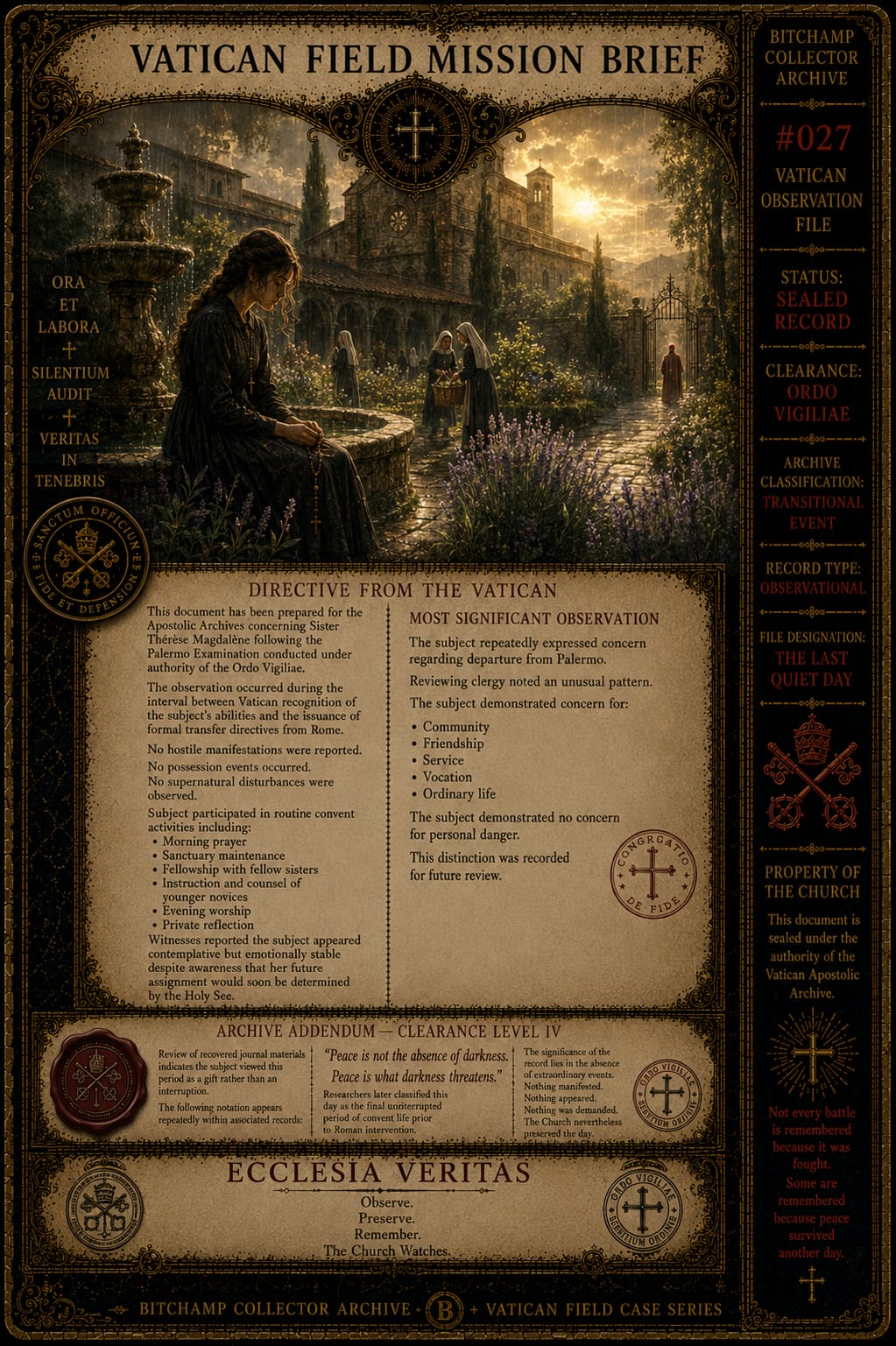
SISTER THÉRÈSE
Chapter Five — Still Waters, Burning Lamps
March 7th · 12:45 AM · Palermo, Sicily
When people hear stories about my life, they often assume every day was spent standing at the edge of some abyss. They imagine ancient evils lurking behind chapel walls, cursed relics hidden beneath altar cloths, and sleepless nights filled with voices that should not exist. I understand why they imagine such things, because most of the pages in these journals concern unusual events, and unusual events are naturally the ones people ask about. No one gathers around a fire hoping to hear a story about a pleasant afternoon spent polishing brass or sharing soup with women who have already heard every complaint one can make about soup. Yet as I sit here writing these words, I find myself thinking less about demons and more about sunlight, less about fear and more about peace, because peace deserves to be remembered just as much as terror.
The morning after Monsignor Vieri departed Palermo, I awoke before the convent bell, though I had slept only in fragments.
It was not the memory of the crypt that kept me unsettled, nor even the sight of shadows twisting against old stone while cursed water spread across the floor like spilled ink. Those things frightened me, certainly, but fear fades differently when it has a shape. What remained after Vieri left was uncertainty, and uncertainty is more patient than fear because it does not exhaust itself. Rome had made its decision, and somewhere beyond the sea, men I had never met were already discussing what should become of me as though my future were a document waiting for the proper seal.
For several moments I remained in bed listening to the familiar sounds of the building around me. The convent was old enough to have developed habits of its own, and after years of living within those walls I knew most of them by heart. Timber shifted inside ancient beams, pipes murmured quietly beneath the stone floors, and wind wandered through unseen cracks with soft whistles that changed according to the season. These were not the sounds that frightened me. They were the sounds of home, as familiar as my mother humming in the kitchen or my father clearing his throat before reading aloud from Scripture.
What struck me that morning was not what I heard, but what I did not hear. There was no hidden pressure beneath the silence, no sense of being watched, no cold breath moving through the corner of the room where ordinary shadows gathered. For several years I had been learning to measure spaces in ways no one had taught me and few people would understand. I listened when rooms became too quiet, noticed sudden changes in temperature, and watched darkness longer than most would consider healthy. Fear had trained me into vigilance, and vigilance had become so familiar that peace almost felt suspicious when it arrived without warning.

That morning, however, the silence surrounding me was not suspicious. It did not lean toward me or conceal anything behind itself. It simply existed, gentle and complete, within the little room where I had spent so many nights praying for courage I did not feel. Looking back now, I believe that realization affected me more deeply than I understood at seventeen. Darkness has a way of convincing people that danger is the natural state of the world, yet the world contains far more goodness than darkness. We only notice darkness more quickly because it is louder, and evil has always depended upon the arrogance of noise.
I dressed slowly and stepped into the corridor while the convent remained asleep around me. Moonlight lingered along the stained-glass windows, casting faded patches of blue, crimson, and gold across the stone floor like fragments of old paintings. Somewhere in the distance, Sister Benedetta was snoring with enough determination to challenge the structural integrity of the building, and the sound echoed faintly through the hallway. I smiled before I could stop myself. There are countless horrors I wish I could forget, yet somehow the human mind preserves the absurd with extraordinary tenderness, and even now I can still hear that woman sleeping like a thunderstorm trapped inside a chapel.
I made my way outside before the bell rang and entered the garden behind the convent. That garden had always been my refuge, though it was not impressive in any formal sense. Wealthy monasteries maintained symmetrical flowerbeds and carefully planned pathways, but ours possessed the comfortable disorder of something loved rather than controlled. Rosemary grew wherever it pleased, lavender wandered beyond its assigned borders, and wildflowers appeared each spring with the stubborn confidence of things that did not require permission. The entire place felt alive in a way that carefully managed spaces rarely do, and I had often gone there when the world inside me became too loud.

A thin layer of mist lingered across the ground that morning, gathering between lavender bushes and rosemary beds like pale smoke that had forgotten how to rise. The old fountain at the center reflected the final stars while the eastern horizon slowly surrendered to dawn. I settled onto its worn stone edge with my rosary in hand and watched the world awaken around me, feeling for the first time in many days that nothing required my vigilance. The stillness did not feel fragile. It felt merciful, which is a different thing entirely.

There are moments when creation itself seems engaged in prayer, not because anything miraculous occurs, but because beauty arrives with such quiet certainty that gratitude becomes unavoidable. The sky shifted gradually from charcoal to silver, from silver to pale gold, and from gold to the soft blue that always reminded me of Marian robes in old paintings. Birds began greeting one another from nearby rooftops while Palermo stirred beyond the convent walls, first with bakers, then fishermen, then merchants opening shutters and arguing gently with the day. The scent of fresh bread reached the garden several minutes later and carried me backward through time. I thought of my mother moving through our kitchen before sunrise, humming hymns and folk songs while I pretended to read at the table just to listen to her.
Memory has a tendency to polish the past, and I know better than to trust all of its kindness. My childhood was not perfect, and no honest childhood ever is. My parents argued, my brothers annoyed me relentlessly, money sometimes tightened around the household like a fist, and illness had visited us more than once. Yet as I sat beside the fountain that morning, what returned to me was warmth: my father's laughter, my mother's voice, the smell of bread cooling on the counter, and the way sunlight entered our kitchen window as though it belonged there. I wondered what they would say if they could have seen me then, sitting in a convent garden after being examined by Rome for gifts I barely understood.
That question visited me more often than I admitted. My family understood faith, sacrifice, and service, but I was less certain they would understand the strange roads those virtues had opened beneath my feet. How does one explain visions to people who have never seen the world tear at the edges? How does one describe the weight of a calling that continues growing heavier each year while still insisting it is a blessing? Even now, I do not know whether I wanted them to understand or whether I was grateful they did not have to.
I remained beside the fountain until footsteps approached through the mist and Sister Isadora appeared with a basket of laundry balanced against her hip. She noticed me immediately and smiled, which was one of her gifts. Isadora had a way of making even the most ordinary greeting feel as though one had been expected kindly. She possessed a rare talent for treating everyone the same regardless of reputation, whether they were bishops, novices, visiting clergy, or troubled young women rumored to see things that should not be seen. In a season when many people looked at me as though I were a question, Isadora looked at me as though I were simply Thérèse.
"You look thoughtful," she said, lowering the basket to the damp ground beside her. I told her that I was thoughtful, and she replied that such a condition sounded dangerous, which made me laugh despite the heaviness that had settled in me since Vieri's departure. She sat beside me on the fountain's edge, and for several minutes we watched the sunrise without speaking. Some friendships require constant conversation in order to prove they exist. Others are strong enough to survive silence, and Isadora's friendship belonged firmly to that second and better category.

Eventually she glanced toward me and asked whether it was true. I knew at once that she meant Rome, because Rome had become the unspoken subject hiding beneath nearly every conversation in the convent. When I answered yes, the city bells began ringing beyond the walls, and the timing made the word feel more final than I intended. Isadora absorbed the answer quietly, her hands folded over the basket in her lap. Then she said she had hoped they were wrong, and the sadness in her voice surprised me because I had spent so much time worrying about what Rome wanted that I had forgotten other people might grieve my leaving.
When I asked what she meant, Isadora smiled faintly and said she had hoped they were wrong about taking me away. The words lingered between us, changing the shape of the morning. Until that moment, leaving Palermo had existed as an abstract possibility inside my mind, something discussed in offices and implied by sealed letters that had not yet arrived. Hearing it spoken aloud by someone who would remain behind transformed the possibility into something real. For the first time, I imagined the convent without me, and though I did not believe myself essential to its life, the image still felt wrong.
She asked when I would leave, and I told her I did not know. She asked whether I would come back, and I looked toward the chapel roof and the familiar windows reflecting dawn before giving the same answer. It felt inadequate, but honesty often does when comfort is what we wish to offer. Neither of us spoke for a while after that, because uncertainty had entered the garden and taken a seat between us. Rome existed hundreds of miles away, yet it already cast a shadow across the lavender, the fountain, and the quiet friendship I had not realized I was afraid to lose.
Isadora eventually rose, brushed moisture from her skirt, and announced that if I was leaving soon, she ought to make use of me while she still could. I told her that sounded suspiciously uncharitable, and she assured me it was extremely charitable because I would be helping her clean the sanctuary. When I groaned, she smiled and said even my groan contained despair. That was another of her gifts, though I did not think of it in those terms then. She could turn grief sideways until it resembled humor, giving the heart a safer way to hold it.
We crossed the garden together and entered the chapel through the side door used primarily by the sisters. The sanctuary smelled faintly of candle wax and incense, scents so familiar that I rarely noticed them unless I had been away for some time. Morning sunlight streamed through the stained-glass windows and spilled across the floor in brilliant patches of color, while dust drifted through the beams like tiny stars suspended in the air. The church felt alive in that peculiar way sacred places often do when empty, as though the prayers of generations still lingered among the stone. After everything that had happened in the crypt with Monsignor Vieri, I was grateful to see a holy place being nothing more and nothing less than holy.
Isadora handed me a polishing cloth and pointed toward the largest candelabras near the altar. The assignment felt less like a request and more like a sentence handed down by an unforgiving court. Each fixture stood taller than I was and contained enough brass to outfit a small army, and the coastal air tarnished them faster than any reasonable person could tolerate. The sisters maintained them meticulously because neglected brass dulled the beauty of the sanctuary, and beauty mattered even when no visitor was present to admire it. I suspected Isadora enjoyed assigning me unpleasant tasks, though she denied this whenever accused and I never believed her.

For the next hour we worked side by side, and the labor proved more calming than I expected. There is something deeply restorative about caring for objects that serve a clear purpose. One polishes a candelabra not because salvation depends upon brass, but because the candles it holds illuminate prayer books, altar cloths, and faces lifted toward heaven. Maintaining them felt like a small act of respect for everyone who would kneel there without noticing the work had been done. That is often the nature of holy service: the best of it disappears into usefulness.
While we worked, our conversation wandered through ordinary complaints that felt more healing than solemn conversation would have. Isadora complained about laundry, and I complained about brass. She informed me that several novices had become convinced I could read minds, and I replied that if such a gift had been granted to me, I would spend far less time around novices. That answer made her laugh hard enough to nearly drop a candlestick, and the sound echoed through the empty church with such warmth that my throat tightened unexpectedly. Friendship often reveals its value only when separation becomes possible.
Eventually Isadora set down her cloth and studied me with an expression that made me brace myself. She asked if she could ask something serious, and I told her she usually did whether she warned me or not. For a moment she seemed to reconsider, then looked toward the altar before asking whether I was frightened. Most people assume fear disappears once faith becomes strong enough, but that belief has always seemed more poetic than truthful to me. Faith does not remove fear. It teaches fear where to stand.
I told her yes, because anything else would have been dishonest. When she asked whether I feared Rome, I said partly, though Rome itself was not the whole of it. I stared toward the crucifix above the altar, where sunlight had gathered along the figure of Christ until the wood seemed almost warm. For a moment I considered offering a simpler answer, one more suitable to convent conversation and less revealing of the private rooms inside my mind. Instead, I told her I was afraid of becoming someone I would no longer recognize.
The words felt strange once spoken aloud, but they were accurate. The visions no longer frightened me the way they once had, because the supernatural had become an unfortunate reality rather than an unimaginable one. What troubled me more was the possibility that years of confronting darkness might slowly make me harder, colder, or more distant than I wished to become. I had seen enough already to understand that evil does not always destroy people by defeating them. Sometimes it alters them until they survive at the cost of what made survival worthwhile.
Isadora listened quietly, then smiled in the infuriatingly gentle way she had when she intended to correct someone without making them feel foolish. She said I was worried about becoming a monster, and I laughed because the phrasing sounded absurd. When I asked how she could be so certain I would not, she folded her arms and answered that monsters do not worry about becoming monsters. I opened my mouth to argue, then closed it again because the logic was difficult to dispute. Years later, after witnessing things that would have horrified my younger self, I would return to that sentence more often than Isadora ever knew.
By midday the sanctuary gleamed, and fresh candles stood ready for evening prayer. Isadora declared herself satisfied with the work and released me from further polishing duties, perhaps because she noticed my arms beginning to ache or perhaps because she feared I would begin praying for divine intervention against brass. The kitchen soon provided my next assignment. The convent cook had injured her wrist several days earlier and appreciated any assistance available, though she expressed appreciation by issuing instructions with the authority of a military commander. Before long I found myself seated at a wooden table surrounded by vegetables, knives, and three novices who were making a heroic effort not to stare at me.
Their efforts would have been more convincing had they remembered to stop staring whenever I looked in their direction. The youngest finally gathered enough courage to ask whether someone from the Vatican had truly come to investigate me. The other two immediately stopped chopping vegetables, which made it clear the question had been debated long before I entered the room. I answered that it was true, and the youngest asked whether Monsignor Vieri had been frightening. I considered the question carefully because fear is not always a measure of cruelty. Sometimes a person is frightening because he carries the weight of places where others refuse to stand.
I told them Vieri had frightened me at first, though afterward I thought he was simply tired. The answer disappointed them, or at least confused them, because young people often prefer mystery to wear sharper clothing. I explained that some people spend their lives looking directly at unpleasant things so others do not have to, and that such work leaves marks even when those marks are not visible. The room grew quieter after that. I continued slicing vegetables and found myself thinking that I remembered the man far more clearly than the investigator: his caution, his intelligence, his burden, and the brief sadness in his face when he told me I would not be permitted an ordinary life.

The afternoon brought rain, not a storm, but a steady drizzle that darkened the streets and painted the convent windows with wandering trails of water. Palermo always seemed beautiful during rain. The city softened, noise diminished, colors deepened, and even familiar buildings appeared contemplative beneath gray skies. After finishing in the kitchen, I spent part of that afternoon in the library, which occupied an older section of the convent and smelled of dust, leather, and aging paper. Few places brought me greater comfort. Tall shelves lined the walls from floor to ceiling, and every volume seemed to contain not only words but the patient endurance of lives that had vanished before mine began.
Books have always felt like conversations waiting patiently to happen. One never truly reads alone, because every page places the mind in dialogue with someone who lived before. Saints, scholars, poets, historians, and anonymous copyists all remain surprisingly talkative when given sufficient paper. I wandered among the shelves without destination and eventually settled near a window overlooking the courtyard. Rain tapped softly against the glass, and the book resting in my lap remained mostly unread because my thoughts kept drifting toward Rome.
The word had begun appearing everywhere, whether spoken aloud or not. It hid inside conversations, prayers, glances, and the pauses people left around me. I wondered what awaited me there, and my imagination supplied possibilities ranging from magnificent to terrifying: vast archives hidden beneath ancient stone, scholars debating mysteries beyond ordinary understanding, secret divisions of the Church devoted to confronting supernatural threats, and rooms where men like Monsignor Vieri decided which souls were gifts and which were dangers. Some possibilities sounded absurd. Years later, I would discover that reality often exceeds imagination when the Church decides secrecy is necessary.
At seventeen, however, Rome remained little more than a distant idea powerful enough to unsettle me. I did not fear the city itself so much as I feared leaving the life I understood. A gentle knock interrupted my thoughts, and I looked up to find Lucia, one of the younger novices, standing nearby with a book clutched against her chest. She had clearly been gathering courage for some time, so I told her that whatever she was worried about was probably nonsense. To my relief, she laughed, and the tension immediately eased.
Lucia asked whether she might sit, and I made room beside the window. For several moments we listened to the rain together before she admitted she was afraid she did not belong in the convent.
The confession emerged so quietly that I nearly missed it, but the pain beneath it was unmistakable. Vocation is a complicated thing, though people often speak of it as if God sends a formal invitation accompanied by perfect certainty. In my experience, reality is far messier. Doubt accompanies many genuine callings, and fear often walks beside faith like a difficult but persistent companion.
When I asked why she believed she did not belong, Lucia said everyone else seemed so certain. I smiled because the answer felt painfully familiar. I told her that everyone was pretending, which startled her so much that she almost dropped the book. I explained that I had met bishops who doubted themselves, priests who doubted themselves, and sisters who doubted themselves, because the human heart is not designed for constant certainty. When she asked whether I doubted myself, I laughed and said frequently, though I decided not to confess how often frequently truly meant.

For nearly an hour we spoke beside that rain-covered window. We discussed faith, fear, vocation, and the strange tendency human beings have to compare their private struggles with other people's public appearances. I doubt I solved anything for her, and I have learned not to overestimate the power of one conversation. Most important conversations do not solve problems. They simply remind people they are not alone, which is sometimes the first mercy a frightened soul can receive.
As evening approached, I visited Bishop D'Avanzo and found him exactly where I expected: buried beneath paperwork. Books occupied every available surface, letters formed precarious stacks across his desk, and ink stains decorated his fingers with their usual enthusiasm. Looking at him always reminded me of a scholar who had accidentally become a bishop and was still slightly surprised by the outcome.
He smiled when I entered and asked how I was feeling. The question sounded simple, but it was not, because he had never used simple questions carelessly.
I thought about the garden, Isadora, the novices, Lucia, Rome, and the rain washing Palermo clean beyond his window. Then I told him I felt grateful. His relief was so visible that it nearly broke my heart. We spoke for almost an hour, not about demons or investigations or Vatican decisions, but about service, sacrifice, responsibility, and the strange way God often guides people through uncertainty rather than around it. By the time I left his office, the rain had stopped and evening light stretched across the courtyard. For the first time since Monsignor Vieri had arrived in Palermo, I felt something resembling peace.

The sisters gathered for supper shortly after sunset, and though the meal itself was simple, the company made it memorable. Bread, soup, roasted vegetables, and enough conversation to ensure that no one remained silent for very long filled the dining hall with a warmth no fire could provide. Looking back now, I cannot remember exactly what the soup tasted like, but I remember every face around the table. Memory preserves people more faithfully than details. The flavor of a meal fades, but the sound of someone's laughter can remain whole for decades.
The dining hall glowed beneath hanging lamps while rainwater still clung to the windows, catching the last traces of daylight. Shadows stretched along the walls, but they were ordinary shadows, created by furniture and candlelight rather than anything sinister. The distinction mattered more to me than I realized at the time. There had been years when every darkness seemed to carry potential danger. That evening, darkness was simply darkness, and the relief of that ordinariness settled over me like a blanket.

I sat between Sister Isadora and Sister Benedetta, which proved to be a tactical mistake. Benedetta had spent most of the afternoon napping and therefore possessed enough energy to compensate for everyone else at the table. Within minutes she was telling stories about a traveling priest who had accidentally blessed a goat instead of a parishioner during a village procession, and the details changed each time she repeated the tale. By the third retelling, the goat had become a local celebrity. By the fourth, it had achieved minor sainthood, and even the Mother Superior surrendered to laughter.
As I listened to the sisters talking around me, I became aware of how much my life had been shaped by these women. They were not warriors, theologians, or exorcists, and most would never travel beyond Sicily. Yet they possessed a quiet strength that had carried them through hardship after hardship. They cared for the sick, comforted the grieving, prayed for people who would never know their names, and practiced small acts of faithfulness day after day without expecting history to notice. The world celebrates dramatic heroism, but the Church survives because of ordinary people.
During the meal, Isadora leaned toward me and murmured that the novices were watching again. Several of them immediately looked away when I glanced across the table, and one nearly dropped her spoon. I sighed, and Isadora told me I had become mysterious, as if that were an accomplishment rather than an inconvenience. The attention embarrassed me more than it pleased me. There is a peculiar loneliness that accompanies being placed upon a pedestal, because people stop seeing the person and begin seeing an idea.
The meal continued long after the dishes had been cleared. Stories replaced conversation, and memories replaced stories, until the sisters were discussing people who had once lived within those walls. Former abbesses, elderly nuns, visiting priests, impossible cooks, and characters from decades past returned to life through convent folklore. I listened quietly and found myself wondering whether anyone would tell stories about me someday. At seventeen one rarely thinks about legacy. One thinks about tomorrow, and for me tomorrow had begun to feel increasingly uncertain.
Eventually the evening bell rang, chairs scraped against the floor, and the sisters rose together for Compline. The sanctuary looked different at night because the brilliant colors of stained glass had surrendered to darkness and candles now provided most of the illumination. Their flames flickered gently in the still air, casting soft golden light across stone walls polished by generations of prayer. The church felt smaller after sunset, more intimate somehow, like a family gathered around a hearth after the world outside had gone quiet. I took my place among the sisters and let the familiar prayers carry me.
Certain prayers become woven so deeply into a person's life that they no longer feel memorized. They feel inhabited. Their rhythms settle into the heart and remain there, providing shape when ordinary language fails. That evening I paid closer attention than usual, not because the prayers were new, but because I had begun to suspect I might soon be praying them elsewhere. Every word seemed sharper, every silence deeper, and every candle flame more beautiful than it had any right to be.

At first I assumed the feeling came from gratitude, but later I understood it came from impending loss. Human beings rarely appreciate something fully until they understand it might end. The possibility of Rome changed how I viewed everything around me: the chapel, the sisters, the routine, the familiar prayers, the very stones beneath my feet. Nothing had vanished yet. Nevertheless, I had already begun saying goodbye.
When Compline ended, the sisters departed one by one and soft footsteps faded into the corridors. I remained behind, not because I needed to pray, but because I needed to sit, and there is a difference. The chapel gradually emptied until only candlelight and silence remained. Somewhere beyond the walls, Palermo continued living its life: families gathered for late meals, merchants closed their shops, children ignored bedtime instructions, and the city breathed around us without knowing that I sat in the back pew trying to understand the future. I thought of Monsignor Vieri then, not as an investigator, but as a man marked by responsibility, and wondered whether Rome was filled with such people.
Eventually I returned to my room, where moonlight stretched across the floor through the small window. The convent had settled into silence once more, and this time the silence carried no warning. I lit a candle, opened this journal, and tried to describe the peace that had followed me through the day. It was not happiness exactly, because happiness often depends upon circumstances and circumstances can change without asking permission. What I felt was quieter and steadier than happiness. It was the certainty that, despite everything I did not know, I remained held by something larger than my fear.
The future still frightened me. Rome frightened me. The unknown frightened me. Yet fear no longer occupied the center of my attention. Gratitude did, and gratitude is a difficult thing for darkness to corrupt. I was grateful for the garden, for Isadora, for Lucia, for Bishop D'Avanzo, for novices who asked awkward questions, and for elderly sisters who transformed goats into saints over supper. I was grateful for candlelight, prayer, friendship, and ordinary days that asked nothing of me except that I notice them.
Most of all, I was grateful that peace still existed. That may sound obvious to those who have never doubted it, but people who spend enough time confronting darkness sometimes begin believing darkness is winning. One sees suffering so often that suffering begins appearing permanent, and one witnesses evil so frequently that evil starts feeling larger than it truly is. The mistake is understandable. It is also dangerous, because evil is loud while goodness is often quiet, and quiet things are too easily mistaken for weak ones.
As I prepared for sleep that night, I began to understand something my younger self had only sensed. The purpose of every battle, prayer, sacrifice, and act of courage was not simply to defeat darkness. Defeating darkness was only part of the task. The greater purpose was protecting what darkness threatened: laughter around a supper table, peace in a convent garden at dawn, the comfort of familiar voices, the warmth of friendship, and the simple dignity of ordinary life. Those things were worth defending. Those things were worth suffering for.
The shadows would return eventually, because darkness always returns. But so does light. That night the walls did not whisper, the shadows did not move, no ancient presence watched from hidden corners, and no voice called my name from beyond the veil. The silence carried no warning and concealed no threat. It was simply silence, and as I extinguished my candle, I found myself grateful for the bed, the moonlight, the distant sound of rainwater dripping from the chapel roof, and the sisters sleeping peacefully beyond the walls.
Perhaps that is why I remember that day so clearly. Not because anything extraordinary happened, but because nothing did. Before Rome, before the missions, before the years of darkness and wonder that still awaited me, the Lord gave me one final ordinary day in Palermo. A day of sunlight. A day of laughter. A day of peace. A day to remember what I was fighting for.
The letter from Rome arrived the following morning.
But that is a story for another page.
— Sister Thérèse Magdalene