
SISTER THÉRÈSE
Vatican Mission Report
SISTER THÉRÈSE
Chapter Six — The Bells of Saint-Benoît
March 9th · 2:41 AM · Saint-Benoît Monastery, France
It began with an envelope, though at the time I did not yet understand how much weight a single sealed letter could carry.
I have learned that important moments rarely announce themselves with thunder. They seldom arrive draped in spectacle or revelation. More often they come disguised as ordinary interruptions: a knock at a door, a voice calling your name from another room, a folded letter placed quietly into waiting hands. The soul often recognizes these moments before the mind does. Something deep within us stiffens, as if an invisible thread tied to the future has suddenly been pulled.
Sister Isadora found me in the chapel just before Lauds.
I was kneeling in my usual pew, rosary threaded between my fingers, whispering the fifth Glorious Mystery into the dim silence. Dawn had not yet fully broken over Palermo, and the sanctuary existed in that fragile hour when darkness has not surrendered but light has begun negotiating its victory. The candles near the altar had burned low, their flames small but stubborn, casting trembling gold across the worn stone floor. Above them, the stained glass remained mostly black, as though the saints themselves had not yet awakened.
Isadora approached with unusual quiet. She was never loud by nature, but neither was she timid, and I could tell by the way she moved that she already understood the importance of what she carried. She waited until I completed the prayer before extending a cream-colored envelope toward me, its parchment thick and rigid enough to resist the slight tremor in her hand. Even before I saw the wax seal, my stomach tightened.
“It’s from Rome,” she said softly.
She did not need to say more.

The Vatican crest had been pressed deep into red wax, the crossed keys so sharply stamped they cast tiny shadows beneath the candlelight. Official correspondence from Rome always felt strange to me. Even when the words inside were mundane, the seal itself carried centuries of authority, bureaucracy, fear, devotion, and political calculation. It was impossible to separate the spiritual from the institutional when dealing with Rome. The Church was both mystical body and administrative machine, and sometimes those two realities fit together less comfortably than people imagined.
“For you,” she added.
I took the envelope. It felt heavier than paper should. There are moments when the body reacts to truth before thought catches up. My pulse quickened almost instantly, and though my face remained composed, I felt something inside me brace itself. I knew, with the peculiar certainty that comes without explanation, that whatever was written inside would alter the shape of my life.
I broke the seal beneath candlelight. The letter inside was concise in the way Vatican documents often are. Rome, contrary to what poets might prefer, does not indulge dramatic prose. Its language tends toward precision, economy, and controlled ambiguity—words chosen to commit fully to nothing beyond what is necessary. Yet beneath that sterile discipline lay unmistakable consequence.
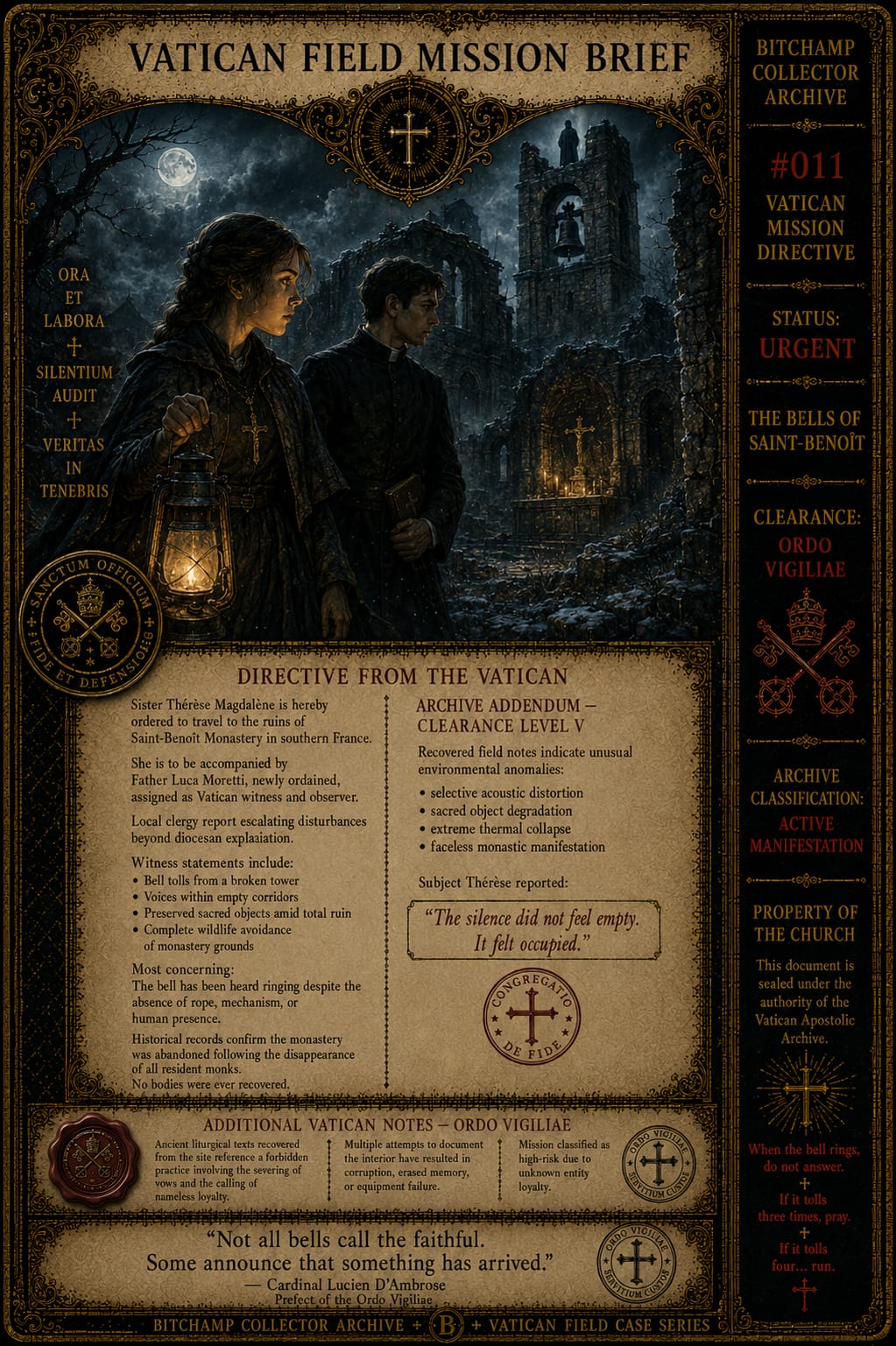
This was not another inquiry. Not another interview. Not another evaluation. It was an assignment. An official mission. I had been ordered to accompany Father Luca Moretti, recently ordained, to the ruins of Saint-Benoît Monastery in the Pyrénées of southern France. Reports of escalating spiritual disturbance had exceeded diocesan explanation. The Diocese of Lourdes had formally requested intervention. My gifts were to be employed without restriction. Father Moretti would serve as witness, aide, and representative of Rome.
One sentence rooted itself in my thoughts and refused to leave.
His presence is as much to observe as it is to support.
I read that line three times. Then folded the letter. Then opened it again. I remained in that pew long after the sisters had departed for morning duties. Gradually, dawn entered the sanctuary through the stained glass, painting fractured blues, reds, and gold across the chapel floor, but I barely registered the shifting colors. My thoughts had narrowed around a single realization.
Palermo was ending. Perhaps not forever. Perhaps not even for long. But the season of quiet preparation—the strange half-life between childhood and vocation—had come to an end. Rome had decided what I was.
Useful. Monsignor Vieri’s voice returned to me with unwelcome clarity.
You are now a weapon in the hand of God.
At seventeen, I still hated that phrase.
Weapons do not choose where they are aimed.
Goodbyes, I discovered, are rarely dramatic. No orchestral music swells. No speeches emerge fully formed from aching hearts. People say practical things because practical things feel safer than grief. Sister Benedetta told me France had terrible bread and insisted I pack extra socks. Lucia hugged me so tightly I thought she might crack a rib. Bishop D’Avanzo embraced me with both arms and whispered a blessing so quietly I only caught fragments of it—mercy, discernment, courage.
Isadora waited until last. She pressed a small cloth pouch into my palm.
Inside were dried lavender petals from the convent garden.
“So you don’t forget home,” she said.
That nearly broke me. Not because the gesture was grand, but because it was small. Great tenderness often hides in small things. People assume gifts are meant to prepare us for what lies ahead, but sometimes the kinder gift is something that anchors us to what we are leaving behind.

Rome moved with brutal efficiency. A black car from the Curia collected me at the airport. There was no ceremonial welcome, no dramatic briefing in candlelit chambers, no hidden corridor full of whispered secrets. Instead there were signatures, identification checks, travel documents, and schedules. The supernatural, I would later learn, often traveled beneath paperwork. Even evil becomes administrative once enough institutions become involved.
I met Father Luca Moretti in a private waiting lounge near our departure gate.
My first impression was immediate and deeply uncharitable.
I disliked him. Not because he was rude. Because he was composed. Too composed. He rose when I entered, tall and lean, with dark hair combed so neatly it felt almost aggressive. His beard was trimmed with mathematical precision. His cassock was immaculate. His shoes reflected light. He carried himself with the quiet discipline of someone who believed emotional leakage was a form of carelessness. But it was his eyes that interested me most.
Sharp. Observant. Guarded. He studied before trusting. That made two of us. “Sister Thérèse Magdalene,” he said.
“Father Moretti.”

His voice surprised me. Warm baritone. Educated. Controlled. No smile followed the greeting, only a polite nod that felt measured rather than cold. Yet I sensed almost immediately that he had already formed opinions about me. It was subtle—the extra half-second of observation, the way his gaze moved not just to my face but to my hands, posture, breathing.
He was evaluating. That suspicion proved correct. The flight to Toulouse passed beneath a sky the color of weathered iron. Rain streaked the aircraft windows in slanted lines while most passengers slept, read, or performed the peculiar ritual of collectively ignoring one another that modern travel seems to demand. Moretti spent nearly the entire flight writing in a small black notebook. He wrote with extraordinary concentration, every movement economical and deliberate, as though even handwriting required discipline.
At first I ignored him. By the second hour, the notebook irritated me.
By the third, I wanted to ask whether he was documenting cloud formations.
I resisted. Barely. A driver met us in Toulouse and loaded our luggage without conversation. Before starting the car, he handed Moretti a sealed note and waited while he read it. Whatever the contents were, they did not improve his mood.
The driver finally spoke in heavily accented Italian.
“Locals do not go near Saint-Benoît after dark.”
Then he crossed himself. That interested me more than the warning.
Words can lie. Bodies rarely do. The drive into the Pyrénées took hours.
Pines thickened around the road. Villages became sparse. Civilization gradually surrendered to rock, forest, and mist. The higher we climbed, the quieter the world became. Even the engine sounded muted, as though the mountains absorbed noise before it could fully form.
Moretti finally broke the silence during our third hour.
“May I ask you something, Sister?”
His tone was formal but careful, the tone of a man who disliked asking questions without first determining whether they deserved asking.
“Of course.”
He closed the notebook. “Do you feel something when… something is near?”
I turned toward the window. “Define something, Father.”
His jaw tightened slightly. “You know what I mean.”
I allowed myself a small smile. “It isn’t exactly a feeling,” I said. “Not in the emotional sense. It’s more like a distortion. Cold in places that should be warm. Familiar words spoken wrong. The sensation of being watched through glass you cannot see. Sometimes rooms feel subtly misaligned, as though reality has shifted a fraction of an inch off center.”
He listened without interruption. “That’s usually when I know.”
He absorbed that quietly before opening the notebook again.
I sighed. “You don’t believe me.”
He paused. Interesting. He did not deny it immediately. “I believe in God,” he said at last. “I believe what the Church teaches. But I also believe human perception is fragile. Fear persuades. Suggestion persuades. Trauma persuades.”
“And blood?” I asked.
He looked at me. “When a child’s eyes turn black during a rosary? When a woman speaks a language she never learned? When sacred objects rot inside locked rooms?”
His gaze held mine. Silence stretched between us. Then he answered. “Then I pray harder.”
I laughed before I could stop myself.
He frowned. “Was that amusing?”
“A little.”
“Why?”
“Because that may be the most honest answer a priest has ever given me.”
Something changed in his expression then. Not warmth. Not trust. But curiosity. That mattered. By late afternoon we reached the old road to Saint-Benoît.
The monastery appeared gradually through fog, revealing itself in fragments rather than form. First the bell tower emerged, jagged against the gray sky like a broken finger pointing nowhere merciful. Then rooftops appeared beneath it, their angles warped by time and collapse. Finally the shattered rose window came into view, its fractured geometry resembling an eye that had been violently blinded yet somehow still watched.
Even from a distance, something felt wrong.
Not ruined. Preserved in ruin. Like decay itself had stopped progressing. The driver stopped far from the gates.
“I go no farther.”
Moretti frowned. “We still have half a kilometer.”
The driver crossed himself again. “Yes.”
That ended discussion. The air changed the moment my boots touched the ground.

Not colder. Not warmer. Wrong. That is the closest word I can offer.
Silence surrounded us, but not ordinary silence. There were no birds in the trees. No insects in the grass. No rustling wind despite the cloud movement above. It felt less like the absence of sound and more like sound itself had been denied entry.
Moretti noticed it too. I saw it in the way his posture changed—subtle, but unmistakable.
“The locals avoid this place.”
“Yes.”
“Animals?”
I looked toward the lower hillside. A flock of sheep grazed in the distance.
None approached the path. “Animals too.”
He followed my gaze, then studied the hill itself.
The grass nearest the monastery grew in unnaturally straight lines, flattened in narrow repeating bands as though something passed there regularly without leaving footprints.
“What happened here?” he asked.
I kept my eyes on the monastery.
“The last monks were slaughtered during the Revolution. Some claimed they practiced forbidden rites in the weeks before the attack. Others believed frightened villagers invented those accusations to justify murder.”
He swallowed. “The bodies?”
I felt the cold before answering. “They were never found.”
We walked the remaining distance in silence, not because conversation had ended but because the landscape itself discouraged speech. Each step toward Saint-Benoît brought with it an increasingly unnatural sensation, as though the monastery exerted pressure before we had even crossed its threshold. I became aware of my own breathing in uncomfortable detail, of the friction of fabric at my wrists, of the faint creak of leather from my travel bag. Ordinary sounds felt strangely amplified inside my body while the world outside us remained muted, and that imbalance unsettled me more than overt menace might have.
Moretti seemed to feel it as well, though his training made him reluctant to admit discomfort too quickly. He slowed once near the rusted gate and crouched beside one of the flattened bands in the grass, studying it with the analytical focus of a scholar examining an artifact. His fingers hovered above the bent blades without touching them, and I noticed his hesitation before contact. That hesitation told me something important. Skepticism often presents itself as confidence, but real skepticism becomes cautious when evidence resists explanation.
“This isn’t wind damage,” he said quietly, rising again. “It’s too uniform.”
“No,” I replied. “It isn’t.”
He glanced toward me. “You already knew.”
“I suspected.”
“That is not the same thing.”
I looked back toward the monastery. “In my experience, Father, suspicion is often simply knowledge arriving before proof.”
He considered that answer for several seconds without responding. I noticed then that his relationship to silence differed from mine. My silence had grown from years of listening for things others could not hear. His silence came from deliberation. He weighed words before spending them, as though each sentence required justification. That trait initially struck me as cold. In time, I would understand it differently.
The rusted gates groaned when we pushed them open, and the sound seemed grotesquely loud against the oppressive quiet. Even that metallic cry behaved strangely, echoing only once before being swallowed by the air. I had encountered places before where acoustics felt distorted, but Saint-Benoît produced something more troubling than distortion. It felt selective. Certain sounds survived. Others disappeared almost instantly, as though the monastery were deciding what it wished to keep.
The smell hit me the moment we crossed the threshold.
Frankincense. Old wine. Wet stone. And beneath it all, something metallic and intimate that no amount of prayer ever fully disguises.
Blood memory. Moretti stopped beside me so abruptly that our shoulders nearly touched. I felt him inhale again, sharper this time, as if trying to convince himself the first impression had been mistaken. His composure held, but I saw the subtle tension gathering in his jaw.
“You smell that.”
It was not phrased as a question.
I turned toward him slowly. So he smelled it too. That mattered. It is a strange thing to feel relief when someone else confirms something terrible, yet anyone who has lived with unshared perception understands the instinct. Validation does not make horror smaller, but it does make solitude lighter.
“Yes,” I said.
He scanned the courtyard. “Incense.” “And iron.”
His eyes narrowed. “Blood?”
“Something remembers blood here.”
The courtyard had once been beautiful. I could see that immediately. Even beneath ruin, architecture preserves intention. Cloisters framed a central stone well. Broken archways still suggested symmetry. Ivy had climbed the outer walls in thick twisting veins, reclaiming masonry with patient indifference. Rainwater pooled in shallow depressions where monks had once walked in prayerful procession. The monastery had not simply decayed. It had been overtaken by a slow, watchful persistence.

What unsettled me most was not the damage.
It was the order. Ruins usually carry randomness—collapsed beams, scattered stone, debris shaped by gravity and weather. Saint-Benoît felt curated. Destruction existed, certainly, but it had settled into patterns almost too coherent to be accidental. Fallen stones formed lines. Broken wood rested at improbable angles. Even the ivy seemed to avoid certain walls while aggressively claiming others. The entire place carried the unnerving impression of having arranged itself.
Moretti noticed the altar before I did.
Inside the main chapel, dust coated pews, moss climbed the lower walls, and frescoes peeled like weathered skin from plaster. Time had worked thoroughly upon nearly everything visible. Yet at the far end of the sanctuary, beneath the broken remains of the rose window, stood an altar untouched by decay.
Clean. Not merely less dirty. Clean. Fresh candles stood upright in brass holders polished recently enough to reflect ambient light. A Bible rested open at the center, its pages crisp, unwarped by moisture, untouched by mildew. Even the altar cloth appeared recently replaced.
I felt cold move beneath my skin.
Not weather. Recognition. Something here understood symbolism. That made it worse. Moretti stepped toward the altar with measured caution. “Someone has been here.”
“Yes.”
“Recently.”
“Yes.”
His gaze moved to the open Bible.
“Revelation.”
The word lingered between us. Neither of us commented further. Some books announce intent more loudly than others.

We established camp in the old dormitory wing before sunset. The room we chose retained enough structural integrity to trust for one night, though barely. Cracked stone walls leaned inward with the exhausted posture of age. Half the ceiling remained intact. The floor sloped slightly toward the eastern wall, forcing us to position our bedrolls carefully to avoid sliding in our sleep. Dust covered nearly every surface, yet here too I noticed signs of disturbance—clean streaks where something had passed repeatedly over stone.
We unpacked with the quiet efficiency of people trained for unpleasant contingencies.
Travel kits. Holy water. Salt. Oil. Blessed beads. Portable crucifix. Ritual texts. Moretti arranged everything with precise order, each item placed according to function and likely need. I watched him while pretending not to. There was something deeply revealing about how a person prepared for crisis. Panic creates clutter. Discipline creates systems. Moretti’s systems were excellent.
He noticed me watching. “You disapprove?”
“Of what?”
“My organization.”
I almost smiled. “No. I’m surprised.”
“By?”
“You pack like a surgeon.”
His mouth twitched. It was not quite a smile. “Order improves survival.”
That answer told me far more than he intended.
“Who taught you that?” I asked.
He paused while tightening the cap on a vial of blessed oil.
“My father.”
The brevity of the response made clear the subject was closed.
Interesting. Noted. Dusk arrived faster than expected. The gray light outside drained gradually from the broken windows until stone and shadow became increasingly difficult to separate. We lit two lamps, though their glow felt weak against the darkness gathering beyond the dormitory entrance. The monastery absorbed warmth unnaturally fast. Within minutes, visible breath drifted before us despite our layered clothing.
Moretti finally broke the silence. “You’re expecting something tonight.”
I finished stringing blessed beads across the doorway and turned toward him.
“Preparing.”
“That sounds evasive.”
“It’s a distinction.”
He folded his arms. “How?”
I leaned lightly against the wall. “Expectation creates assumptions. Preparation accepts uncertainty.”
He studied me. “And if nothing happens?”
“That would be ideal.”
“You don’t sound convinced.”
“I rarely trust ideal outcomes in cursed monasteries.”

That earned the smallest visible reaction from him.
Not laughter. But something close. He stepped nearer the doorway and looked into the corridor beyond, where darkness had thickened into nearly solid black.
“If something does happen,” he said, “how do we know it’s real?”
The question was more sincere now. Less academic. Less theoretical. I answered carefully. “Because it won’t want us to know.”
He frowned. “That sounds paradoxical.”
“It is.”
He turned fully toward me. “I thought exorcists were supposed to be rational.”
“I’m not an exorcist.”
“Then what are you?”
The question landed with unusual weight. Wind moved faintly somewhere high in the broken structure, producing a low tonal hum through fractured stone.
I chose honesty. “A mirror.”
His brow furrowed. “What does that mean?”
I looked past him into the darkness.
“It means what hides in darkness eventually reveals itself around me—not because I force it, but because reflection is intolerable to things built on deception. Evil prefers distortion. It thrives in misdirection. But mirrors are cruel. They offer no negotiation.”
He was silent for a long while.
When he finally spoke, his voice had softened.
“Then I hope you’re not afraid of mirrors.”
The words unsettled me. Not because they were hostile. Because they sounded like warning. Night settled completely. The hours between dusk and midnight passed with agonizing normalcy. That is often how such places work. True terror rarely begins with spectacle. It begins with waiting. Waiting corrodes confidence more efficiently than violence because the mind cannot sustain heightened vigilance forever. Fatigue becomes its own vulnerability.
We took turns reading scripture aloud. At first, this served practical and spiritual purpose. Spoken prayer can alter atmosphere, particularly in contaminated spaces. Yet after several hours I noticed something troubling. Sound behaved inconsistently within Saint-Benoît. Certain words carried cleanly through the dormitory. Others seemed dampened, as though absorbed before reaching full volume. When Moretti read from the Gospel of John, every mention of light resonated sharply. Every mention of darkness seemed to lose strength halfway through utterance.
I said nothing. Not yet. At half past midnight, exhaustion began dulling the edges of alertness. Moretti sat at the foot of his bedroll, rosary in one hand and notebook resting beside him, though he had stopped writing some time earlier. His posture remained upright, but fatigue had softened the rigid precision he maintained so carefully. For the first time since meeting him, he looked young.
Not inexperienced. Young. That distinction mattered. I realized then that whatever confidence he projected had likely been forged under enormous expectation. Rome had sent a newly ordained priest into something clearly abnormal. Either they trusted him greatly, or they were testing him as ruthlessly as they had tested me.
Perhaps both. The first sound came so quietly I almost dismissed it.
A footstep. Above us. Not loud. Not dramatic. Just enough weight to disturb old wood.
Moretti’s eyes snapped upward. Our gazes met instantly. Neither of us moved. Another step followed. Slow. Measured. Deliberate. Wood creaked overhead. My pulse dropped rather than rose. Fear sometimes accelerates the heart. Recognition often stills it. There should have been no footsteps. The upper floor had collapsed decades earlier.
The sound crossed directly above our heads with the calm pace of someone walking a familiar hallway. No hurry. No hesitation. Each step carried quiet certainty, as though whatever moved above us had done so many times before.
Then the steps stopped. Silence returned. But it had changed. It no longer felt empty. It felt occupied. The silence pressed against us with an intelligence that was difficult to describe and impossible to ignore. It reminded me of the charged stillness before lightning strikes, when the world seems to hold its breath in anticipation of violent release. My skin tightened beneath my habit, and every instinct sharpened toward the darkness beyond the weak circle of lamplight. Across from me, Moretti had not moved, though the rosary in his hand had gone rigid with tension.
He spoke first, but only barely. “You heard that.”
It was not phrased as a question, yet I understood what lay beneath it. He was not asking whether sound had occurred. He was asking whether reality had just shifted beneath his feet in the same way it had beneath mine. There is a terrible intimacy in shared terror. Two people who witness the impossible together become bound by something language rarely reaches.
“Yes,” I said quietly.
The footsteps did not resume. That somehow made it worse. If something had continued moving, the mind could at least orient itself toward direction and purpose. Stillness offers no such mercy. Stillness invites imagination to do the work, and imagination is often more brutal than truth. I watched Moretti fighting that exact battle in real time. His training urged analysis, but analysis requires data, and Saint-Benoît had begun offering sensation without explanation.
Another thirty seconds passed. Perhaps a minute. Then the bell rang. The first toll exploded through the monastery with such force that dust shook loose from the rafters and drifted through the lamplight like ash. The sound was not merely loud; it was physical. I felt it in my ribs before I fully heard it, as though the vibration had entered bone before reaching the ear. Ancient bronze carries a strange authority when struck, and this bell sounded impossibly old, older than the monastery itself, older than stone should remember.
Moretti flinched despite himself. Not dramatically. Not enough to shame him. But enough. Before either of us could speak, the second toll rolled through the corridors. This strike came deeper, slower, almost deliberate in its cruelty, allowing the first resonance to fade just enough for dread to fully settle before the next impact arrived. Somewhere in the monastery, loose masonry shifted and fell with muted cracks. Yet even those secondary sounds felt distant, as though the bell had become the only sound Saint-Benoît considered worthy of preserving.
By the third toll, the atmosphere had transformed completely.

The air grew heavier. Colder. Denser. Breathing required effort. I became aware of condensation forming along the stone wall beside me, thin veins of moisture crawling downward as though the monastery itself had begun to sweat. The lamps dimmed—not extinguished, but weakened, their flames shrinking inward despite the absence of wind. Shadows lengthened across the dormitory floor until they no longer seemed attached to any logical source of light.
Then silence returned. But it was no longer silence. It was presence. Moretti rose slowly to his feet, every movement controlled by discipline rather than calm. There is an important difference. Calm is emotional stillness. Discipline is action despite emotional chaos. By then I could see the fracture lines forming in his certainty, though to his credit he did not surrender to panic.
“What happens now?” he asked.
His voice remained steady. Barely. I did not answer immediately because something had already drawn my attention toward the doorway.
The blessed beads. They were moving. At first the movement was subtle, almost delicate, a slight tremor running through the strand as if touched by faint vibration. Then the tremor intensified. One bead knocked softly against another. Then another. Soon the entire strand shivered in irregular pulses, the sound small yet grotesquely intimate in the stillness.
Click. Click. Click. Moretti saw it. His face drained of color. “That should not be possible.”
“No,” I said.
“It isn’t touching them.”
“No.”
The beads began to smoke. Thin black threads curled upward from the polished wood, carrying with them the acrid smell of scorching oil and burnt resin. I stepped forward instinctively, holy water already in my hand, while Moretti tightened his grip on the crucifix hanging at his chest. Neither of us spoke. Words had become secondary.
One bead cracked. The sound was tiny. Sharp. Like a knuckle breaking. Another followed. Then another. The strand sagged as tension failed bead by bead, each fracture accompanied by a faint blackening that spread through the wood like infection. The blessing embedded within them was being consumed in real time. I had seen sacred objects corrupted before, but never with such deliberate patience. Whatever stood beyond that doorway was not forcing entry through brute violence.
It was eroding sanctity. That frightened me more. Then I saw it. A shape standing beyond the doorway. Motionless. Human height. Robed. For one irrational second, my mind supplied an explanation born from desperate logic. A monk. A squatter. A trespasser. Someone alive. Someone human. The brain clings to ordinary possibilities long after evidence begins dismantling them.
Then the figure stepped forward into the edge of lamplight.

Not fully. Just enough. Its robes were ancient, though robes was almost too dignified a word for what remained. The fabric hung in layered strips, dark with moisture and age, stitched from material that might once have been ceremonial but had since decayed into something funerary. The hem dragged across stone without sound. Its hands were clasped loosely before it, pale and unnaturally still.
Moretti stopped breathing. I heard it. Or rather, I heard the absence. Then the figure raised its head. I have witnessed possession, corruption, distortion, and manifestations that would challenge the imagination of most theologians. Even now, after decades of confronting horrors both subtle and grotesque, certain images remain impossible to revisit without feeling the old cold return.
That face was one of them. There was no face. No eyes. No nose. No mouth. No features at all. Only smooth pale flesh stretched where identity should have been, seamless and waxen like unfinished sculpture. Yet despite the absence of features, there was no ambiguity in what it conveyed.
It was looking at us. And somehow— impossibly— it was smiling. Not metaphorically. Not impressionistically. I do not know how to explain this without sounding mad, but the absence itself had formed expression. The smoothness where a mouth should have been curved with unmistakable amusement. Something in the flesh shifted subtly, enough for the mind to perceive intention without anatomy.
Moretti staggered back half a step. Not from cowardice. From collapse of framework. That was the moment I saw true terror enter him—not fear of injury, but fear born from epistemological collapse. Everything his rational mind used to interpret reality had just failed simultaneously. The impossible was no longer theoretical. It stood ten feet away and regarded him with faceless delight.
His voice emerged as a whisper. “Dear God…”
The figure moved again. It did not walk. That distinction matters. Walking contains weight transfer, balance, subtle shifts of muscle and intention. This thing advanced without any of those mechanics. One instant it stood beyond the threshold. The next it occupied space closer to us. Movement occurred, but the body did not transition through it in any human way.
The remaining blessed beads snapped. Every one of them. The strand fell to the floor in smoking fragments.
The temperature plunged so violently that frost bloomed across the stone near the doorway, spreading outward in delicate white veins. My breath fogged in thick clouds. The lamps dimmed further until Moretti and I stood inside a failing circle of amber light while darkness pressed inward from every direction.
Then it spoke. Not aloud. Inside us. The voice entered my mind with oily intimacy, bypassing the ear entirely. It was neither male nor female, neither loud nor quiet. It felt old in the way bones feel old.
Two mirrors, it said. A pause. Then amusement. No… one mirror. Its attention shifted. Toward Moretti. The pressure around him changed instantly. I saw it happen. His shoulders locked. His pupils widened. His lips parted without sound. Something had touched him. Not physically. Deeper. The thing tilted its featureless head. And one fracture. I moved. Fast. Not because I fully understood, but because instinct screamed before reason could assemble language. I stepped between Moretti and the entity, raising the crucifix in one hand while the other opened the vial of holy water. My pulse hammered, but training—such as I possessed—held.
“Do not listen,” I said sharply.
Moretti did not respond. His eyes remained fixed. Unblinking. Wrong. The entity leaned slightly forward. Again that impossible smile. And for the first time since entering Saint-Benoît, I understood something dreadful.
It had not been waiting for me.
It had been waiting for him.
— Sister Thérèse Magdalene