THE FIRST BLOOD OF KHAR-DRAVEN
Before Lune Flintborn carried Khar-Draven into the wars of surface kings and broke monsters open beneath skies she never trusted, she was only a daughter of Flintdeep, born under a mountain that did not easily love its children. Flintdeep was not a city in the way humans used the word. It did not sprawl across hills or crown itself with towers or announce its wealth with painted gates. It lived inside the mountain, ribbed with iron bridges and smoke-blackened stairways, its halls descending in rings around a heart of white fire. Market levels rang with barter and insult. Clan halls thundered with argument. The forge levels breathed heat night and day, and below them waited the oath-vaults, ancestor crypts, sealed seams, and older roads where even drunk dwarves lowered their voices.
Lune loved the deeper places best. She liked the pressure of them, the weight of stone overhead, the way silence there had structure. Surface folk thought caves were empty unless filled with echoes, but dwarves knew better, and Lune knew best of all. Granite muttered when stressed. Ironstone hummed near hidden veins. Old basalt brooded under torchlight. New tunnels complained like fresh wounds. Flintdeep itself had a voice beneath all of those smaller voices, slow and vast and difficult to separate from the beating of her own blood. The mountain did not speak in words most days. It spoke in weight, in warning, in the tightening of air before a crack.
The elders called it fancy when she was young. Her brothers called it mountain-dreaming. Her father, Varek Flintborn, said nothing for a long time, which in Flintdeep was not dismissal. A dwarf could bless a child, condemn a king, or end a friendship with silence if he held it properly. Varek held silence like a hammer waiting above hot iron. He was master of the Flintborn forge, broad as a stone door, gray in the beard before his time, and patient only in the dangerous way. Men who mistook patience for softness often learned the difference with fewer teeth than they had owned that morning. When Lune was eight, she placed her palm against the eastern root-tunnel and told a patrol captain not to take his men through it. He laughed because captains are often promoted faster than wisdom can catch them. Ten minutes later, part of the ceiling came down and killed four mules. No soldiers died, which the captain credited to fortune, but afterward he did not laugh near Lune unless someone else started first.
By twelve, she had learned to hide what she heard. Not because she feared the gift, but because people who fear a gift will try to use it before they understand it. Mine-masters wanted her on survey crews. Priest-smiths wanted her tested for sacred geomancy. Her aunt Brunna, who had once taken a hobgoblin axe in the thigh and kept walking until the hobgoblin apologized by dying, wanted Lune trained for war. Varek wanted her in the forge. He won because he was her father, because he was Flintborn, and because he said it without raising his voice. So the forge took her.
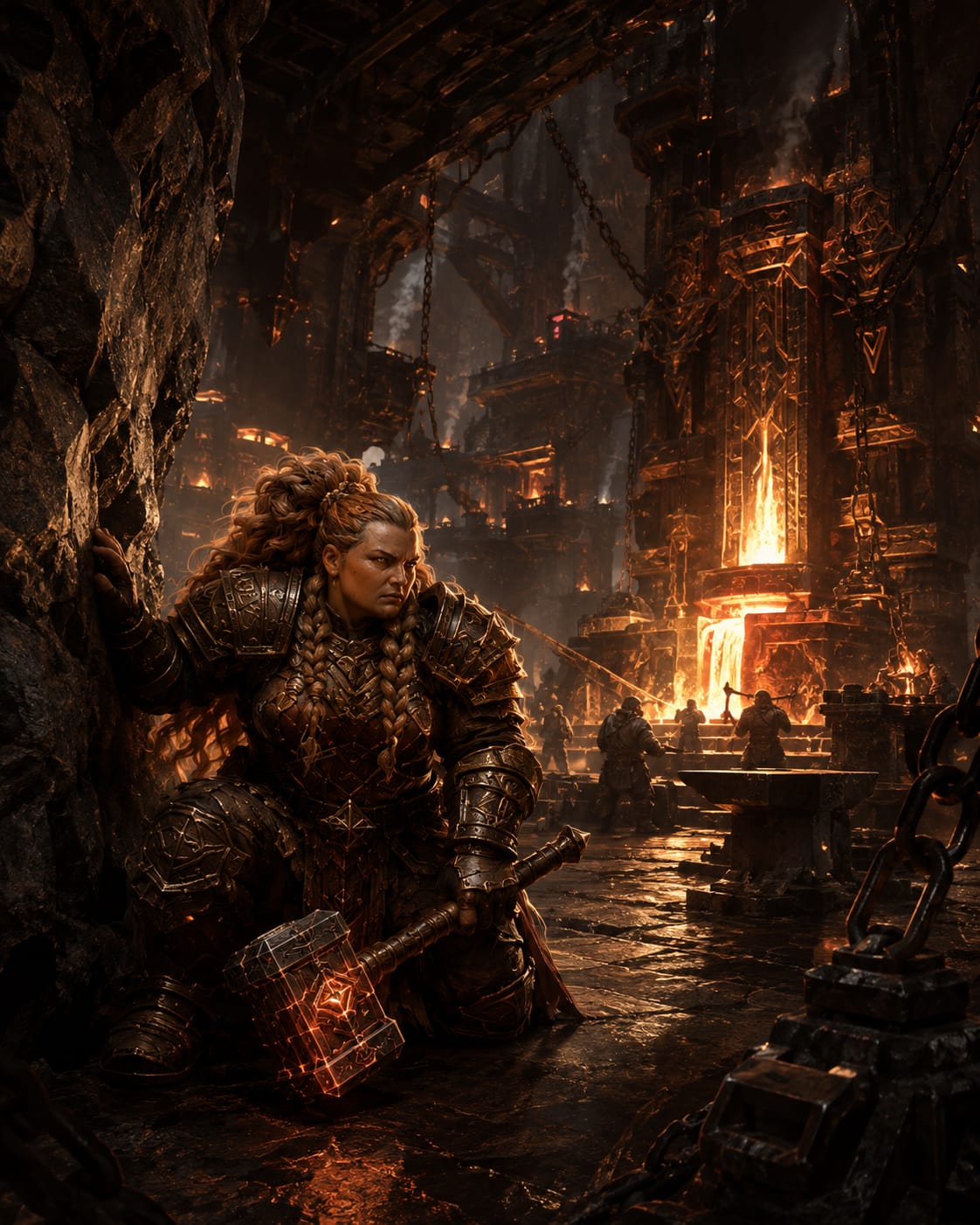
The Flintborn forge was older than the current king, older than the king’s father, older than three human dynasties that had claimed the valleys below and vanished into half-finished songs. Its central hearth burned white-blue, fed by a deep coal seam that had never gone cold in recorded memory. Above the anvil wall hung the tools of Lune’s bloodline: tongs, chisels, rune-picks, shaping hammers, war-hammers, funeral hammers, and one empty space where no tool hung because the thing that belonged there was too sacred to be displayed and too feared to be named casually. Khar-Draven rested below. Not in the forge. Not in the armory. In the Blood Hall.
Every Flintborn child knew the stories. Khar-Draven had been made by the first of their line when Flintdeep was young and the mountain still resented being hollowed. Some said the hammer had been forged from star-iron. Some said from the tooth of a dead earth-god. Lune’s grandmother had said it was made from ordinary iron and terrible promises, which Lune believed more than the prettier lies. Beautiful stories were usually told by people who had not paid for them. The Blood Hammer did not belong to the strongest Flintborn. It belonged to the one the mountain named. That was what the old oaths said. For six generations, the mountain had named no one. The hammer had slept beneath the forge while Flintborns lived, married, fought, drank, buried sons, buried daughters, and pretended a sleeping weapon was the same thing as a harmless one. Lune saw it only once before the night it ruined her life.
She was twelve then, following her father after her uncle Darrum died under a broken hoist chain. Varek carried a shallow stone bowl of his brother’s blood in both hands, the old way, solemn and bareheaded. Lune was meant to wait outside the Blood Hall, but waiting had never been among her talents. She slipped down the stair after him and watched through the gap in the half-open stone door. Khar-Draven lay across a black altar. It was not beautiful. That was the first thing she remembered. Surface legends loved beautiful weapons: shining blades, golden hafts, jewels set into pommels like frozen vanity. Khar-Draven had none of that. It was squat, brutal, dark iron from head to haft, with a square striking face on one side and a hooked beak on the other. Runes ran across it like old scars. The grip was wrapped in something too black to be leather and too dull to be metal. It looked less like a weapon than a verdict.
Varek poured Darrum’s blood into the groove around the altar. The hammer did not move. It did not glow. It did not honor the dead with even the smallest tremor. But the stone beneath Lune’s feet whispered. Not yet. She stumbled backward so hard she cracked her elbow against the stair. Varek found her there and looked at her for a long time. He did not scold her. He did not ask what she had heard. He only closed the Blood Hall door and said, “When the mountain speaks, child, do not answer too quickly.” That was the closest he ever came to admitting he heard it too.
The years after that hardened Lune’s hands and narrowed her patience. She learned rune-etching, tempering by color, ore-reading by smell, and the difficult art of not striking idiots simply because they were available. She was not the strongest apprentice in the forge, nor the fastest, nor the loudest. She was, however, the only one who could tell when metal wanted one more breath in the coals before the quench. She could feel flaws inside a blade before they opened. She could hear when an ingot had been poorly mined, badly smelted, or cursed by a man who did not wash before touching good iron. That made Varek proud. It made everyone else uneasy. Uneasy people look for reasons to be right. They found one in the lower seam.
The discovery came in winter, when snow sealed the upper passes and the city turned inward around its fires. A mining crew under Master Odrik broke through a wall of pale stone below the fifth root-level and found an ore vein no survey map had promised. It was black with silver threads running through it, hard enough to ruin two pick-heads and bright enough under lantern flame to make greedy men forget superstition. They called it crown-iron before any smith had tested it, because naming a thing richly is the first step toward selling it. Lune called it wrong. She said so in the survey hall with soot still under her fingernails and half the mine council staring down from the speaking benches. Odrik had brought up a fist-sized chunk of the ore for display. It sat on the table between them, glossy and dark, silver veins shimmering under lamp flame like nerves beneath thin skin. The moment Lune entered the room, the stone under her boots tightened. “That seam should be closed,” she said. Odrik snorted. “Based on what?”
Lune stared at the ore. The longer she looked at it, the more certain she became that it was not waiting to be shaped. It was waiting to be opened. “Based on the mountain telling me it is not ore.” Several men smiled. A few laughed outright. “Then what is it?” Odrik asked. Lune looked toward the floor because the warning had become a slow ache in her teeth. “A scab.” The laughter came quickly after that. Laughter always does when fear needs a mask. Odrik laughed loudest, slapping the bench in front of him with one thick hand while the council exchanged relieved glances. It was easier to make a young woman dramatic than to make a mine unprofitable. It was easier to dismiss a warning than refund a king’s steward, who had already begun calculating tax on wealth not yet safely born. Varek did not laugh. Brunna, standing with her arms crossed near the door, did not laugh either. But two silent Flintborns were not enough to stop a hungry mine. The lower seam opened three days later.

At first, nothing happened. That was the worst of it. Disaster rarely has the courtesy to prove the fearful wise at once. For eight days the miners cut crown-iron from the deep rock and carted it upward under guard. For eight days forge-masters argued over purity, merchants argued over worth, and the king’s steward sent polite inquiries that smelled strongly of ownership. Flintdeep grew busy with hope. Hope makes more noise than caution. It fills halls, warms taverns, loosens tongues, and makes careful men impatient with the old rules that kept them alive. Lune stopped sleeping. The mountain had gone quiet. Not peaceful. Quiet. On the ninth night, the deep bells rang. Lune sat up in darkness before she understood what had woken her. These were not the upper hall bells that called assembly, nor the market bells that announced fires, births, or brawls in taverns that would later become songs if enough chairs were broken. These were the deep bells, iron-throated and ugly, rung only when something below the living city had gone wrong.
The stone beneath her bed whispered one word. Now. She was moving before thought caught up. Boots. Belt. Work tunic. Axe from the wall, because the hammer she wanted was buried under oath and stone. When she reached the corridor, others were already running, some armored, some half-dressed, some carrying children upward toward the safer halls. Smoke moved along the ceiling, not black but gray-white and mineral bitter, as if stone itself had been ground into breath. Varek found her at the stair to the lower forge. He wore his old war harness, the one he had not buckled since the Orc Years, and he carried a shield with fresh straps. Armor made him look older. Not weaker. Never that. Only carved into the shape of memory. “Go up,” he said. “No.” “This is not forge work.” “It is Flintborn work.” That stopped him for half a breath.
KHAR-DRAVEN DOES NOT WAKE FOR GLORY.
TRUE FLINTBORN LISTEN WHEN STONE SPEAKS.
Behind him, Brunna came limping down the stairs with two axes across her back and murder already arranged on her face. “Let the girl come,” she said. “If we all die, she can say she was right while doing it.” Varek’s mouth twitched once. That was all the blessing Lune got. The three of them descended. The lower levels had become chaos. Men came upward bleeding and white-eyed. One had no hand and did not seem to understand it yet, staring at the red fountain from his wrist as if waiting for someone to explain the missing part. Another dragged half a shield behind him with the arm still strapped inside, though not his own. Somewhere below, something screamed in a voice that began as stone grinding and ended as a woman begging to be put back in the wall. Lune had heard men die before. She had heard cave-ins, furnace bursts, the wet crack of bad luck in a working hall. This was different. This was the mountain being entered by something that hated being born.
They found the first creature at the third landing. It had once been a miner. Lune recognized the belt buckle, the beard rings, the burned patch on one sleeve where forge sparks had caught two weeks prior. But the body had split open along seams that no body should possess. Silver-black mineral threaded through his skin like veins of ore. His jaw hung loose, stretched by growths pushing from inside. One eye had hardened into a milky stone marble. The other looked at them with enough remaining terror to prove something of the man was still trapped in there. Varek said his name softly. The thing lunged. Brunna took its legs out with one axe. Varek met the falling body with his shield. Lune brought her axe down into the back of its neck, and the blade stuck in flesh that had gone gritty and hard. The creature thrashed, screaming through a throat full of gravel. Varek pinned it. Brunna buried her second axe in its skull. Black fluid ran out across the stair. It steamed where it touched stone.
Lune stared at it and felt the mountain recoil. “How many?” she asked. No one answered. Below them, the deep bells stopped. The silence that followed was worse.
They fought down through two more landings. The creatures came first as ruined miners and then as things that had never been dwarves at all. Pale shapes crawled from cracks in the cut walls, long-limbed and jointed wrong, their bodies crusted with the same silver-black mineral. They had faces like unfinished masks and mouths that opened vertically, splitting their heads from chin to brow. When they bit, they did not tear flesh cleanly. They ground it. The first guard they caught lost half his face in a single chewing crush. He stumbled backward screaming through the ruin of his cheek, blood and teeth spraying over his beard while one eye rolled wildly above the torn meat. Brunna stepped past him, drove both axes into the creature’s neck, and kicked it into a mine shaft. It fell with a clattering shriek that went on long after it should have hit bottom. “I hate new things,” Brunna growled. Varek shoved Lune behind him as another pale shape came across the ceiling. “Then stop letting them meet you.”
Lune should have been only afraid. She was afraid, certainly. Fear had filled her mouth with metal and made the haft of her axe slick under her palms. But beneath the fear was something hotter, something that did not shake. Anger. Not merely at the creatures, and not even at Odrik or the council, though she had room enough in her heart to hate them properly later. She was angry at the wound. Angry that warnings had been weighed against profit and found inconvenient. Angry that Flintdeep, loud and stubborn and imperfect and beloved, could be taken from below like a sleeping animal dragged from its den. The mountain felt her anger. For the first time in her life, it answered with the same. The wall to her right cracked from floor to ceiling. Varek looked at her. “Not me,” she said. He almost believed her. They reached the lower seam and found ruin.
The crown-iron chamber had become a slaughter pit. Lanterns swung from chains, throwing wild light over overturned carts, broken picks, dead miners, dead guards, and things moving among them with patient hunger. The wall of ore had opened like a mouth. Beyond it was not a tunnel. It was a black hollow veined with silver light, descending farther than any lawful mine shaft, pulsing faintly as if something beneath the world had a heart. Master Odrik was pinned to the far wall by a spike of crown-iron through his belly. He was still alive. His beard was soaked red to the chest. His hands gripped the spike as if he could pull himself free by being ashamed enough. When he saw Lune, he laughed once, and blood jumped from his mouth. “Scab,” he said.
Then something inside the wall pulled him backward. The spike vanished with him. Odrik folded through the opening in pieces, shoulders breaking, ribs collapsing, one leg catching sideways until the hip tore with a wet pop that made Lune’s stomach twist. She heard bones break in sequence, like a butcher snapping kindling behind a curtain. Varek shouted her name, but the warning came too late. A huge shape surged from the hollow, not crawling like the others but unfolding. It had four arms, shoulders ridged in black mineral, and a head crowned with antler-like growths of crown-iron. Its chest split open as it moved, showing no organs, only grinding stone plates slick with blood and crushed beard hair. Three dead miners hung half-absorbed into its torso, their mouths still moving soundlessly. Brunna charged first, of course.

She struck low, both axes biting into the thing’s forward knee. The creature staggered but did not fall. One of its arms came down and smashed her into the floor so hard the stone cracked around her body. Lune heard her aunt’s spine break. Heard armor flatten. Heard the breath leave Brunna in one wet bark. Varek roared and hit the thing with shield and hammer. For eleven heartbeats, Lune saw her father become young again. He drove the creature backward with blows that would have killed anything made by sane gods. His hammer broke stone from its ribs. His shield shattered one of its hands. He struck the crown of its head and split a silver-black horn from the skull. It screamed, and the scream loosened stones from the ceiling. Then the wall behind him opened.
A smaller creature slid out, fast and silent, and drove both claws through Varek’s back. The points burst from his chest. Lune stopped breathing. Varek looked down at the claws, offended more than surprised, then turned his head just enough to find his daughter through the smoke and dust. “Blood Hall,” he said. The creature lifted him. Lune screamed, and the mountain screamed with her. The ceiling above the smaller creature collapsed in a jagged spear of stone, crushing it flat and ripping the claws out through Varek’s chest in a red spray. He fell hard. Lune ran to him, slipping in blood, dropping her axe, catching his head before it struck the floor a second time. He was too heavy. He had always been too heavy. “No,” she said. Varek’s eyes moved over her face. There was so much blood coming out of him that for one terrible moment she hated his body for being unable to keep what made him alive. “Do not answer too quickly,” he whispered. Then he died. The mountain went silent.
And from far below, beneath forge, mine, crypt, and oath-vault, something old began to wake.
Lune did not remember climbing back toward the forge. Memory came in fragments after that: her father’s blood on her hands, Brunna coughing once where she should have been dead and then going still forever, guards shouting from somewhere behind her, pale things screaming, stone breaking, her own boots hitting stairs, her breath coming ragged and animal. She remembered the feeling that the whole mountain had turned its attention toward her at last. She reached the Blood Hall alone. The door was sealed by a round stone lock carved with Flintborn names. Lune had no key. She had no council writ. She had no elder with her to speak the opening oath. She had blood. She placed both hands on the lock. Varek’s blood filled the grooves. For one dreadful instant nothing happened. Then the lock drank. The stone door groaned inward.
Lune stepped into the chamber she had first seen as a child and found Khar-Draven waiting exactly where it had waited for six generations. The black altar. The blood groove. The brutal square head. The runes like scars across dark iron. The hammer did not glow. It did not sing. It did not rise for her in some courtly display of destiny. It lay there, heavy and indifferent. She hated it for that. She crossed the chamber and gripped the haft. Nothing happened. She pulled, and the hammer did not move. Lune planted one boot against the altar and pulled harder. Pain shot through her shoulders. Her palms slipped on blood. The muscles in her back screamed. Still Khar-Draven remained exactly where it was, as though all the desperation in the world did not weigh enough to interest it. “Wake up,” she said. The hammer ignored her.

Below, Flintdeep shook. Dust sifted from the ceiling. Somewhere in the halls above, people were dying. Somewhere in the lower seam, the breach widened. Somewhere her father’s body cooled on broken stone while things from beneath the world stepped over him into the city he had spent his life protecting. Lune tightened both hands around the haft until her fingers cramped. “Wake up.” Silence. Then she remembered the old stories. The Blood Hammer did not belong to the strongest Flintborn. It belonged to the one the mountain named. Lune looked at the dried groove around the altar. She looked at the blood on her hands, her father’s blood already darkening in the runes. Then she looked down at herself and understood something so simple that it felt cruel. Borrowed blood had opened the door. But it would not wake the weapon. Not all the way.
Lune drew her belt knife. She pressed the blade across her palm. For the first time that night, she hesitated. There are pains a person meets by accident and pains a person chooses. The chosen ones ask questions. They want to know who you are without the mercy of surprise. Lune closed her hand around the knife and cut deep. Blood welled bright between her fingers. She smeared it across Khar-Draven’s grip. The hammer inhaled. Not literally. Not with lungs. But the entire chamber drew tight around that first taste of living Flintborn blood. The runes along the hammer’s head filled slowly with a dark red light. The altar beneath it cracked. The walls answered with a low tone that pressed against Lune’s teeth and made the blood in her ears pulse in rhythm. A voice moved through the stone. When she was a child, it had said, Not yet. When the bells rang, it had said, Now. This time it said: Name the debt.
Lune’s bleeding hand closed around the haft. She thought of Varek’s eyes, Brunna crushed into the floor, Odrik folded into the wall, the guard missing half his face, Flintdeep above, full of children and cowards and fools and good people who had no idea how close the dark had come to their beds. “All of it,” Lune said. Khar-Draven came free.

It should have been too heavy. That was Lune’s first thought. The hammer was larger than anything she had trained with, dense beyond reason, made for ancestors whose bones had probably been exaggerated by song. Yet when it lifted, it did not feel light. It felt correct. It pulled her shoulder down, dragged her stance wider, changed the shape of her breathing. It did not become part of her. It made room for itself and expected her to adapt. The first creature met her outside the Blood Hall. It had the shape of a dwarf but no face left, only a vertical seam full of silver teeth. It came at her on all fours, claws throwing sparks off the stone. Lune swung badly. Too wide, too angry, no form at all. Khar-Draven corrected the blow. The hammer twisted her wrists mid-swing and dropped into the creature’s skull with a sound like a melon struck by a door. The head vanished into the neck. Black fluid burst across the floor and steamed against Lune’s boots. The body collapsed, legs kicking twice.
The hammer drank the blood through the stone. Lune felt it. A hot thread ran from the floor into the hammer, from the hammer into her hands, from her hands into her bones. Strength followed. Not clean strength. Not heroic strength. Something older and uglier, earned through impact and payment. She descended. Every creature between the Blood Hall and the lower seam learned the same lesson in a different shape. Khar-Draven did not cut. It ended arguments. One pale thing leapt from the ceiling and she smashed it sideways into the wall, leaving a burst pattern of black blood and broken limbs. Another came through a side arch with two dead guards hanging from its arms, and Lune hooked the hammer’s beaked end into its chest seam and tore it open. The guards fell out in pieces. The creature shrieked until she drove the square face through its mouth and out the back of its head.
She was hit again and again. Claws opened her cheek. Teeth tore into her shoulder. A spike of crown-iron punched through her thigh and scraped bone. Every wound should have slowed her. Instead, every drop of her blood that struck Khar-Draven made the runes burn brighter. Lune understood then why the hammer had been hidden. Not because it was too sacred. Because it was too willing. By the time she reached the lower seam, she was red to the elbows and laughing without joy. The chamber had changed while she was gone. The breach had widened into an open throat. The great four-armed thing stood in the center of the ruin, surrounded by lesser shapes. Behind it, the black hollow pulsed with silver veins, and beyond that pulse Lune saw movement too large to understand. Not one creature. Not a swarm. A depth full of things waiting for the wound to open wide enough. Varek’s body lay where he had fallen. Something had eaten his left arm.
That was the moment Lune Flintborn stopped being afraid of what the hammer might cost her. She walked into the chamber and struck the floor. The stone answered. A shockwave ripped outward in a red-black ring, cracking the chamber floor and throwing the nearest creatures from their feet. One landed against a mining cart and split open from hip to throat. Another was crushed beneath falling stone as the ceiling responded to the hammer’s command. The rest screamed and came at her. Lune met them in the blood.
Afterward, no song ever agreed on how many she killed. The smallest number was twelve. The honest number was that no one had enough courage to count. She moved like a cave-in given temper. The hammer rose and fell, each blow changing the room. Bones broke. Stone shattered. Black blood steamed. A creature wrapped both arms around her from behind and bit into the side of her neck. Lune screamed, drove herself backward into a wall, and felt ribs snap behind her. She turned, dragged the thing over her shoulder, and brought Khar-Draven down until its skull became dark paste in the floor cracks. The four-armed thing watched. Then it came for her.
Their first collision broke Lune’s shield arm. She did not have a shield, but that was how the pain felt: as if something invisible had been strapped to her and shattered. One of the creature’s fists caught her across the side and sent her skidding through blood and gravel. She struck a fallen beam hard enough to white out the world. For a moment, she heard only ringing. Then the mountain spoke. Up. Lune rolled as the creature’s foot came down where her head had been. Khar-Draven dragged her upright. She swung at the knee Brunna had damaged earlier. The hammer struck the cracked joint and drove broken stone inward. The creature roared, staggering. Lune swung again, into the same wound. The leg buckled. The chamber shook when the monster dropped to one side. It caught her with another arm and squeezed. Her ribs began to bend.
The pain was immediate and absolute. Breath fled her. Black spots opened in her sight. The creature lifted her toward the split in its chest, toward the grinding plates inside where pieces of dead miners still twitched. Lune jammed Khar-Draven sideways between herself and the creature’s chest. The hammer’s runes flared. The plates inside the monster stopped grinding. Name the debt, the stone demanded. Lune could barely breathe. Blood ran from her mouth. Her broken arm hung useless. The creature’s grip tightened, and something inside her torso made a wet clicking sound. She looked past the monster at the breach. She looked at her father’s body. Then she understood what the hammer wanted. Not rage. Not revenge. An oath. “By Flintdeep,” she choked. The hammer grew hotter. “By the blood under this mountain.” The chamber floor began to glow beneath the spilled dead. “By every Flintborn before me.” The creature screamed and tried to throw her away, but Khar-Draven had hooked into its chest and would not release. “By every Flintborn left.”
Lune drove her forehead against the hammer’s haft and pushed the last of her breath into the words. “Close.” Khar-Draven answered. Every drop of Flintborn blood in the chamber ignited. Varek’s blood. Brunna’s blood. Lune’s blood. The old stains in the stone beneath the forge. The ceremonial grooves in the Blood Hall. The buried memory of ancestors whose names had been carved into door locks and funeral slabs. It all woke at once, running through the mountain like fire through a root system. The hammer punched through the creature’s chest. Not with Lune’s strength. With the mountain’s. The four-armed thing split backward from sternum to spine. Its body opened around the blow in a burst of black fluid, silver shards, and compressed screams. The dead miners trapped in its torso fell out in pieces. Its upper arms thrashed. One struck Lune across the face and tore her cheek open to the teeth. She held on.

The breach behind it convulsed. Things inside the hollow began to shriek. The chamber floor rose. Stone moved like water, folding upward in slabs around the black opening. Crown-iron screamed as it bent. The ore vein that had looked so rich, so promising, so harmless under lantern light twisted back into itself and sealed like a wound cauterized by an angry god. Lune fell to one knee. Khar-Draven remained embedded in the dying creature. The monster reached for her with one remaining hand. She met it with her broken arm. Not to block. To offer. The creature’s claws closed around her forearm and crushed it. Bone broke through skin. Pain detonated up to her shoulder. Lune screamed, but the scream became part of the hammer’s work. Blood poured down her wrist and into the runes. Khar-Draven drank. The final stone slab slammed shut over the breach. The shock threw Lune backward. Darkness took the chamber. For a while there was no battle. No bells. No screaming. Only the drip of blood and the slow settling of stone.
Lune woke beneath bodies. Some were creatures. Some were dwarves. One was Brunna, whose dead hand had somehow ended up gripping Lune’s ankle as if refusing to let the girl go alone. Lune pushed free with one arm and a sound that was not quite sobbing. Her broken forearm had swollen grotesquely. Her cheek hung open. One eye was nearly sealed. She could taste blood, stone dust, and something bitter from the black fluid drying on her lips. Khar-Draven lay beside her. Quiet again. But not sleeping. Never sleeping. She crawled first to Brunna, then to Varek. There was no dignity left to give him. The dead are often robbed of dignity by the manner of their leaving. Lune cleaned what blood she could from his face with the edge of her sleeve and pressed her forehead to his. “I answered,” she whispered. The mountain did not reply. That was mercy.
When the rescue party finally reached the lower seam, they found Lune sitting against the sealed wall with Khar-Draven across her lap and dead things piled in a half-circle around her. Three guards raised crossbows before they realized what she was. One vomited into his beard. Another began praying in a voice too high for pride. The king’s steward arrived an hour later and called her blessed. The priest-smiths called her chosen. The surviving soldiers called her savior. Lune said nothing. She watched them carry Varek away. She watched them lift Brunna with both axes still strapped to her back. She watched Odrik’s apprentices search for pieces of him and find enough to fill a bucket. She watched the council stare at the sealed breach and make the faces of men already preparing explanations that would preserve their authority. That was when Lune understood that she had not saved Flintdeep cleanly. There are no clean salvations. Only survivals people polish later.
They brought her to the upper healing hall at dawn. She should have been carried, but she walked. No one tried to take Khar-Draven from her. That was the first sign her life had changed. The second came when the elders entered her chamber three days later wearing formal chains and funeral faces. They spoke of honor. They spoke of bloodline. They spoke of duty in the careful tones people use when asking someone wounded to become useful again before she has finished bleeding. Lune listened until they were done. Then she asked how many had died. No one answered quickly. That was answer enough. After they left, she sat alone with the hammer across her knees. Her arm had been set badly because there was no way to set it well. Her cheek had been stitched from jaw to ear. Her ribs ached whenever she breathed. The healers said she would live, but they said it with the cautious optimism of people who understood survival was not the same as restoration. Khar-Draven was dark again. Ugly again. Waiting again.
Lune rested her good hand on the haft. For the first time since the breach closed, the mountain spoke clearly. Not chosen because worthy. Lune closed her eyes. The words moved through her bones. Chosen because blood is running out. She wanted to weep then, but grief had become too large for tears. It sat inside her like another mountain, black-rooted and immovable. So she did what Flintborns did when grief exceeded the body. She made an oath. “Then I will spend it slowly,” she said. The hammer warmed beneath her palm.

Years later, when surface kings whispered her name before battles and monsters turned from the sound of Khar-Draven striking stone, they would call that night the Awakening of the Blood Hammer. The songs would say Lune Flintborn was chosen by destiny. The murals would show her standing whole and radiant over the sealed breach, hair blown back by sacred fire, hammer raised high, the mountain bowing around her. Paintings lie.
She had been a half-dead girl with a broken arm, a torn face, and her father’s blood dried into the lines of her hands. She had been afraid. She had been angry. She had been the last thing standing between Flintdeep and the hunger underneath it. And Khar-Draven had not cared whether she was ready. It had only asked the debt. From that day on, wherever Lune Flintborn walked, the stone beneath her knew the weight of her name. Mountains answered her slowly. Graves listened. Deep doors remembered their hinges. And when blood touched the hammer, even a drop, the old runes woke like embers under ash. Not for glory. Never for glory. For debt. For bloodline. For Flintdeep. For the terrible truth every chosen thing eventually learns: A weapon does not become sacred because it saves. It becomes sacred because someone survives long enough to carry what it cost.