
SISTER THÉRÈSE
Vatican Mission Report
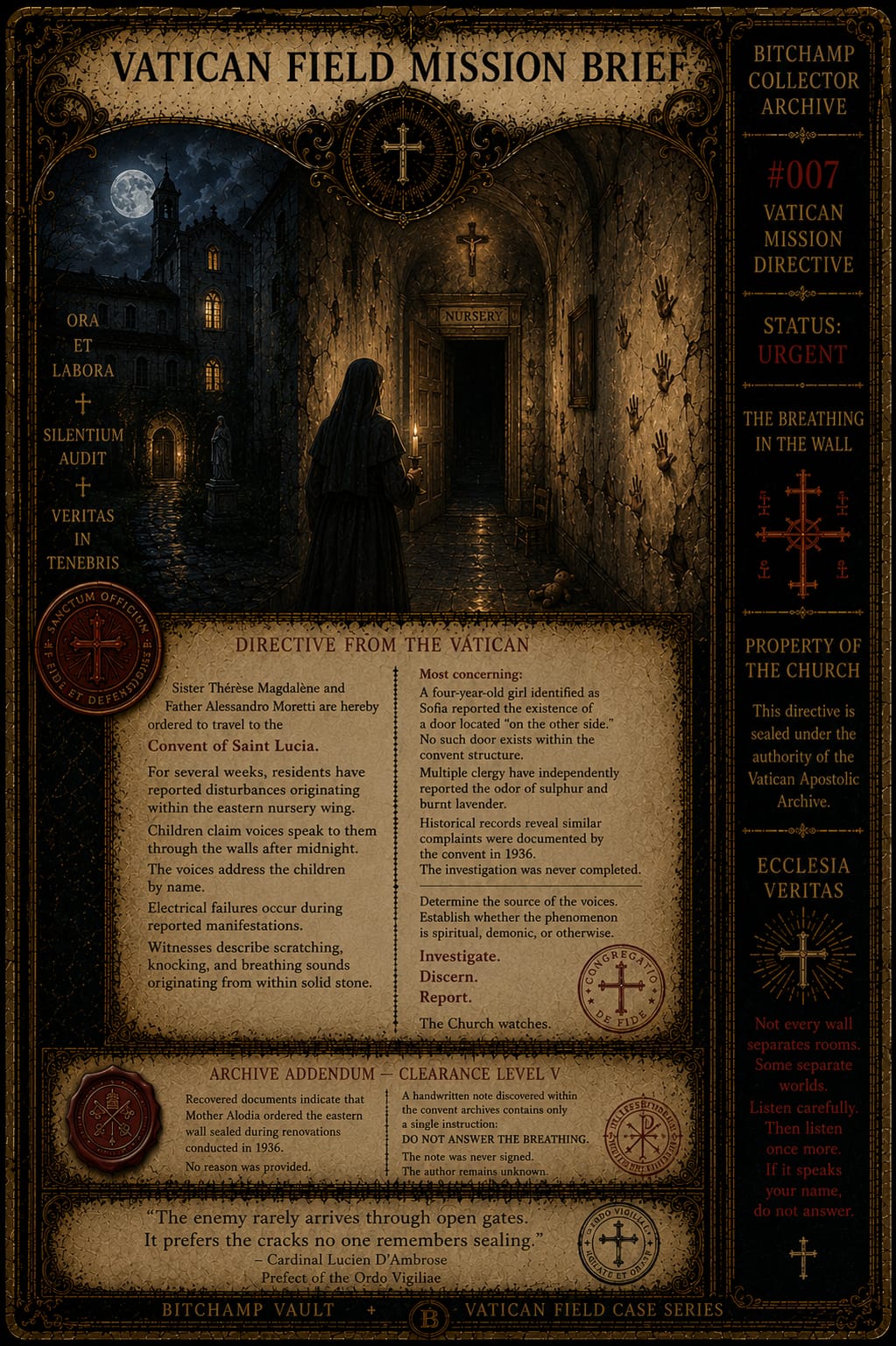
SISTER THÉRÈSE
Chapter Two — Of Candlelight & Scratching Things
March 3rd · 2:12 AM · Convent of Saint Lucia
The power in the east wing went out just after midnight, and I remember with painful clarity that there was no storm above us when it happened.
No thunder moved through the hills. No lightning threw its white bones against the windows. No wind struck the convent hard enough to trouble the shutters. The night outside Saint Lucia was cold, wet, and still, with rain resting on the old stones rather than falling from the sky. A night like that should have made ordinary sounds seem larger: the tired complaint of pipes, the clicking of radiators, the little coughs and sighs of sleeping children. Instead, when the lights died, the convent seemed to hold its breath.
There was no warning to prepare the mind. No nervous flicker in the lamps. No dimming of the corridor bulbs. One moment the convent held its familiar after-midnight glow, that thin electric dimness which gathers around old religious houses like a modern apology for candlelight, and the next it was gone. Darkness did not arrive as an absence. It entered. Sudden, complete, possessive. It filled the hallway with such intention that I felt, before I understood anything else, that something had closed its hand around the east wing.
Even the emergency lights failed.
That is what frightened Sister Agnes most when she found me outside the refectory with her rosary clenched so tightly in her right hand that the beads had bitten half-moons into her skin. Sister Agnes is seventy-three years old and has lived through two wars of the soul and one war of the world, although she rarely speaks of either. She is practical in the way women become practical when they have buried more people than they have feared. She knows old pipes from bones. She knows damp plaster from old evil. She knows grief from hysteria, and she has very little patience for either when there are children to feed in the morning.
Yet when she stood before me in the dead corridor, holding a candle in a brass holder with both hands, she did not ask whether a fuse had blown.
She asked if I had heard it too.
I did not answer quickly. I was listening.
In old places, one must always listen before speaking. Words have weight after midnight. They tell the unseen where the living are standing. They also reveal fear, and there are things that navigate fear better than sight.
The Convent of Saint Lucia has never been silent, not truly. It breathes in the rain. It clicks in the cold. It settles after sundown with the slow dignity of a body lowering itself into sleep. Wooden beams complain. Chapel doors sigh against their hinges. Mice sometimes hurry behind the pantry wall. Wind moves through the broken vent above the east stairwell and makes a sound very much like a child trying not to cry. I know these noises. I have learned them the way one learns the voices of family members moving in another room.
Those sounds belong to the convent.
This did not.
It came from somewhere beneath the floor and inside the wall at the same time, which is the way of certain things. They do not respect the architecture God gave the world. They move through depth, through memory, through hollows left by pain. A faint scraping first. Then a pause. Then three deliberate taps.
Tap. Tap. Tap.
Sister Agnes crossed herself so quickly that the candle flame trembled. I smelled wax, dust, damp wool, and the little medicinal sharpness of the oil she rubs into her knuckles before bed. Beneath those ordinary scents, faint but unmistakable, another odor entered the corridor and settled between us.
Sulphur.
And something sweet beneath it.
Burnt lavender.
I have known that scent since childhood, though I have spent most of my life praying to forget it. It does not announce every wicked thing. The dead have their own perfumes. Grief smells of rainwater and old cloth. Fear smells of metal. Certain spirits carry the smell of earth where no earth should be. But sulphur and burnt lavender together belong to a narrower class of visitor. Intelligent. Patient. Mocking. Close enough to the sacred to hate it properly.
“Go back to the infirmary,” I told her.
“The little ones are there,” Sister Agnes whispered. “Sofia woke crying before the lights failed. She said something was saying her name through the plaster.”
At that, the candle flame leaned sharply to the left.
There was no draft.
I took the candle from her before she could protest. “Lock the infirmary door. Place salt beneath the threshold if there is any left from the pantry. Do not let the children pray aloud unless I am present.”
Her eyes widened, not because she doubted me, but because she understood the instruction. A prayer can be a shield. In the mouth of the frightened, it can also become an opening. Fear bends words. Fear gives the enemy rhythm. I have heard the Our Father turned into a counting song by a child too terrified to understand what she was inviting. I have heard Latin come back from a wall with one syllable wrong and the whole room colder for it.
“And you?” she asked.
I adjusted the black shawl around my shoulders. My mother embroidered the edge of it with gold thread before I took my vows. She did not live long enough to see me wear it within the walls of Saint Lucia, and perhaps that is a mercy. She believed my sight was holy because she had to. Mothers often name wounds as gifts when they cannot bear to see their children bleed.
“I am going to the nursery,” I said.

The east corridor was colder than the rest of the convent. It always has been. The sisters blame the old foundations and the poor masonry. The architect who repaired the outer wall in 1981 blamed moisture rising from the earth. The diocesan inspector blamed neglect and wrote five pages about drainage, ventilation, and the moral importance of maintaining Church property.
None of them had ever stood barefoot on that stone after midnight.
I had left my shoes beside my bed when the first knock woke me. I did not go back for them. There is something important in bare feet. The body knows what the eyes cannot. Stone gives testimony through temperature. Wood through vibration. Dust through what disturbs it. As I walked, the floor beneath my soles changed from cold to colder, then to something that felt almost damp, though when I knelt and touched the stones with my fingers, they were dry.
The corridor seemed longer by candlelight. That is an old trick of frightened houses. They do not truly expand, not in a way a mason could measure, but distance becomes uncertain. Doors sit farther apart. Corners delay themselves. The mind expects a turn and receives only more hallway. I counted the stones beneath my feet to keep myself from counting the taps inside the walls.
Portraits of former abbesses watched from both sides. Their faces had been painted in the severe style of women who spent their lives convincing themselves that mercy did not need softness. Mother Celestina. Mother Ruth. Mother Beatrice, who died in 1899 after refusing to abandon the convent during the fever. Good women, all of them, and all quite dead. Yet as I passed Mother Beatrice’s portrait, the wood behind it gave a small inward knock.
I stopped.
Tap.
A pause.
Tap.
Another pause.
Tap.
The sound traveled ahead of me down the corridor as if something were moving inside the wall at the exact pace of my walk.
I whispered the first prayer that came to me, not loudly, not theatrically, but in the tone one uses when addressing a dangerous animal that may still choose to remain in the dark.
“Saint Michael the Archangel, defend us in battle.”
The wall answered by scratching once, slowly, from inside the plaster.
Not a rat. Not settling wood. Not water in pipes.
A nail dragged across the inner surface, patient enough to be personal.
I continued.
At the turn toward the nursery, the darkness thickened. This is not poetry. There are nights when darkness is only the absence of light, and there are nights when it has grain. Texture. Appetite. The candle in my hand burned lower as I approached the nursery door. Its flame pulled downward, flattening toward the wick, as though bowing under pressure.
The nursery door was open.
I always close that door.
I close it with my own hand after the last child has been tucked beneath blankets. I touch holy water to the frame. I say the prayer in Latin because the old language leaves fewer gaps. Then I stand for a moment and listen. Only when I hear the soft, uneven breathing of children asleep do I leave.
Tonight the door stood open into darkness.
And from within, a child whispered my name.
“Sister.”
Not a cry. Not fear.
A summons.
I stepped inside.

The nursery windows are high and narrow, set into stone too old to remember the men who cut it. Moonlight entered through them in pale vertical blades, falling across the cots where the children slept beneath wool blankets. Six of them. Little Luca with his thumb still tucked against his mouth. Marta curled around the rag doll she denies loving. Tomas, whose nightmares come when it rains. Elena and Paolo facing one another across the aisle as if continuing some silent argument from the day.
And Sofia.
She was not in bed.
She stood near the far wall in her white nightdress, her dark curls loose around her face, one hand pressed flat against the cracked plaster beside the old radiator. Four years old. Olive skin. Wide brown eyes. Too much silence in her for a child. Some children arrive at Saint Lucia loud with abandonment. They bite. They scream. They break toys because they cannot break the world that delivered them here. Sofia arrived quiet. That troubled me more.
I lowered myself beside her so I would not loom.
“Sofia,” I said gently, “you must not leave your bed in the cold.”
She did not look at me. Her gaze remained fixed on the wall.
“They were whispering,” she said.
“Who was whispering?”
Her small hand flattened harder against the plaster. “The people in there.”
The candle flame turned blue at the root.
I looked at the wall. The plaster was old, water-stained near the corner where the paint had bubbled and split. Nothing moved on its surface. No shadow crossed it. No crack widened. Yet I could feel the attention behind it. Attention is different from presence. A presence fills a room. Attention finds you from somewhere else.
“What did they say?” I asked.
Sofia’s lower lip trembled. “They said my name first. Then they said yours.”
I kept my face calm. Children read fear faster than scripture.
“And what did they say about me?”
At last she turned. Her eyes were wet, but she had not been crying. The tears had gathered there as if placed by another hand.
“They said you hear them too.”

For a moment the convent disappeared around me, and I was fourteen again in Palermo, standing beneath stained glass while something behind an altar breathed like a beast trying to learn the shape of a man. I heard the Mass continuing around me. Latin. Incense. My mother’s rosary. My father’s bowed head. Behind all of it, the breathing.
I forced the memory down. That is one of the first disciplines of my life: do not let yesterday’s terror answer today’s threat. Evil is patient, but memory is vulnerable. It will open the same door again and again if fear is allowed to hold the key.
“Sofia,” I said, “listen carefully. Did they ask you to open anything?”
She nodded.
“What?”
“The little door.”
“There is no little door in this room.”
She looked back to the wall.
“There is on their side.”
Something tapped from inside the plaster inches from her hand.
Three times.
Sofia did not flinch.
I did.
I took her gently by the wrist and moved her away from the wall. Her skin was cold. Too cold. Not the ordinary chill of a child standing barefoot after midnight, but the deep cold of something touched from beneath. She allowed me to lead her back toward her cot, though her eyes remained on the corner.
“They said not to sleep,” she whispered. “They said if I sleep, she will come through.”
“Who will?”
Sofia climbed into bed and lay down stiffly, like a doll returned to its box.
“The woman with the broken neck.”
I drew the blanket over her. “There is no woman here.”
Her gaze shifted above my shoulder.
“There is now.”
I did not turn immediately.
That is a discipline I learned painfully young. Never obey the direction of a haunted child’s eyes too quickly. Some things require acknowledgment before they can enter fully. Some wait to see whether you will grant them the dignity of fear.
I made the Sign of the Cross over Sofia’s forehead. Her eyelids fluttered. She sighed once, and sleep took her with unnatural speed, dropping over her face like a curtain.
Only then did I stand.
The room behind me was empty.
The wall was not.

I placed my palm against the plaster where Sofia had touched it.
At first there was nothing but cold.
Then came the pulse.
Slow. Heavy. Wrong.
Not a heartbeat. A heartbeat belongs to the living and carries within it a desperate, holy insistence. This was more like breath moving through stone. It pressed outward against my hand, withdrew, pressed again. The wall seemed to become thinner beneath my fingers, not in substance but in obedience. For one terrible moment I felt that if I pushed hard enough, my hand would pass through into whatever space waited behind it.
I began the prayer of Saint Michael again.
The pulse quickened.
Behind me, one of the sleeping children whimpered. I kept my hand on the wall.
“In nomine Patris,” I whispered.
A voice inside the plaster whispered back, almost tenderly, “Teresa.”
It did not use the French pronunciation given to me in the convent. It said my name as my mother had said it when I was small and feverish in Palermo. Soft at the beginning. Strong at the end.
My fingers stiffened.
The voice became my mother’s.
“Figlia mia.”
My daughter.
The cruelty of that nearly undid me.
I closed my eyes. “You are not my mother.”
“No,” it whispered, and now it was closer. “But I know where she is.”
The candle went out.
Darkness filled the nursery. A child drew breath sharply in sleep. Another turned over, bed frame creaking. I stood blind with my palm against the wall and felt something on the other side press its hand to meet mine.
Its fingers were longer than mine.
More than five.
I pulled away and struck a match from the small tin I keep in the pocket of my habit. My hands were steady until the flame appeared. In that sulfurous burst of light, I saw the wall clearly.
There were marks in the plaster.
Not scratches.
Words.
They had been written from inside the wall, pressed outward in raised ridges as if invisible fingers had shaped the plaster while it was soft.
LET HER OPEN.
The match burned down toward my fingertips. I lit the candle again, and the words sank back into the wall before the flame steadied, leaving only the ordinary crack near the radiator.

I remained in the nursery for more than an hour.
I prayed quietly beside each bed. I touched holy water to the windows. I tied a strip of blessed black thread around the radiator pipe where the wall felt thinnest. I set a small line of salt beneath the door and another behind Sofia’s cot. I did not know whether any of it would hold. One must be humble about such things. Faith is not a lock. It is a hand placed against the door while help is coming.
As I moved between the cots, I noticed details that had escaped me when fear first brought me inside. The children’s breaths did not quite match. They slept, yes, but their breathing rose and fell in a pattern too orderly for sleep, almost as if something had arranged them into a choir. Luca inhaled. Marta exhaled. Tomas inhaled. Elena and Paolo answered together. Sofia remained utterly still.
I placed two fingers beneath Sofia’s nose and felt the faint warmth of life. Only then did I allow myself to continue.
“You cannot have them,” I said to the wall.
I spoke softly so the children would not wake, but the words entered the room with more authority than volume could have given them. There are statements one makes to people and statements one makes to the order of things. This belonged to the second kind.
The radiator clicked once.
From inside the wall came the sound of something smiling.
I cannot explain that sentence more clearly. I only know what I heard.
Sometime near one o’clock, the power returned in the west wing. The east remained dark.
At one-thirty, Sister Agnes came to the threshold and whispered that the children in the infirmary were sleeping again.
I told her not to enter.
She saw my face and obeyed.
Only when the nursery had settled into the ordinary breathing of children did I leave. I closed the door behind me. I blessed it. I said the prayer.
Then I stood in the corridor and listened.
Nothing answered.
That frightened me most of all.

I returned to my room with trembling limbs and burning lungs. The walk back seemed to take longer than the walk there. The convent had altered while I was inside the nursery. I cannot prove this. I can only record what I perceived. Doors sat slightly farther apart. The portraits watched from different angles. The east stairwell, which should have been ahead on my left, appeared for several steps on my right before correcting itself when I stopped and shut my eyes.
There are moments when the world becomes unsure of its own arrangement.
Those are the moments when one must not run.
In my cell, the candle on my desk still burned where I had left it before going to the corridor. The flame had consumed nearly half its body, drowning the brass holder in wax. My diary lay open. The pen rested diagonally across the page, though I remember leaving it straight.
I locked the door.
I prayed.
I waited.
Nothing moved.
Only then did I remove my shawl and sit on the edge of the bed. The room was cold, but sweat had gathered at the base of my spine. I pressed my hands together until the tremor in them passed. When my breathing steadied, I began preparing to wash. That was when I saw the marks.
Three scratches.
Red, raised, and deliberate, drawn across the skin as though made with a heated needle. They were not deep. There was no blood. Yet the flesh around them burned with a heat entirely separate from the cold room. I touched one lightly and tasted iron in my mouth.
Three.
Always three.
The mockery of the Holy Trinity.
I had not felt them happen. That is the true violation. Pain at least announces contact. A wound discovered after the fact carries another horror: the knowledge that something reached you while you believed yourself guarded.
I sat there for some time, staring at the marks, and thought of the first time I saw them as a girl. Not there, not exactly, but beneath my wrist after the Mass at Santa Agnese. I thought of the man beside the crucifix, the blackness where his eyes should have been, and the long pale finger pointing at me from behind the altar rail while every good person around me continued praying as if the world had not torn open.
I have been watched since childhood.
I have been followed from Palermo to Rome, from Rome to mission houses whose names have been burned from official records, from one desperate room to another where the Church sent me because someone had to stand between the living and what desired them. I have heard the dead confess through cracked plaster. I have seen statues weep oil that boiled on the floor. I have held children while voices older than kingdoms spoke through their milk teeth.
And still, tonight, the sight of those three scratches made me feel terribly young.
Not afraid.
That would be too simple a word.
I felt recognized.
There is a difference.
Fear says something may harm you.
Recognition says something knows how.
I washed the marks with holy water. The skin hissed faintly. A thin thread of steam rose and disappeared. I do not expect anyone who reads this to believe that detail, but accuracy is a form of obedience, and so I record it plainly.
The scratches remained.

By then the convent had quieted. Somewhere beyond my door, Sister Agnes’s slow steps passed once and did not return. The rain began at the windows, soft at first, then harder. The east wing stayed dark.
I lit a fresh candle.
I opened this diary.
And I began to write.
You may think me overly sensitive, or perhaps superstitious. I would have thought the same once, long ago, before the veil first thinned and showed me the shape of what presses against it. I have no talent for superstition now. Superstition is fear without discipline. What I have is memory.
Old places remember.
Saint Lucia remembers more than most.
The convent was not built on empty ground. None of our official pamphlets say this, naturally. They speak of charity, restoration, education, and the admirable generosity of noble patrons. They do not mention the Roman burial chambers beneath the garden. They do not mention the sealed lower rooms discovered during repairs after the flood of 1936. They do not mention Mother Alodia, who ordered the east wall plastered over from floor to ceiling and forbade the novices from sleeping there for nine years.
I found her note three winters ago in the archive cabinet, folded inside an inventory of altar linens.
Do not answer the breathing.
That was all she wrote.
No explanation. No seal. No date beyond the year.
I understand her better tonight.
The presence in the east wing is not merely residual. It is not grief repeating itself, nor a dead sister wandering from habit and sorrow. It knows names. It changes position. It imitates the beloved. It asks a child to open a door that exists on its side of the wall.
That last detail troubles me.
Doors matter.
The Church speaks often of gates. Heaven has them. Hell has them. The human heart, though priests rarely phrase it so plainly, is full of them. What entered the nursery tonight did not ask Sofia to come away. It asked her to open. That is an older strategy. More patient. More dangerous.
A frightened soul can be chased.
A lonely one can be invited.
And Sofia is lonely.
I see it in the way she watches other children receive letters. In the way she holds bread with both hands, as though afraid someone might take it back. In the way she stands at chapel and moves her lips half a beat behind the others because she wants to belong to the prayer before she understands it.
Something in the wall has noticed.
That is why I will not sleep.
I have placed blessed salt across my threshold. I have wrapped my rosary twice around the bedpost. The relic of Saint Catherine rests beneath my pillow. These things comfort the human part of me, and perhaps they offend what waits in the dark. But I know better than to mistake objects for courage. A rosary in a coward’s hand is only beads. Holy water without faith is only water.
So let this page be witness if I am not able to speak clearly tomorrow.
At midnight, the east wing lost power without natural cause.
At approximately twelve-twenty, multiple sisters reported hearing movement within interior walls.
At twelve-forty, child resident Sofia claimed voices had addressed her by name and instructed her to open a door.
At twelve-fifty, I made physical contact with the nursery wall and detected a pulse-like pressure from within.
At that time, the presence imitated the voice of my deceased mother.
Shortly thereafter, raised lettering appeared in plaster and receded when exposed to candlelight.
At one-forty-seven, I discovered three unexplained scratches on my body.
The odor of sulphur and burnt lavender persists.
I do not yet know whether the entity is bound to the convent, drawn to the child, or drawn to me.
I suspect all three.

The candle is nearly finished now. Wax has reached the edge of the desk and begun to drip onto the floorboards in slow pale drops. The sound is very small. It should be too small to matter.
Yet tonight every small sound has meaning.
I can hear the old bones of the convent breathing around me. The rain at the glass. The faint ticking of the cooling radiator. My own pulse, steadying as I write these final lines.
And something else.
There is scratching again.
Not from the nursery.
Not from the corridor.
Not from inside the wall.
I have stopped writing twice to listen. Each time the sound stops with me. Each time I lower my pen, it begins again, slow and patient, directly beneath the floorboards under my bed.
It wants me to kneel.
That much is clear.
It wants me to place my ear to the floor like a child listening at a locked door.
I will not.
I am Sister Thérèse Magdalene of the Cross. Daughter of Italy. Granddaughter of stonecutters and shepherds. Baptized beneath the ancient arches of Santa Agnese and confirmed with the name of a martyr. I was born with sight, though I did not ask for it. I was given a burden, though I did not understand its weight. I have walked in both light and shadow, and I have learned that the shadow is loudest when it is afraid of being named.
They can follow.
They can whisper.
They can scratch and crawl and wear the voices of the dead.
But this is a house of God.
And I am His servant.
His witness.
His shield.
If they come again tomorrow, I will be ready.
But tonight, before I seal this page, I must record one final detail.
The scratching beneath my bed has stopped.
Now something is breathing there.
— Sister Thérèse Magdalene