
SISTER THÉRÈSE
Vatican Mission Report
SISTER THÉRÈSE
Chapter One – The Girl Who Heard Breathing Beneath the Hymns
March 4th · 12:36 AM · The Diary of Sister Thérèse Magdalene
I was fourteen years old when I first heard something breathing beneath the hymns, though that morning began with nothing more supernatural than tight shoes and my mother’s irritation. The shoes had been bought before winter and had become cruel by spring, pinching my toes with every step along the cobbled streets of Palermo. My Sunday dress had betrayed me as well, the sleeves climbing too high on my wrists and the hem sitting awkwardly above my ankles despite my mother’s repeated attempts to smooth it into respectability. At fourteen, I believed such humiliations mattered terribly, because I had not yet learned how quickly ordinary discomfort can be swallowed by true fear.
My mother walked beside me with her rosary looped around one hand and her patience worn thin before we had even reached the square. She said I was growing like a weed and that the Lord would either make me a saint or a seamstress, because no decent family could afford to keep lengthening hems every three months. My father laughed softly at this, which earned him the look she reserved for men, saints, and children who refused to understand practical burdens. I remember loving them both in that embarrassed, restless way children love their parents when they are old enough to resent correction but not old enough to recognize devotion hidden inside it.
The streets of our quarter were already alive with the Sunday morning habits of the city. Laundry moved between balconies like pale flags, and women leaned from upper windows to call down gossip with the authority of church bells. Vendors opened their stalls beneath striped awnings, arranging oranges, figs, olives, and bread still warm enough to perfume the air. Somewhere below the hill, the harbor sent up its familiar breath of salt and fish and sun-struck rope, and I remember thinking Palermo sounded exactly as it always had, which is perhaps why the sound waiting for me later felt so impossible.

The warmth of that day remains vivid to me because it was wrong for the season. Spring had only begun, yet the air pressed against the skin with the heavy softness of June, and the stones underfoot held heat as though they had slept beside a fire. My mother complained about this too, saying weather that arrived before its time always made animals restless and people foolish. I rolled my eyes because I was fourteen and believed suspicion of weather was an old woman’s superstition. Now I have lived long enough to know that the world often changes temperature before it opens.
Santa Agnese dei Fiumi stood at the edge of the old quarter, built of sea stone so pale in sunlight that the walls sometimes appeared carved from bone. The church was older than any house around it, older than the olive trees that bowed along the path, and older, my grandmother liked to say, than the memory of the families who claimed to have built it. Its bell tower leaned slightly over the square, not enough to alarm an architect but enough to make children imagine it listening to them. Even before that day, I had always felt Santa Agnese possessed a silence deeper than other churches, a silence that did not merely wait for prayer but remembered every prayer ever spoken inside it.
My father dipped his fingers into the holy water when we entered and made the Sign of the Cross with the slow care of a man who believed reverence should never appear rushed. My mother followed, touching her forehead, breast, and shoulders while her lips moved around a private intention I was too young to ask about. I crossed myself quickly, distracted by the coolness inside the church and the sudden relief it gave my aching feet. The sanctuary received us with incense, candle smoke, polished wood, old stone, and the faint floral sweetness of lilies arranged before the statue of the Virgin.

Sunlight came through the stained glass in long bright panels, laying red, blue, and gold across the floor as if the martyrs had spilled their robes there. Dust moved through the colored beams with the slow grace of ash underwater, and every candle seemed to tremble inside its own small halo. The front of the church shone beautifully, but the corners remained darker than they should have been, especially near the apse behind the altar. I noticed this without understanding why it troubled me, then dismissed the thought because children are trained to distrust their own unease when adults around them appear calm.
We sat in our usual pew near the middle of the sanctuary, close enough to see the priest’s face but far enough that my attention could safely wander. My mother knelt at once and began moving her rosary through her fingers, while my father bowed his head with the quiet heaviness that sometimes came over him inside churches. Around us, the congregation settled into familiar patterns of coughs, whispers, kneelers, prayer books, and rustling fabric. I recognized nearly every face, and that familiarity gave the room a sense of protection, as though evil would never dare enter a place so thoroughly occupied by ordinary people.
The Mass began with the procession of altar servers and the low murmur of Latin rising into the vaulted ceiling. Incense drifted from the thurible in pale ribbons, catching the colored light before dissolving above the sanctuary. The priest’s voice moved steadily through the opening prayers, and the choir answered with the smooth obedience of people who had sung those words all their lives. For a while there was only the ancient rhythm of the liturgy, and I allowed myself to sink into it without understanding how precious that safety was.
My mind wandered, as it often did then, toward lunch, school, and the boy three pews ahead who had once loaned me a pencil and thereby occupied an unreasonable amount of my imagination. I watched the back of his head with grave seriousness, then became ashamed of myself and tried to look devout. My mother would have pinched my elbow if she had noticed, but she was deep in prayer and my father’s eyes remained lowered. I remember that silly distraction clearly because it was the last truly childish thought I had before the world changed its shape around me.
The first breath was so soft that I accepted it as part of the church. It seemed to rise between the choir’s notes and disappear beneath the priest’s voice, a low inhalation followed by a slow release. I thought someone nearby must have been ill, perhaps the old man behind us who often slept through homilies with his mouth open. I did not turn at first because the sound embarrassed me on someone else’s behalf, and I still believed every sound in a church must have a harmless human source.
Then it came again, deeper than before and far too deliberate to belong to a sleeping parishioner. The inhalation seemed to drag through a throat not made for air, and the exhalation carried a wet patience that made my skin tighten beneath my dress. I looked over my shoulder and found only bowed heads, closed eyes, and the small bored movements of children trying to remain still. No one appeared disturbed, which frightened me more than if half the congregation had turned at once.
I faced forward and tried to force my attention back to the altar, but the breathing had entered the Mass now and would not leave it. It moved beneath the Latin like a second liturgy, not competing with the sacred words but waiting inside their pauses. Each time the choir rose, the sound withdrew, and each time the choir softened, it returned with greater clarity. It was not loud, and perhaps that was why it unnerved me so deeply, because loud things announce themselves honestly while quiet things ask to be discovered.

I told myself the heat had made me unwell. I told myself the incense had thickened the air and that my imagination, restless from boredom, had given shape to an ordinary discomfort. These explanations were sensible, and I clung to them because sensible thoughts are small candles in the mind. Yet the more I tried to reason with the sound, the more certain I became that it was not happening around me in the usual way. It seemed to be breathing from the building itself, from the stones, from the shadow behind the altar, from some depth beneath the hymns where no living lungs should have been.
A strange pressure gathered in my ears, and the church began to feel distant despite my body remaining exactly where it was. My mother’s rosary clicked beside me, but the sound reached me as if through water. My father shifted on the kneeler, and the wood creaked softly, yet that too seemed far away. I understood, with a child’s terror and without an adult’s vocabulary, that I had been separated from the room while still sitting inside it.
The shadows near the apse deepened until they no longer behaved like shadows cast by architecture. They held together against the sunlight, gathering around the base of the crucifix and along the carved folds of the altar cloth. I blinked hard, expecting the darkness to correct itself, but it remained heavy, thick, and almost attentive. The priest continued speaking only a few feet from it, unaware or untouched, and the sight of his calmness filled me with a loneliness I had never known.
The breathing came once more, and this time I knew it was coming from behind the altar. It was low and steady, like a wild animal attempting to imitate a man asleep. My hands curled against the edge of the pew, and I remember feeling the smooth varnish beneath my fingers with absurd intensity. Every part of me wanted to lean toward my mother and whisper, but shame held me still almost as firmly as fear, because I could not bear the thought of being wrong.
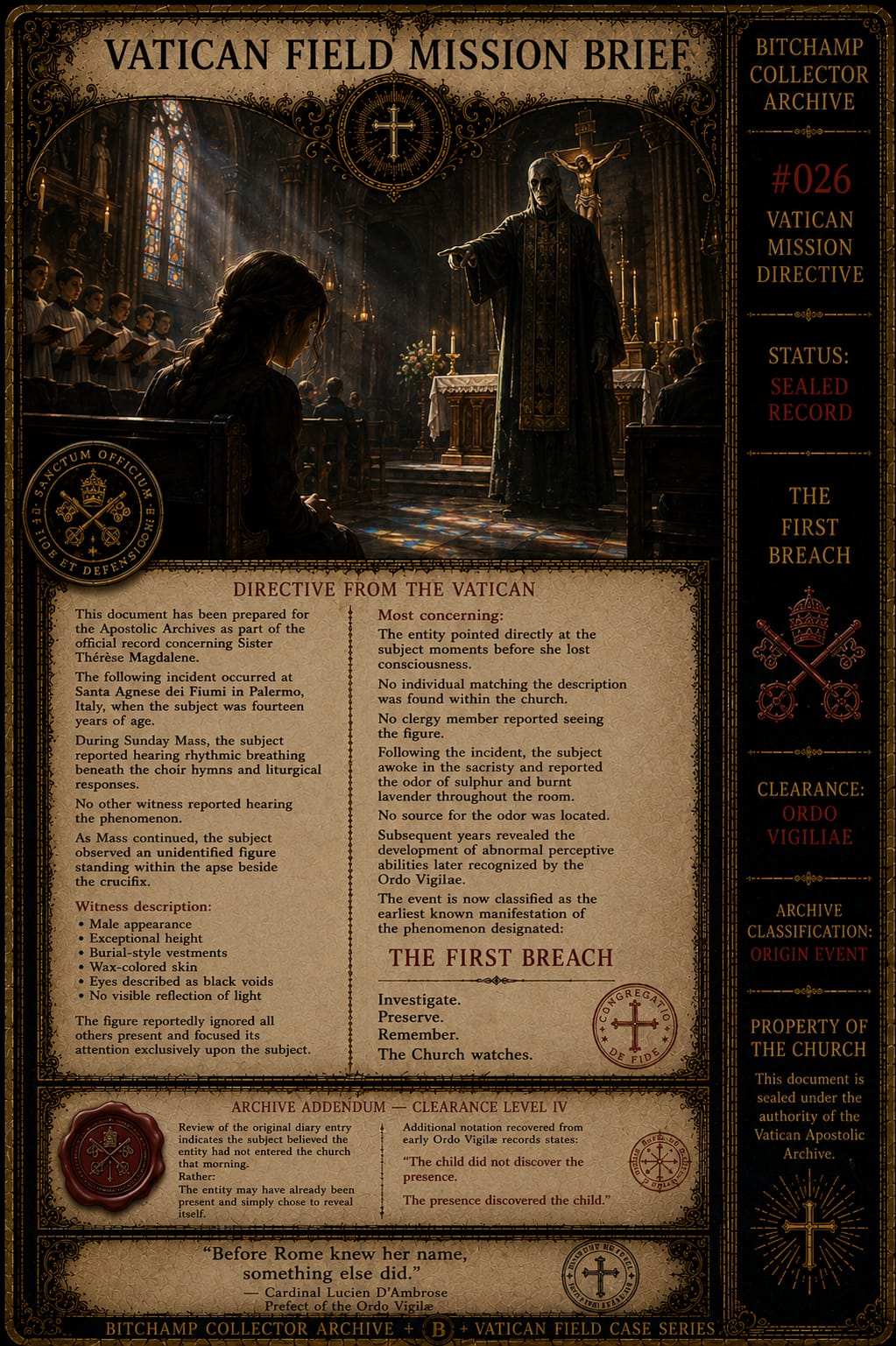
Then the figure appeared in the apse, though appeared is not quite the correct word. It was more as if my eyes finally admitted what had already been standing there. He occupied the space just beside the crucifix, where no one but the priest should have been, and his stillness made him more terrible than movement would have done. He was tall, gaunt, and draped in robes too old for the century, the fabric hanging from him with the dry stiffness of burial cloth stored too long in a sealed room.
His face had the color of candle wax left in a crypt, pale yellow and faintly translucent where the stained-glass light should have touched it. His mouth was thin and fixed in a smile that did not move, not cruel enough to be called a sneer and not warm enough to be mistaken for kindness. But his eyes were what marked him as something outside the mercy of nature. They were black without reflection, black without depth, black in the manner of openings rather than eyes, as if sight itself had been removed and something much older looked through the empty place.
He was not watching the Mass. He did not look at the priest, the altar servers, the crucifix, or the raised host. His attention crossed the sanctuary with perfect certainty and settled on me. I looked toward my mother in panic, but she continued mouthing the Creed with her rosary caught between thumb and forefinger. My father’s head remained bowed, and all around me the faithful prayed on, protected by ignorance or abandoned to it.
I tried to tell myself he was a man, because the mind will choose any cage that keeps terror contained. Perhaps a sacristan had stepped where he should not have stepped, or some confused old priest had wandered into view wearing vestments from storage. Yet no human explanation survived the way the light avoided him. The gold and red panels from the stained glass crossed the floor around his feet but did not climb his robes, as though even sunlight refused the labor of touching him.
He took one step forward without sound. No fabric shifted, no shoe met stone, and no echo entered the sanctuary. One moment he stood near the deepest part of the apse, and the next he had drawn closer to the altar rail. The breathing grew heavier as he moved, though his chest did not rise and his mouth remained fixed in that terrible stillness.
My body wanted to flee, but the pew held me like a hand across the lap. I could not stand, could not speak, could not even make myself reach for my mother’s sleeve. Around me, people rose and knelt according to the rhythm of the Mass, and I followed only because my body had been trained to obey while my mind broke apart. I have faced many things since that day, some louder, some bloodier, some more openly vile, but few have equaled the horror of being a child surrounded by adults who could not see the danger standing in front of them.
The figure raised one hand with slow, graceful precision. His fingers were long and narrow, the joints too pronounced, the skin stretched tightly over them as though it had been fitted after death. For one fleeting instant, he resembled a conductor preparing to guide the choir, and the thought was so grotesque that I nearly laughed from fear. Then he extended a single crooked finger and pointed directly at me.

The sanctuary blurred at the edges. My stomach lurched as if I had been dropped from a height, and the colored light on the floor stretched into trembling bands. I heard my mother inhale sharply, though even that sound seemed to come from a great distance. The last thing I saw before darkness rose around me was the figure’s smile widening without his lips moving at all.
When I woke, I was lying in the sacristy with a damp cloth on my forehead and the taste of metal in my mouth. The room smelled of wax, old vestments, furniture polish, and the bitter edge of incense soaked into wood over many years. My mother sat beside me with one hand pressed to her chest, while my father stood near the priest, speaking in the low voice men use when they are afraid but determined not to appear so. For several seconds I could not remember why they looked that way, and then the memory returned with such force that I sat up too quickly and nearly fainted again.

The priest told me I had collapsed from heat and incense. He said young girls sometimes became lightheaded during Mass, especially when churches were crowded and spring arrived with unusual warmth. My mother accepted this explanation because she needed to, and my father nodded because the alternative had not yet been offered. I wanted to tell them about the breathing, the figure, the black eyes, and the finger pointing from beside the crucifix, but the words gathered in my throat and refused to become sound.
I asked only one question. I asked whether anyone had been standing behind the altar. The priest frowned with such honest confusion that I understood the answer before he gave it. No one had been there, he said, and then he looked at my parents with the careful concern of a man revising his explanation from faintness to nerves.
That look silenced me more effectively than disbelief would have done. Children learn quickly when adults are prepared to be frightened of them. I lowered my eyes, accepted the water they gave me, and allowed the story of heat and incense to settle over the room like a clean white sheet. Beneath that sheet, however, the truth remained awake.
There was a smell in the sacristy that did not belong there. It came faintly at first, threaded through the ordinary odors of the room, and then sharpened as I breathed more carefully. Sulphur, unmistakable and dry, lay beneath something floral that had been ruined by fire. Burnt lavender. I had no name for its meaning then, but my body recognized it with such revulsion that I began to tremble again.
The figure was gone, yet the scent remained, and that frightened me more than his presence had. A thing seen might be doubted later, especially by a child who wants desperately to return to herself. A scent lingers with a different authority. It enters the body and makes memory physical, and even now, decades later, there are nights when the faintest trace of scorched lavender will return me to that sacristy before prayer can steady me.

We went home after the priest decided I should rest. My mother fussed over me the entire way, though I could tell irritation had begun to replace fear because irritation was easier for her to manage. My father carried my shoes for the last few streets after seeing me wince, and he said nothing about it when my mother pretended not to notice. I loved him fiercely in that moment, with a child’s sudden gratitude, because his silence gave me permission to be fragile without explaining why.
I did not tell them that day. I did not tell my mother while she made broth and watched me from the corner of her eye. I did not tell my father when he came to my room before supper and asked, too casually, whether anything had troubled me during Mass. I did not even tell my grandmother, who believed more than the rest of us and might have crossed herself, closed the shutters, and understood too much.

That night I lay awake listening for the breathing. The house made all its usual sounds around me, pipes clicking, floorboards settling, wind moving faintly against the shutters. Each ordinary noise became suspect because fear had taught me that something unnatural could hide inside familiar rhythms. I kept my eyes on the dark corner of my room and tried not to imagine a tall figure standing there with black openings where his eyes should be.
Sleep came only in fragments. When it did, I dreamed of the church filled with water up to the altar steps, the candles still burning beneath the surface and the choir singing without mouths. I dreamed of statues turning their heads when I passed and of hands pressing outward from inside the walls, begging to be named. In one dream, my mother called to me from behind the altar, and when I approached, her voice became the slow breathing I had heard beneath the hymns.

The weeks that followed did not return me to normal, though for a while I performed normalcy well enough to satisfy those around me. I attended school, helped my mother, argued about dresses, laughed when expected, and prayed with my family at the proper times. Yet something in me had shifted slightly out of alignment with the visible world. I began noticing cold spots in warm rooms, shadows that moved half a beat late, and the expressions of statues when no one else was looking.
At first I believed I had been cursed. That was the only language available to a frightened girl who had seen something terrible in a holy place and then continued seeing traces of it everywhere. I searched my conscience for sins large enough to explain the punishment and found only childish disobedience, vanity, impatience, and the usual selfishness of youth. It would take years for me to understand that a gift can feel exactly like a wound before grace teaches us how to carry it.
Years would pass before I took my vows. Years would pass before Rome learned what I could see, before the Ordo Vigiliae placed sealed files before me, before I stood in rooms where grief had teeth and prayer had to be spoken like a blade. I have since encountered entities more violent than the figure at Santa Agnese, and I have witnessed manifestations that would have shattered the girl I was. Still, none of them were first, and first horrors claim a chamber in the soul that no later terror can fully occupy.
I no longer believe that day created my sight. Creation is too clean a word for what happened. It was not as though a door appeared where there had been a wall, but rather that a door already present opened wide enough for me to notice the darkness beyond it. Whether something entered my life that morning or I entered its attention, I cannot honestly say.
I know only this. When I walked into Santa Agnese dei Fiumi, I was a girl worried about tight shoes, stained sleeves, and whether my mother would scold me through lunch. When I left, the world had become larger, lonelier, and far less merciful than I had been taught to expect. Evil no longer belonged only to scripture, monsters no longer belonged only to stories, and somewhere beyond the safety of ordinary sight, something had begun breathing my name.
— Sister Thérèse Magdalene