
SISTER THÉRÈSE
Vatican Mission Report
SISTER THÉRÈSE
Chapter Three — The Smoke Beneath Her Skin
March 5th · 1:04 AM · Palermo, Sicily
They say the first time one uses a gift, any gift, it should feel like light entering a room that has waited too long for morning. They say it should feel like revelation, like grace, like the soul recognizing the shape God intended for it all along. Perhaps that is true for painters, singers, healers, and saints whose stories arrive already polished by the hands of those who loved them. Mine did not feel like light. Mine felt like drowning.
I was sixteen years old when it happened, and by then I had already learned to keep certain things to myself. Two years had passed since the Mass at Santa Agnese dei Fiumi, two years since the figure with black eyes stood behind the altar and pointed at me while the rest of the congregation continued praying as if nothing in the world had changed. I had told no one the truth of that day, not fully, not even Nonna, who might have believed me and frightened me all the more by doing so. Children think silence protects them, but silence is rarely protection. More often, it becomes a room where fear learns to grow.
By sixteen, I understood that something had altered in me, though I did not yet possess the courage to call it a calling. I saw things at the edges of ordinary life, small impossible things that vanished the instant I turned toward them directly. A woman in mourning once walked past me in the market with seawater pouring from her sleeves, and no one but I stepped aside to avoid the trail she left behind. A statue of Saint Lucy in our parish chapel wept once during evening prayers, not tears of blood or oil, but clear water that smelled faintly of river mud. At night, I sometimes woke with the certainty that voices had been speaking just outside my window, though my room stood on the second floor and no balcony touched that wall.
Still, I tried very hard to remain ordinary. I helped my mother with laundry, carried bread to neighbors, attended Mass, studied when I was told to study, and listened when my elders spoke as though obedience could keep the world in its proper shape. Palermo was full of sorrow, but it was also full of chores, and chores have a way of convincing the young that life is manageable. My hands were often cracked from helping Nonna boil linens for the sick families in our quarter, and my back ached from scrubbing floors or kneeling too long at morning Mass. Faith was present in me, yes, but quietly. It was a small flame sheltered between both hands, not yet the fire that would later be required of me.
That summer was a cruel one. Heat gathered in the streets before noon and stayed there long after sunset, trapped between walls of old stone and plaster until the whole city seemed to sweat through the night. The harbor smelled stronger than usual, fish and salt and rope and rot mingling beneath the sweeter scents of basil, oranges, and laundry soap. Men argued more quickly in the market, mothers slapped dust from their children’s collars with less patience than usual, and even the church bells seemed tired when they rang across the rooftops. It was during that summer that Maria Antonetta stopped speaking.
Maria was my closest friend then, though even now the word friend feels too small for what she was to me. We had known one another since childhood, since the age when girls become sisters by sharing secrets under tables and stealing figs from bowls meant for guests. She lived above her father’s butcher shop on Via della Croce, where the air always carried the scent of rosemary, smoke, and iron no matter how carefully her mother scrubbed the stairs. Maria was seventeen, one year older than I, and she wore that year like a crown. She had black hair thick as ink, a laugh that startled birds from wires, and a voice so warm that even scolding from her sounded like music.
She was the sort of girl people noticed. Women in the market called her bella and pretended not to envy her mother, while boys suddenly found errands to run past the butcher shop whenever she leaned from the upstairs window. Priests praised her singing during feast days, and old widows trusted her to read letters from sons who had left Palermo and rarely wrote back. Maria belonged naturally to the world in a way I never did. She could enter any room and make it feel less severe.
I loved her for that, though I did not have language for the ache of it then. I loved how she teased me when I became too solemn, how she stole olives from my plate, and how she crossed herself quickly whenever a funeral procession passed before immediately whispering some wicked joke that made me ashamed to laugh in public. When I grew quiet after the incident at Santa Agnese, Maria noticed before anyone else did. She never forced me to explain. She simply began walking home with me more often, filling the silence with enough conversation for both of us.

The change in her began subtly enough that people first mistook it for moodiness. She forgot the words to a hymn during the Feast of Saint Peter and laughed it off too loudly afterward. She failed to appear at the fountain one morning when we had promised to meet, then claimed later that she had slept through the bells, though Maria never slept through anything. She stopped leaning out of the window above the butcher shop, stopped singing while sweeping the stairs, and stopped answering when I knocked. When her mother came to the door, she often did so with red eyes and told me Maria was resting.
At first I believed she was ill. The heat had made everyone unwell, and fever moved through the quarter that July with the stealth of a thief. Nonna said half the city had bad air in their lungs and sourness in the blood, which was her explanation for nearly everything until a priest or doctor contradicted her. I brought Maria broth once, then bread, then a small packet of dried lavender tied with thread because she had always liked the smell. Her mother thanked me each time but did not invite me upstairs, and that frightened me more than any refusal would have.
Rumors began, as rumors always do, in lowered voices beside doorways. Someone said Maria had quarreled with her father and refused to eat, while someone else said a jealous girl had cursed her after a festival dance. A woman from two streets over claimed she had seen Maria standing barefoot in the alley at dawn, facing a wall and speaking to it as though someone stood on the other side. When that story reached me, I laughed because I wanted it not to matter. The laugh sounded false even to my own ears.
The first time I saw her after the rumors began, she barely looked like herself. She came to the window above the butcher shop while I stood in the street below, and for a moment I felt relief so strong it nearly became anger. I called her name and lifted the basket I had brought from my mother’s kitchen. Maria stared down at me with her hands resting on the sill, but the sun was behind her, so I could not see her face clearly. She did not wave, did not smile, did not answer, and after several seconds she stepped backward into the room without closing the shutters.

That night, I dreamed of smoke moving beneath skin. It was not the smoke of a fire, nor incense, nor the blue haze that rises from oil lamps when the wick is trimmed badly. It was darker than that, almost alive, traveling under the surface of an arm that was not my own. I saw it coil along veins, gather beneath the wrist, and pulse there as though listening. Somewhere in the dream, Maria was laughing behind a closed door, and when I woke, I could still hear the laughter fading into the ordinary sounds of morning.
On July 19th, the Feast of Saint Agnes, my mother baked rosemary bread before dawn. She did this whenever someone was ill, believing that food prepared early carried more mercy in it than food prepared in haste. The kitchen filled with warmth and the scent of flour, salt, olive oil, and herbs crushed between her fingers. She wrapped one small loaf in cloth and told me to bring it to Maria’s mother after Mass. Her voice was casual when she said it, but she did not meet my eyes.
The sky that day was so blue it almost hurt to look at. I remember this clearly because everything beneath it felt too sharp, too brightly outlined, as if the world had been scrubbed clean for something terrible. The streets shimmered in the heat, dogs lay motionless in strips of shade, and even the vendors in the market called out with less strength than usual. I carried the bread against my chest, and its warmth seeped through the cloth into my hands like a living thing. By the time I reached Via della Croce, I had begun to dread the errand without knowing why.
The street was quieter than it should have been. The butcher shop stood open, but no one waited at the counter, and Maria’s father was not behind the block with his apron tied around him. The hooks near the back wall hung empty while a few flies circled lazily in the heat. The smell of iron lingered as always, but beneath it lay another odor, faint and bitter, like hair singed over a candle flame. I hesitated at the foot of the stairs and almost turned back.
Maria’s mother opened the upstairs door before I knocked. She looked smaller than I remembered, though only days had passed since I had last seen her. Her hair had escaped its pins, and there were flour streaks on the front of her dress, as though she had begun several tasks and completed none of them. When she saw the bread in my arms, her mouth trembled. She stepped aside without a word, and that silence told me what polite conversation would have hidden.
The apartment was dim despite the hour. Shutters had been drawn across the front room, leaving only narrow blades of sunlight along the floorboards. A bowl of water sat untouched on the table beside a folded cloth, and a rosary lay near it, tangled in itself. From somewhere beyond the hall came the sound of a chair creaking once, then stopping abruptly. Maria’s mother crossed herself and whispered that her daughter had been asking for me, though she said this with the expression of someone uncertain whether the request had truly come from Maria.

I asked whether a priest had been called. She looked toward the closed bedroom door and said Father Paolo had visited the previous evening, but Maria would not allow him near her. When I asked what that meant, Maria’s mother pressed both hands to her mouth and shook her head. I understood then that adults sometimes refuse to speak not because they lack words, but because words make the truth too solid. She took the bread from me and immediately flinched, as though the warmth of it had burned her palms, then gave it back without explanation.
I walked down the narrow hall with the loaf held before me. The floorboards creaked beneath my feet, each sound louder than it should have been in the muffled apartment. I remember noticing a crack in the plaster shaped like a crooked finger. I remember the smell growing stronger as I approached Maria’s door, iron and smoke and something sour beneath both. I remember praying without words, because no proper prayer would arrange itself in my mind.
Maria’s room had always been lively. Ribbons hung from the mirror, dried herbs dangled near the window, and little scraps of paper covered one wall where she wrote songs, recipes, half-finished poems, and insults about people who annoyed her. She kept a blue shawl folded over the chair by her bed and a chipped ceramic bird on the windowsill because she claimed it watched over her dreams. When I entered that day, all of those familiar things remained in place. Yet the room no longer belonged to her.
The shutters were drawn almost fully closed. Heat pressed against the walls, thick and stale, making the air difficult to breathe. Maria sat on the edge of her bed with her feet flat on the floor and her hands resting at her sides. Her posture was too straight, her shoulders did not rise and fall with normal breathing, and the pale dress she wore hung strangely from her body, as if she had become thinner overnight. At first she did not turn toward me.
“Maria,” I said softly, and even that small word seemed to disturb the room. She did not answer, so I stepped closer, clutching the bread like a shield. I wanted to sound calm, older, useful, but my voice came out as the voice of a frightened girl trying not to be frightened. I told her my mother had baked for her, that everyone missed her, and that she would laugh when she felt better because the whole quarter had become boring without her insults. None of this moved her.
Then she whispered, “Do not let it touch the bread.”
I stopped. Her voice was hers, but emptied of its warmth, the rhythm taken from it and leaving only words placed one after another. I asked what she meant, though I already felt the answer waiting in the room. Maria turned her head slowly toward me, and the movement was so controlled that it seemed performed by someone testing unfamiliar joints. Her eyes fixed on the wrapped loaf in my hands.
“If it touches it,” she said, “it will leave the taste behind.” I swallowed and asked what taste she meant, because terror often makes cowards of us before it makes believers. Maria looked at me then, and I saw that her pupils were widened until almost no brown remained. Her lips had cracked from thirst, though she showed no discomfort, and her skin was gray in patches along the cheekbones and throat. Beneath that pallor, something dark seemed to move and settle.
“The taste from her hands,” Maria said.

I nearly dropped the bread then. The room seemed to tilt slightly, not enough to make me fall, but enough to remind me that the body knows danger before the mind admits it. I forced myself to breathe through my nose and asked whose hands she meant. Maria smiled faintly, and the expression struck me as obscene because it resembled her old mischief while containing none of her joy. “The old woman in the alley,” she said. “The one who asked for bread.”
I told her I did not know any old woman. “Yes, you do,” Maria whispered. “You saw her once and pretended you did not.” Those words opened something in my memory: a bent figure at the end of a shaded alley near the fish market, one hand against the wall, head bowed as if in prayer or sickness. I remembered feeling an immediate urge not to look at her, and I remembered Nonna gripping my elbow and telling me to keep walking. I had obeyed, and by the time we passed the alley mouth, the figure was gone.

“She was hungry,” Maria said. “She asked so sweetly. She said everyone refuses the old because they are afraid of becoming them.” I said her name again, more firmly this time, but Maria’s smile only widened. “Her hands were on backwards,” she whispered. The bread slipped from my fingers and struck the floor, and Maria’s eyes followed it down with the concentration of an animal watching something bleed.
For several seconds, neither of us moved. Then Maria began to tremble, not violently at first, but with a small vibration that seemed to pass through her from somewhere beneath the bed. Her hands curled into the bedsheet, and her throat worked as if she were trying to swallow something too large. I stepped toward her before I understood I had moved. “Maria, listen to me,” I said. “Look at me, only me. Whatever this is, you are not alone.”
Her gaze snapped back to mine, and that was when I felt it. A charge filled the room, sharp and invisible, like the pressure in the air before lightning strikes too close to the house. The tiny hairs along my arms rose, and the ceramic bird on the windowsill clicked once against the wood though no breeze entered through the shutters. Somewhere in the front room, Maria’s mother began praying under her breath. Each word sounded farther away than it should have, as though the hallway between us had stretched.
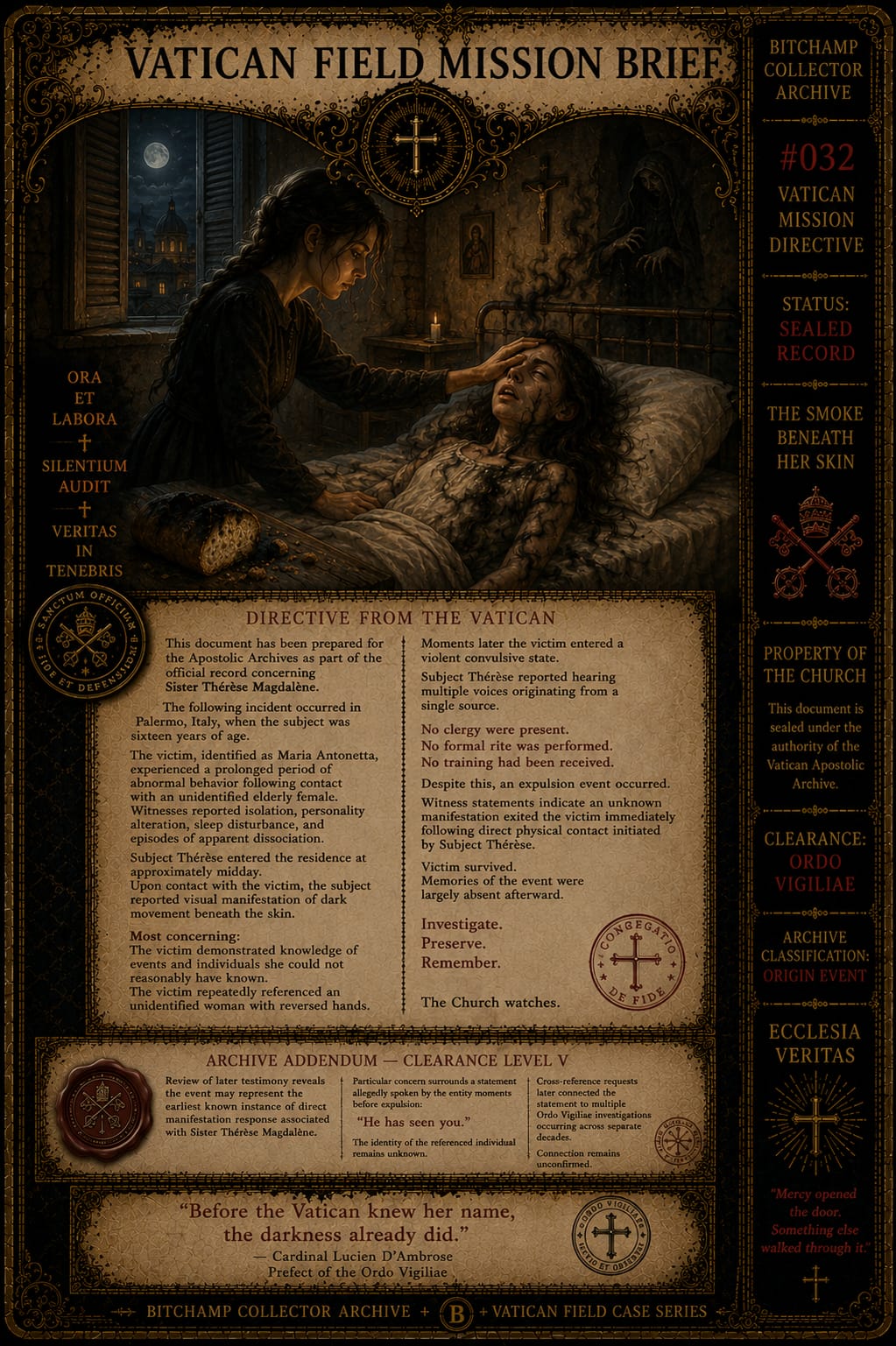
Maria convulsed. Her back arched with such force that I heard the bedframe crack, and her mouth opened impossibly wide as a sound emerged that began as a gasp and deepened into laughter. It was not merely that the voice did not sound like hers. It was that several voices seemed to occupy the same throat, layered unevenly, some old, some young, one almost masculine, one so thin it resembled steam escaping a kettle. The laughter struck the walls and returned to us changed.
I stumbled backward and reached for the crucifix at my throat. My fingers found it but could not close properly around it, and every prayer I had known since childhood disappeared from my mind. The Our Father, the Hail Mary, the Creed, the prayer to Saint Michael, all of them scattered like frightened birds. I remember the humiliation of that more clearly than the terror. I had believed faith meant knowing what to say when darkness entered, but instead I stood there mute, a girl with shaking hands and no words.
Maria’s body folded forward, and when she raised her head, the smile on her face was not hers. “There you are,” it said. The thing looked through Maria’s eyes with bright, terrible satisfaction. “So much silence in you,” it continued. “So much listening. Do you think He gave you eyes only to watch from corners?”
I took one step toward the door, and Maria rose from the bed without using her hands. Her feet dragged across the floorboards as though her body had forgotten the cooperation required for walking. Bones shifted audibly beneath her skin, and her head tilted too far to one side before correcting itself with a sound like wet wood being twisted. I wanted to run, wanted Maria’s mother, Father Paolo, my father, Nonna, anyone older than me, anyone authorized by age or office to stand between me and the impossible. Yet there was no one in that room but Maria, the thing inside her, and the part of me that had been pretending for two years not to know what it was.
She stopped less than a foot away. The smell of smoke beneath her skin was overwhelming now, not smoke around her but beneath her, as though it seeped through her pores without leaving marks. It carried with it the odor of burned lavender, old meat, and damp stone. Her hand lifted slowly toward my face. I could not make myself move as the fingers that had once braided my hair, stolen olives from my plate, and tugged me laughing through festival crowds touched my cheek with the cold of a corpse pulled from deep water.
Something entered me. I do not know how else to describe it, even now. It was not a vision, not exactly, and not possession, though at sixteen I feared it was both. It was a pressure forced behind my eyes, a flood of images and sounds so violent that my knees nearly buckled. I saw an alley with no sky above it, a woman bent under a shawl, her hands reversed at the wrists, palms facing outward while her fingers scratched at her own sleeves.
I saw Maria offering bread with pity in her face. I saw the old woman look up, and where her eyes should have been there were two small mouths whispering prayers backward. Then the vision deepened, and I saw rooms beneath rooms, corridors of soot, faces pressed behind black glass. I saw children sleeping with shadows seated beside their beds. I saw men and women kneeling before altars that were not altars, kissing the feet of saints whose faces had been scraped away.
I saw the figure from Santa Agnese dei Fiumi standing very far off, almost hidden by smoke, his black eyes fixed upon me with the same patient recognition I remembered from childhood. Behind him, something enormous breathed in the dark. I thought I would die from the sound of it. The thing using Maria leaned close and whispered, “Little vessel.” The word struck me harder than any blow.
At the time, I did not understand it fully, but some hidden part of me recognized the danger inside it. A vessel receives, a vessel contains, and a vessel can be filled by what does not belong to it. I felt the thing pressing against the edges of me, searching for an opening, testing griefs I had not yet suffered and fears I had never confessed. It found the memory of the church first and pushed its fingers into it. I was fourteen again beneath stained glass, watching the black-eyed figure point directly at me from beside the crucifix.
“No,” I whispered. It was not a prayer, and it was barely even a word, but it was the first thing that belonged to me in that room. Maria’s hand tightened on my face, and the cold spread down my neck into my chest. My breath stopped. A sound like rushing wind filled my ears, and inside it I heard Maria, the real Maria, not speaking but crying somewhere impossibly far away.

That was what changed everything. Not courage. Not knowledge. Not faith in the grand, shining sense people later ascribe to such moments. I heard my friend alone inside her own body, and something in me refused the cruelty of it. The refusal was small at first, almost childish in its simplicity, but it possessed a strength fear did not understand.
The stillness came then. It did not arrive like fire, nor did it roar through me or fill me with righteous fury. It was quieter than that, and far more frightening. Everything in the room sharpened: the dust near the shutters, the cracked dryness of Maria’s lips, the faint movement beneath the gray patches of her skin, and the crucifix against my chest, warm now beneath my fingers. My fear did not disappear, but it moved aside, as though some deeper command had entered the room and required obedience from every part of me, including terror.
I lifted my hand, though I do not know whether I chose to do it. That question has troubled me for years. My palm came to rest against Maria’s forehead. Her skin was cold and damp, and beneath it I felt motion, a crawling pressure that recoiled from my touch. The thing inside her hissed, but the sound emerged from somewhere lower than her throat.
I opened my mouth, expecting perhaps the Latin of the Church, expecting words I had memorized and heard men speak from altars. Instead, what came out of me belonged to my blood, my childhood, my mother’s kitchen, my grandmother’s bedside prayers, and the first language in which I had ever understood God. “Nel nome di Dio vivente,” I said, “leave her.” The room cracked. There is no better word for it.
The air itself seemed to split with a violent pressure that struck the walls and burst the shutters open. Sunlight poured into the room with such force that I cried out. The ceramic bird flew from the windowsill and shattered against the floor. In the front room, Maria’s mother screamed. The bread on the floor blackened along one edge as though touched by flame.
Maria screamed too, but the scream was not human. It came layered and furious from her open mouth, joined by the sound of many other mouths crying from deeper inside her. Her hands clawed at my wrists as smoke pressed against the inside of her skin, gathering beneath her throat and cheeks, moving frantically now as if searching for a way out. I kept my palm against her forehead though every nerve in my arm burned. I remember weeping while I spoke, not because I was gentle, but because I was terrified of what obedience required.
“Leave her,” I repeated, and the shadow began to peel away. At first it appeared as darkness beneath the surface, lifting from her bones in thin strands. Then it became something thicker, a second skin separating itself from her body with wet, tearing sounds. Maria’s face contorted, and for one horrible instant I feared I was killing her. The entity clung to her mouth, her eyes, her fingers, because it had nested there and mistaken her loneliness and kindness for permission.
I pressed harder and said, “Maria belongs to God.” The thing laughed through the scream and spat that she had given bread, that she had given mercy, that she had opened, that she had pitied. The words came rapidly, each in a different voice. I understood then that evil often enters not through wickedness, but through wounds left unguarded by compassion. Maria had seen what looked like suffering and moved toward it, and the violation was not her foolishness but the enemy’s appetite for mercy.

I do not remember all that I said next. Some of it was Italian, some of it may have been Latin, and some may have been no earthly language at all, though I hesitate even now to make such claims. I remember invoking the living God, the wounds of Christ, the mantle of the Virgin, and every saint whose name had ever comforted me as a child. I remember Maria’s body bending backward until I thought her spine would break. I remember the gray leaving her skin in patches, replaced by the flushed color of a fevered but living girl.
Then the old woman appeared behind her eyes. Only for a moment, her face pressed outward through Maria’s features, thin and shriveled, mouth stretched in rage. Her hands, those backward hands, rose inside Maria’s hands like shadows wearing gloves. She looked at me with hatred so intimate it felt almost like kinship. Then she spoke in a voice that seemed to come from the walls and said, “He has seen you.”
The room went silent. Even Maria stopped screaming. For one suspended instant, all sound vanished except my heartbeat. Then the shadow tore free. It burst from Maria’s mouth and shoulders in a twisting mass of black smoke and pale, grasping shapes that might have been fingers or faces or neither.
The force of it threw me backward against the wall. Maria collapsed to the floor as if every string inside her had been cut. The smoke struck the sunlight pouring through the open shutters and recoiled with a sound like meat dropped onto hot iron. Then it thinned, writhed once near the ceiling, and vanished into a crack above the door. The room fell into the true stillness that follows violence, when the world seems ashamed of what it has allowed.
I slid down the wall and struck the floor hard enough to bruise my hip. My hands burned as though I had plunged them into boiling water. I could not see clearly because tears blurred everything, though I did not remember beginning to cry. Across the room, Maria lay motionless beside the bed with her hair covering part of her face. For several terrible seconds, I believed she was dead.
I crawled to her because my legs would not hold me. Her mother reached the doorway but stopped there, frozen by the sight of us. I touched Maria’s cheek and nearly sobbed when I found warmth in her skin. Her chest rose once, shallowly, then again. I pressed my ear near her mouth and heard breath, not imitation or mockery, but the fragile uneven breath of a girl returned from very far away.
Maria opened her eyes, and they were brown again. She looked at me without recognition for one moment, and that pierced me more deeply than I expected. Then confusion entered her face, followed by pain. Her lips moved, and I leaned closer. She asked why the shutters were open, and such an ordinary question after such horror nearly broke me.
I told her there had been a storm. I do not know why I lied. Perhaps because her mother stood behind me already weeping, or because Maria’s body had endured enough, or because I was sixteen and had no idea how to tell the truth without giving it power again. Maria blinked slowly and said she was tired. Then she slept.
The doctor came that evening and declared it fever. Father Paolo came too, pale and nervous, carrying holy water and a prayer book he held too tightly. He questioned Maria’s mother, then me, though his questions were cautious and carefully shaped to avoid answers he did not want. I told him only what seemed safe: that Maria had convulsed, that she had spoken strangely, that I had prayed. He looked at my burned palms and did not ask why the skin bore the faint shape of fingers around the crucifix I had held.
No one spoke of possession, not aloud. In Palermo, people know when to place a cloth over a thing and call it illness. Maria recovered slowly, and she remembered nothing of the old woman, nothing of the voices, nothing of the smoke beneath her skin. She remembered being tired, then thirsty, then waking with everyone staring at her as though she had returned from death. When I visited her days later, she tried to laugh about how dramatic she must have been, and the laugh sounded almost like hers.
I never told her the truth, and that confession costs me more than I expected even now. I have told strangers terrible truths in hospital rooms, crypts, ruined chapels, and houses where children refused to sleep because their dead relatives stood in corners smiling with too many teeth. I have spoken plainly to bishops, soldiers, widows, and grieving fathers. But I never told Maria what wore her skin that day. I told myself mercy required silence, though I suspect cowardice helped me reach that conclusion.
For weeks afterward, my hands burned whenever I entered a church. Not painfully, not always, but enough to remind me. The skin healed quickly, leaving no visible scar, yet I could feel the memory beneath it. Whenever the priest elevated the Host, warmth gathered in my palms. Whenever I touched holy water, the sensation sharpened.

Nonna noticed me hiding my hands and said nothing for several days, which meant she was waiting for me to become honest on my own. At last she found me one night in the courtyard after everyone else had gone to bed. I was sitting beside the small lemon tree with my palms turned upward in my lap, watching them as though they belonged to someone else. Nonna came out wearing her shawl and carrying two cups of watered wine. She lowered herself beside me with a groan that blamed her knees, the weather, and possibly God in equal measure.
For a long while she said nothing. Then she took one of my hands, and the moment her fingers touched my palm, her face changed. Not with surprise. With recognition. “Ah,” she said softly, and I began to cry before she asked a single question.
She let me cry because that was Nonna’s great wisdom. She understood that grief and fear are like fever; if interrupted too early, they settle deeper. When I could speak, I told her almost everything. I told her about Maria, the old woman, the smoke, the voices, and the words that had come through me. I did not tell her about the figure from Santa Agnese watching from inside the vision, because that part felt too dangerous to release into the air.
Nonna listened without crossing herself. Only when I finished did she look toward the dark windows of our house and sigh. “My mother’s sister saw things,” she said. I stared at her, and she rubbed her thumb gently over my palm as if trying to calm something beneath the skin. She told me her aunt heard the dead before storms, knew when babies would not live, and once refused to let her husband take a road where three men were crushed an hour later.
I asked whether the same thing was happening to me. Nonna’s mouth tightened. “No,” she said. “Yours is worse.” I almost laughed because the answer was so terrible and so plainly delivered. She looked at me then with the expression of a woman who had suspected something for a long time and hated being proven right.
She told me that gifts from God did not always arrive gently. Sometimes they came like burdens because the world was heavy and someone had to carry part of its weight. I asked whether I could refuse. Nonna did not answer quickly. That silence was my answer.
In the days that followed, Maria grew stronger, and I grew quieter. The neighborhood returned to its usual noise, the butcher shop reopened, and boys once again found excuses to pass beneath Maria’s window, though she no longer leaned out as often. Her mother lit candles at Santa Agnese for nine consecutive mornings. Father Paolo preached a homily about illness, endurance, and the mysterious mercy of God, never once looking in my direction. But I knew.
I knew I had not imagined what I saw. I knew the figure in the church, the voices at my window, the weeping statue, the woman with backward hands, and the smoke beneath Maria’s skin were not fever dreams or childish fancies. More than that, I knew I was no longer merely a girl who saw what others could not. Seeing is terrible, but it can still be passive. That day on Via della Croce, the distance ended.
I had acted, not well, not bravely, and not with understanding, but I had acted. That knowledge frightened me more than the entity itself. If I could drive something out, then something had passed through me to do it. If power had answered when I spoke, then I had become responsible for the consequences of speaking. A gift is not only what one can do; it is what one can no longer pretend not to be able to do.
That night, after Nonna slept and the house settled into its ordinary creaks, I knelt beside my bed and tried to pray. The words came slowly. I thanked God for Maria’s life, asked forgiveness for my fear, and begged Him not to ask such things of me again. This was not noble, but it was honest. Anyone who claims they accepted a divine burden without first wishing it belonged to someone else is either a saint beyond my understanding or a liar.
Near dawn, I heard breathing outside my door. It was faint, slower than human breathing, patient in the way I remembered from Santa Agnese. I remained on my knees until my legs went numb. The handle did not turn, and no shadow crossed beneath the door. The sound simply continued for several minutes, then faded with the first bell of morning.
When I opened the door, nothing waited there. But the hallway smelled faintly of sulphur and burnt lavender. I did not tell Nonna, Maria, or the priest. Instead, I washed, dressed, and went to Mass with my family as though my life had not changed beyond repair. My mother complained that I looked pale, my father asked whether I had been sleeping, and I answered them both gently and falsely.
I understand now that vessels are not asked whether they wish to be filled. They are chosen by shape, by emptiness, by what they can bear without shattering immediately. Some are filled with wine, some with oil, some with ashes, and some with grief. A few, God help them, are filled with fire and sent into dark rooms where other people’s daughters are waiting to be saved. That day, I did not yet know the name Ordo Vigiliae.
I did not know I would one day wear a habit, take vows, and walk into places the Church preferred not to mention in daylight. I did not know men in Rome would study my reports with pale faces, or that priests twice my age would one day ask me what I saw before they dared step into a room. I did not know how many voices would speak through the suffering, how many dead would beg to be heard, or how many unclean things would recognize me before I recognized them. I knew only Maria’s breath against my hand. I knew the smoke leaving her body.
And I knew, with the certainty of a girl who had just lost the final mercy of ignorance, that whatever had seen me in Santa Agnese had not been mistaken. I was not merely haunted. I was being prepared. Preparation, I would learn, is often indistinguishable from breaking.
— Sister Thérèse Magdalene